The Government and Political System in Indonesia
Indonesia officially referred to as the Republic of Indonesia is an independent transcontinental state located mostly in South-east Asia with some regions in Oceania. Indonesia is located between the Pacific and Indian oceans and it is the world’s biggest island country with over thirteen thousand islands. As of September 2016, the country’s population was estimated to be 260 million people making it the fourth most populated country in the world. Its capital city is Jakarta and it is the most populated city in the country. Indonesia shares land borders with East Timor, Papua New Guinea, and the eastern region of Malaysia. Other neighbouring states include Palau, Australia, Philippines, Singapore, and the Indian region of the Andaman and Nicobar Islands. The government of Indonesia known as Pemerintah Indonesia in Indonesian can have various meanings. It can be used to refer to the three branches of government which are the Executive, Legislative and Judicial branches. The term can also be used to refer collectively to the Executive and Legislative since they are the branches of government responsible for the daily governance of the country and law-making. At the narrowest level, it can be used to refer to the Executive Branch in the nature of the country’s Cabinet since it is made of the branches of government responsible for daily governance. With this in mind, the article below will discuss the three branches and other institutions of government in Indonesia.
 People's Representative Council of Indonesia, Source
The Executive Branch of Government in Indonesia
The constitution of 1945 invests a lot of power in the Executive branch of government, especially in the president who is aided by a vice president and a cabinet. Both the president and the vice-president are elected by a vote of the citizens for five-year terms. Before 2004, they were elected by the People’s Consultative Assembly, but in the last elections held on 9 July 2014, they were elected directly for a total of two five-year terms. The current president is Joko Widodo and the vice-president is H. Muhammad Jusuf Kalla.
The president is the head of state and also the commander-in-chief of the Indonesian armed forces which is made up of the air force, the army, and the navy. He is also responsible for foreign affairs, policy-making and domestic governance. The president is the one who appoints a cabinet. The cabinet members do not have to be selected members of the legislature. The elected members are in charge of the country’s ministries in areas such as defence, economic affairs, education, religious affairs, foreign affairs, information, and agriculture. The number of ministers and the form of their fields of appointment depends on the president. The president also has the power to issue regulations, implement acts, introduce bills and make correspondences with foreign nations.
The Legislative Branch of Government in Indonesia
The People’s Consultative Assembly of the Republic of Indonesia referred to as Majelis Permusyawaratan Rakyat Republik Indonesia (MPR-RI) is the country’s legislative branch. It is made up of members of the People’s Representative Council and the Regional Representative Council. The MPR has 1000 seats. 500 of them are assigned to the members of the People’s Representative Council. The remaining 500 seats, 100 of them are set aside for representatives of professional groups. These are normally appointed by the president. 147 seats are held by representatives selected by provincial-level legislative assemblies, and the remaining 253 seats are assigned to political parties’ representatives on a proportional basis. The MPR usually convenes every five years in the year after the elections to the parliament.
The key legislative duty of the MPR is to endorse the Broad Outlines of State Policy. This is a document that theoretically sets up the policy parameters for the next five years. The draft is normally developed by a government task force and is usually approved by a consensus. The MPR is also responsible for the deletion or amendment of specific articles and/ or the Constitution’s provisions. A vote by one-third of the majority members in a session of the Assembly can pass any suggested alterations to the constitution including adding or removing provisions, articles and sections.
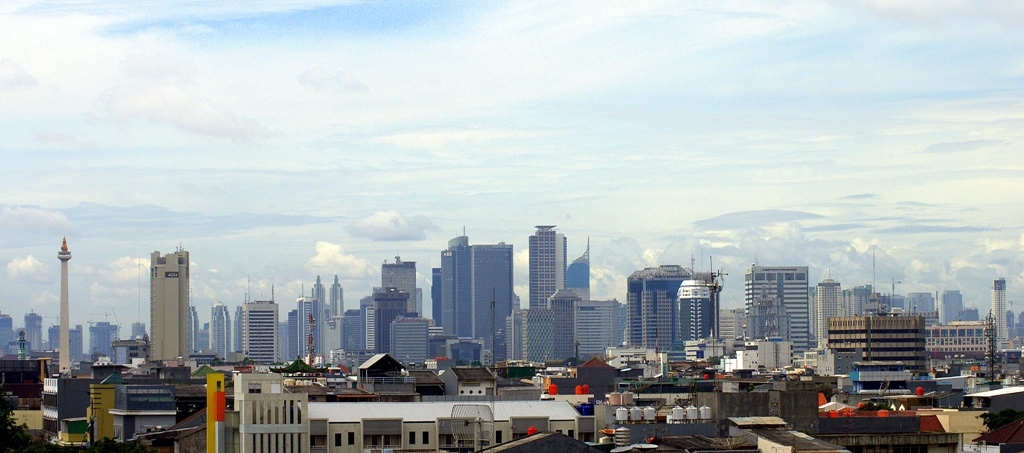 Jakarta, Indonesia, Source
The MPR has the power to hold a general swearing in for both the President and the Vice President after they have been elected. If the president’s office is vacant the MPR can be given the order to hold a general plenary for the Vice President so that he/she can make his/ her oath to act as President. The MPR also has the power to impeach the President and Vice President or either of them if possible misdemeanours of the 1945 constitution and the country’s laws have been practiced during their tenure. The MPR can hold a general meeting to select office holders for the president and vice president offices. This, however, only takes place in a situation where both positions are vacant which could be as a result of death in office, impeachment, and sudden resignation.
The People’s Representative Council
The People’s Representative Council (Dewan Perwakilan Rakyat, DPR) has 560 members and its main functions are oversight, legislative, and budgeting. The DPR cannot be dissolved by the President.
The Regional Representative Council
The Regional Representative Council (Dewan Perwakilan Daerah, DPD) was established by the third amendment to the Constitution of 1945 on 9th November 2001 in a move towards bicameralism. The DPD has been restricted in Article 22D to only deal with bills on establishment, enlargement and merging of regions, regional autonomy, the association of central and local government, management of natural resources, and bills associated with the fiscal balance between the centre and the regions. Members of the DPD are selected via a Legislative Election every five years, together with members of the DPR. The number of members in the DPD is restricted so that it is not more than one-third of that of the DPR. All the provinces in the country select 4 members to the DPD on a none partisan basis.
The Judicial Branch of Government in Indonesia
Indonesia has three main sources of law: Islamic law; customary or adat law; and Dutch colonial law. These sources make the legal system in the country very complex. The Supreme Court is the highest court in the country and judicial power has been vested on it as stipulated in Article 24 of the constitution. Other four court systems can be distinguished below the Supreme Court. The first are the courts of criminal and general civil jurisdiction, for instance, the district courts. The high courts are appellate courts. These courts are administered by the minister of justice, who controls pay, transfer, promotion and judicial appointments. The second court systems are the religious courts. These courts usually solve certain types of disagreements between Muslims in matters of gifts, inheritance, divorce, and marriage. The decisions of these courts are based on Islamic law. For the decisions to be enforced legally they, however, have to be approved by an equivalent secular district court. The Directorate of Religious Justice in the Department of Religious Affairs has the final appellate power. The third is the Taxation Review Board which solves taxation disputes. The forth are the military courts. These have authority over members of ABRI or people of the same status.
 President of Indonesia, Joko Widodo
The Supreme Advisory Council and the State Audit Board
These are quasi-sovereign bodies that have been mandated by the constitution to assist both the executive and the government. Article 16 of the constitution gives the mandate to the Supreme Advisory Council. This is made up of 45 members nominated by the People’s Representative Council and appointed by the president. The council reacts to any presidential questions concerning the affairs of state. It has four permanent committees: defence and security; political; people’s welfare; and economic, financial and industrial. The State Audit Board, on the other hand, has been specified by the constitution in Article 23 and it is mandated to carry out formal evaluations of the government’s finances. The Board reports to the People’s Representative Council, which in turn approves the budget requested by the government.
Local Government
Government administration in Indonesia is processed via descending phases of administrative sub-units. The country is divided into 30 provinces (provinsi or propinsi). There are two special districts (daerah istimewa) of Aceh in northern Sumatra and Yogyakarta in central Java. There is also a special capital district (daerah khusus ibukota) of metropolitan Jakarta, referred to as Jakarta Raya. The provinces have been divided into districts (kabupaten) and the district divided into sub-districts (kecamatan). Below the sub-districts are the groups of villages (desa) and villages (kampong).
The districts are governed by governors (bupati) and they have a local legislature. The district and sub-district leaders are elected via direct local elections. The Local Councils of Representative members (Dewan Perwakilan Rakyat Daerah), who deal with the national legislature more directly, are also elected via a general election. The groups of villages and villages are found in both urban and rural regions and they offer a link between the locals and the central government at the district level. The village heads are normally selected in rural regions and appointed in urban areas.