A Brief History of India from Ancient Times to the Present
India, also known as the Republic of India, is a country located in South Asia. It has more than 1200 million inhabitants and is the second most populated country in the world. It is one of the largest countries in existence with 3.3 million square kilometers. India shares border with Pakistan to the west, China, Nepal and Bhutan to the north and with Bangladesh and Burma to the east. To the south of the country is the Indian Ocean and the Arabian Sea to the west. The Gulf of Bengal lies to the east. There are over 7500 kilometers of beautiful coastline lining India.
The capital of India is New Delhi, which is the most populated city in the country and is the fifth most populated city of the entire planet. It occupies an area of almost 1500 square kilometers, which is full of beautiful avenues, national institutions, museums, monuments and buildings made in a unique architecture style.
India in the present
 Srirangapatna Indian Temple in Mysore, Source The national motto of India is "Satiam Eva Jayate" or "The Truth Alone Triumphs." The hymn is "Jana-Gana-Mana" meaning "The Spirit of All People." The culture of the Indus Valley, a civilization of the Bronze Age, had its beginnings here in India which resulted in many important commercial routes. The region that contains most of historic India is the Indian subcontinent, a place recognized for its incredible culture and historical facts.
As many people know, some of the most impressive religions in the world have been created and developed in India. Hinduism, Jainism, Buddhism and Sikhism are four fairly strong religions that come from this country.
India was previously administered and fairly controlled by the United Kingdom but the nation wanted its independence. It fought and organized nonviolent protests to achieve this goal in 1947. Today the Federal Republic of India consists of 29 states and 7 Union Territories. The government uses a system of parliamentary democracy. Although India's economy has grown and expanded internationally over the last 25 years, it still has many problems. India has been unable to find solutions to its issues of ill-treatment of women, poverty, disease, pandemics, illiteracy and lack of nutrition in both children and adults. On the contrary, the country is proud to have a society consisting of several religions, which speak multiple languages (mostly Hindi and English), and many ethnic people. Apart from having a fairly diverse community, India is a home with a variety of wildlife.
India in ancient times
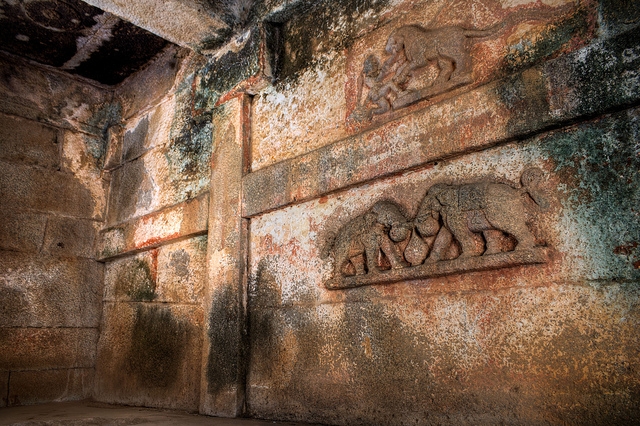 Rocks with ancient carvings, Chitradurga, Source Multiple confrontations arose in the area surrounding india. The results of all these invasions have brought us the different customs and traditions which we know today. The earliest indication of human life in India comes from the Stone Age from a few paintings in what we know today as, Madhya Pradesh. Groups of people began to settle there around 6000 A.C., and the culture of the Indus Valley, as a result, began to form. Very gradually the population grew, more people arrived over time, establishing a culture around the year 3300 A.C. in the area of Pakistan. At that time the great cities of Mohenjodaro and Harappa were built and within them temples were built. Through agriculture and the first acts of trade economy started to develop in the region.
When that first society began to disappear, around the year 500 A.C. the Vedic period began to form. The Vedic period adopted Hinduism as its base forming several kingdoms.
Near the 3rd century B.C. the region witnessed its first wars. Chandragupta Mauria conquered and united a large part of South Asia, creating what was called the "Mauria Empire", ruled by Asoka the Great. What followed was a long two centuries that was called the "Golden Age of India." The Gupta dynasty was responsible for many of the treasuries of India today. Thanks to what the Aryans brought and taught to the people there, they began to produce iron armor and the Sanskrit language was developed. The Sanskrit language contains the bases and roots of almost all Indian languages in existence. Over time the region grew and expanded north.
 Palacio Chettinad en Karaikkudi, Tamil Nadu, Source During the following years, the Chalukia, Viyaia Nagara and Chola Empires took control in the southern part of India. The kings at that time helped advanced logic, languages, the creation of works of arts of literature, science and all allowed for the growth and development of religions and philosophies.
The Mughal Empire
During the tenth and twelfth centuries there were large attacks on the northern part of India, causing it to fall under the rule of the Sultanate of Delhi (1206-1526) and the Mughal Empire (1526-1707). They were difficult times for people, but what they learned was crucial to their future achievements.
During the sixteenth century Akbar the Great helped the country in various ways. Culture, religion, and economy began to advance. Little by little the empires of the Mughal emperors expanded and began to dominate the southern part of the continent. Ahom of Assam, the northern kingdom was the only one that the Mughals could not defeat, but their king, Maha Rana Pratap Mewar, was successful in expanding the country during the sixteenth century.
The Independence of India
Another quite vital aspect for the creation and development of India, which began in the sixteenth century, was the impact of the European countries, specifically Portugal, France, the Netherlands and the United Kingdom. These countries were strong and wanted to use the land of India to set up trading posts and establish colonies.
India fought hard for its independence. The British East India Company, in 1845, took control of the area, so the First Indian War of Independence or otherwise known as Ciphaney Mutiny was formed, in an attempt to reestablish control. Unfortunately for India, it was unsuccessful and the British Crown took full control in the mid 1800s.
Mahatma Gandhi was the leader of India's struggle for independence during the twentieth century. Gandhi helped bring together millions of men and women with the intention of achieving independence for the country in a non-violent way. What Gandhi did was impressive and finally, in 1947, India was successful in its struggle for independence from the British Crown. At the same time, a Muslim state was separated that today is called Pakistan. Officially, in 1950, the Republic of India was established with its own constitution.
Although successful in achieving their independence, India continues with several difficult issues. They have not been able to solve problems with classism, terrorism, and religious violence. In addition, there are quite a few problems with separatist regions in the Jammu, Kashmir area and in the northeastern part of the country.
During the last 25 years, the country has suffered multiple terrorist invasions. India has a long history of problems with China that the Chinese-Indian War in 1962 did not really fully resolve. India has also fought wars with Pakistan several times since 1947. Another important aspect in the history of India is the fact that it helped in the establishment of the United Nations and the Non-Aligned Movement. In 1998 India was declared a nuclear state after several underground nuclear tests. Now India continues to grow its economy and is considered to have a major impact on the global economy.