Languages in Thailand
Thailand, known officially as the Kingdom of Thailand and formerly Siam, is an independent nation situated at the center of the Indochina peninsula in Southeast Asia. The country is bordered to the north by Burma and Laos, to the east by Laos and Cambodia, to the south by the Gulf of Thailand and Malaysia, and to the west by the Andaman Sea and the southern limb of Burma. Its maritime boundaries include Vietnam in the Gulf of Thailand to the southeast, and Indonesia and India in the Andaman Sea to the southwest.A constitutional monarchy, Thailand is currently headed up by King Rama IX, the 9 king of the House of Chakri. He has ruled Thailand since 1946, making him the longest-serving head of state and the longest-reigning monarch in Thailand’s long history.
The capital and largest city in Thailand is Bangkok, which is also the country’s political, commercial, industrial and cultural hub. Approximately three-quarters of the population are ethnically Thai, 14 percent Thai Chinese, and 3 percent is ethnically Malay. The remainder belongs to several different minority groups, including the Mons, Khmers and various hill tribes. This varied ethnic and cultural makeup adds to the linguistic diversity in Thailand, a newly industrialized country that traditionally attracts thousands of expatriates each year from various developed countries.
Languages Spoken in Thailand: Thai
Thai, or more specifically, Siamese Thai, is the lone official language of Thailand, spoken by over eighty percent of the country’s sixty million people. Thai is closely related to Lao, the official language of Laos; Shan, which is spoken in Burma; and a number of less significant languages associated with southern China and northern Vietnam. Thai is used in all official capacities in Thailand, including education, government and the media. Its standard is founded on the dialect of Bangkok, and it is written in the Thai alphabet, an abugida that evolved from the Khmer script.
A Brief History of the Thai Language
 Thai textbookAccording to linguists, Thai is an “uninflected, primarily monosyllabic, tonal language” in the Tai-Kadai family of languages. The spoken variety of Thai is thought to have originated in the region which now comprises the border between Vietnam and China, an idea which provides clues to the origin of the Thai people, an area of continued scholarly debate. From a linguistic standpoint, Thai is related closely to the languages of Vietnam and Yunnan, in addition to those of Myanmar and Laos.
The written form of the Thai language was introduced in 1283 by the third king in the Sukhothai period, a man named Ramkhamhaeng. Sukhothai, which was initially established in central Thailand in the early and mid-thirteenth century, represents the first major kingdom of the Thai. Many linguists believe that the language spoken in Sukhothai resembled Proto-Tai in tonal structure. This early system consisted of three tones on syllables ending in a long vowel or a semi-vowel. On syllables ending in “p,” “t” or “k,” or in a glottal stop after a short vowel, a forth tone existed, althrough these syllables showed no tonal differentiation at all. The Thai system of writing has undergone few changes since its introduction, a fact that allows modern Thai scholars to study inscriptions from the Sukothai era. The writing borrowed elements of Pali, Sanskrit and Indian concepts, as well as a number of words from the Mon and Khmer.
Similar to L'Academie Française in France, Thailand boasts a governing body for the Thai language, known as the Royal Institute. The Institute publishes an official Thai dictionary every few years, adding new words to the language as needed, often drawing on elements of Pali, Sanskrit and Mon.
Regional Dialects of the Thai Language
Within Thailand there are four major regional dialects, including Southern Thai, spoken in the southern provinces; Northern Thai or “Yuan,” spoken in the northern provinces that were once part of the independent kingdom of Lannathai; Northeastern Thai, which is very similar in nature to the Lao language; and Siamese Thai, the national language of the country, which is also referred to as Central Thai or Bangkok Thai. The Siamese Thai dialect is used in most schools throughout Thailand, used for media and entertainment broadcasts, and is widely understood by a sizable majority of the population. In addition to the four major regional dialects, there are also within Thailand a few minor dialects, such as the Phuan and Lue variations of the language, spoken only by very small pockets of the population.
It’s important to remember that the four primary dialects of the Thai language are not the same as the different language “registers”—forms of the language used in various social contexts and for different circumstances in Thailand. Certain words, for instance, are used only by Thai royalty, thus creating a separate, but mutually understandable “royal language.” Below is a brief look at the different language registers in the Siamese Thai language and the situations in which each is used:
- Royal Thai. Influenced by the Khmer language, Royal Thai is used when addressing members of the Royal family or when discussing their activities.
- Religious Thai. Based on Sanskrit and Pāli, Religious Thai is used when discussing Buddhism, the official national religion of Thailand, and when addressing monks and other religious leaders.
- Formal Thai. Also known as Elegant Thai, Formal Thai, in its official written form, includes respectful terms of address, and is used by many of the country’s newspapers and other media publications.
- Rhetorical Thai. Rhetorical Thai is used most commonly in public speaking.
- Common Thai. Common Thai, or Street Thai, is the informal register of the Thai language. It is used for daily conversation between friends, family and colleagues—the most common form of Thai utilized in the country.
The Thai Alphabet and Tones
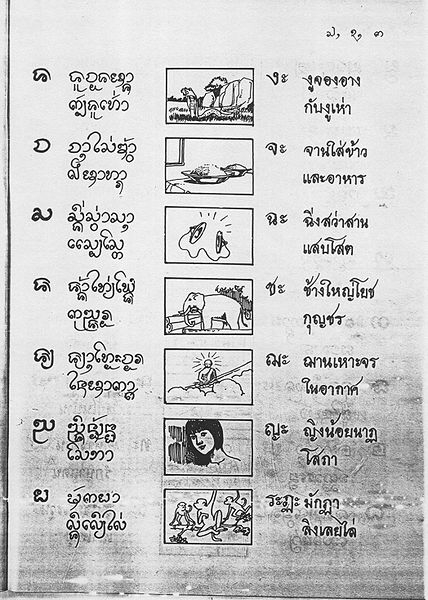 Thai alphabetThe Thai language is based on a phonetic alphabet consisting of 44 consonants and fifteen basic vowel forms. The latter are arranged into roughly 32 vowel combinations. In the written form of Thai, the characters are placed horizontally, left to right, with no intervening space, to form syllables, words and sentences. The vowel “graphemes” are written above, below, before or after the consonant they modify, although the consonant always sounds first when the syllable is spoken. The vowel graphemes (and a few consonants) can be combined in a variety of ways to manufacture numerous compound vowels, known as diphthongs and triphthongs.
All syllables within the Thai language must contain a vowel, but they may begin or end with a consonant sound. Syllables ending in a vowel are called “open syllables,’ while syllables ending in a consonant are called “closed syllables.” Every syllable in the language is pronounced using one of five lexical tones: mid, high, low, rising, or falling. Because of this, speaking Thai in the correct manner creates a variety of fluid, pleasing and melodic patterns—patterns which have resulted in the language being referred to as a “sing song” language by outsiders.
Not to be confused with the languages of China, the Thai language, like English, features an alphabetic or phonemic alphabet, meaning that the pronunciation of a given word is independent of its meaning. Consequently, it is entirely possible to pronounce a word without knowing its definition.
Similar to about half of the world’s languages, Thai is a tonal language. Ethnic Thais use lexical tones when speaking, each of which represents a certain pitch characteristic. These tones must be used when speaking for the listener to properly understand what is being conveyed.
Languages in Thailand: Other Languages Spoken in Thailand
Minority Languages
While Thai is by far the most commonly spoken language in Thailand, it is not the only language one might hear when visiting this beautiful Southeast Asian nation. Several minority languages exist in various regions of the country, the largest of which is the Lao dialect of Isan, a language spoken in the northeastern Thai provinces in a region of the same name. The Isan region in which this dialect is spoken is historically a component of the Lao kingdom of Lan Xang, once a Thai province.
In Thailand’s most southern region, a dialect of the Malay language known as Yawi is the first language of the Malay Muslims, living in the country along the Thai/Malaysia border. Yawi is the primary spoken language of the Thai Malay ethnic group, but it is also used as the lingua franca by many of the native Thai people living in rural areas, and by the samsan people, a mostly Thai-speaking population of mixed Malay and Thai heritage.
Thailand also boasts a substantial population of ethnic Chinese. Varieties of the Chinese language are spoken throughout the nation—varieties that include Mandarin, Cantonese, and Teochew, the latter being the best represented Chinese dialect in Thailand.
Indigenous Languages in Thailand
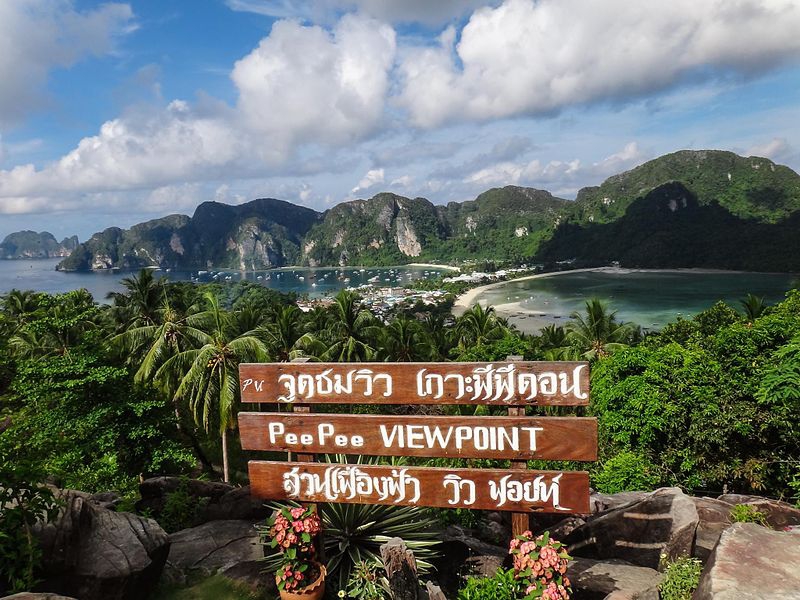 Thai signThere are also a number of indigenous, non Thai-related languages spoken within Thailand’s borders. In the northern section of the country, near Laos and Burma (Myanmar), the ethnic minority hill tribe people can be heard speaking Hmong-Mien, also known as Yao; as well as Lisu, Karen and others. As you move to the eastern half of Thailand, very near Cambodia, many of the native people speak Khmer, and the Mon-Khmer languages known as Suay, Guay, or Kuay.
Other tribal languages also exist within Thailand, including those belonging to the Mon-Khmer family of languages, such as Viet, Mlabri and Orang Asli; the Austronesian family, such as Cham and Moken; the Sino-Tibetan family, such as Lawa and Akhan; and other Thai languages such as Nyaw, Phu Thai, and Saek. In addition, there are several village sign languages used among the hill tribes, though it is not clear whether these are independent languages, as only Ban Khor Sign Language has been fully described and recognized. Two related deaf-community sign languages developed in the cities of Chiangmai and Bangkok, while the national Thai Sign Language is based on principles of American Sign Language.
English in Thailand
English is a mandatory school subject for all Thai students, but is particularly stressed in schools that lie within the borders of Bangkok and other large cities.
The role of the English language in Thailand is growing in both scope and importance, much as it is in other developing nations. New technologies, along with the adoption of, and growing access to the Internet have resulted in a major transition in terms of business, education, science, and technological progress, all of which demand a high proficiency in English. Business and government leaders in Thailand have led the push to make English-education compulsory for secondary and tertiary-level students. With the recent economic downturn that continues to bog down Thailand (and other nations around the globe), a significant number of Thai companies have embraced the idea of regional and international cooperation. From a business standpoint, mergers, associations and takeovers are increasingly common and English is used as the primary means to communicate, negotiate and execute these types of transactions.
English-speakers visiting one of Thailand’s larger cities, particularly Bangkok, are almost sure to find some common linguistic ground, as the number of English-speaking, native Thai residents has risen exponentially over the last decade.