Student Guide for Studying in Spain
This guide sets out what an international student needs to arrange before and after arriving in Spain: how Spanish university degrees are organised, how admission works for students with foreign school qualifications, the study visa for students from outside the European Union and the registration required of EU citizens, health cover, costs, learning Spanish, getting around, and the recognition of degrees obtained abroad. The rules described are those published by Spanish and EU authorities in 2026. Each university and each consulate adds its own deadlines and forms, so the official pages linked in the text should be checked before applying.
The Spanish university system and its degrees
Spanish universities follow the three-cycle structure of the European Higher Education Area. The current rules are in Royal Decree 822/2021, which organises official university studies in three stages:
- Bachelor’s degree (grado): 240 ECTS credits at 60 credits per academic year, which makes four years of full-time study. Degrees governed by specific legislation or by European Union law have 300 or 360 credits. A final degree project is compulsory
- Master’s degree (máster universitario): 60, 90 or 120 ECTS credits, that is, one to two years
- Doctorate (doctorado): open to students who have passed 300 credits in the two earlier stages

The University of Murcia
Bachelor’s and master’s degrees may carry a dual mention (Mención Dual), in which part of the programme is completed in a company, an organisation or a public administration under the supervision of the university. In a bachelor’s degree that part is between 20 and 40 per cent of the credits.
Only degrees described as official (títulos oficiales) have this structure and are valid throughout Spain. Universities also offer qualifications of their own (títulos propios), such as many specialised master’s programmes. These can be good courses and they are accepted for a study visa, but they are not official degrees.

The University of Malaga
Choosing a university and a course
The Ministry of Science, Innovation and Universities publishes a search tool called QEDU (Qué Estudiar y Dónde en la Universidad). It was created for students who want to enter a Spanish university, and its data come from the official register of universities, centres and degrees (RUCT) and from the ministry’s university statistics system. The ministry states that the information is for guidance only, so the details of a course should be confirmed with the university itself. Official degrees are verified and entered in the RUCT.

The Complutense, Pharmacy Department
Points worth comparing before choosing are the language of teaching (Spanish in most programmes, a co-official language such as Catalan, Basque or Galician in some regions, English in a growing number of courses), whether the university is public or private, the size of the city and the cost of living there. Public and private universities also admit students in different ways, as the next section explains.
SpainExchange lists universities in Spain and schools of all types in Spain, and the city pages describe the main student cities. A separate post looks at selecting a university, school or programme in Spain.

The University of Valencia
Admission to a bachelor’s degree with foreign qualifications
Students who finished secondary school outside Spain normally apply through UNEDasiss, a service of the Universidad Nacional de Educación a Distancia (UNED). It evaluates the academic records of international students and holds the exams they need for access to bachelor’s degrees at Spanish universities. The result is an accreditation with an access grade that converts the grades of the home country to the Spanish scale. The student then uses it to apply to the chosen universities.
UNEDasiss distinguishes two main groups of students:
- EU and similar systems: students from the education systems of the European Union and the European Higher Education Area listed by UNEDasiss, including the United Kingdom and Switzerland, and holders of the International Baccalaureate or a European Schools diploma. China and Colombia are in the same group. Those who meet the university entrance requirements of their own system need the accreditation. They can raise their grade with specific competence tests (Pruebas de Competencias Específicas, PCE), of which at least two are recommended
- Other countries: students whose studies can be declared equivalent (homologación) to the Spanish bachillerato. For a public university they need the accreditation and PCE exams, and UNEDasiss recommends sitting at least four subjects

The University of Barcelona
Each university sets its own admission criteria, which may include a particular branch of the bachillerato and proof of language level. Private universities use their own admission systems and should be asked directly.
The key dates follow the same pattern every year. The online application for the accreditation opens on 4 February and closes on 1 December. PCE exams are held in two sessions, in May or June and in September. Public universities usually close pre-registration in the first days of July. For the 2026-27 academic year the deadline for international students was 7 July 2026. UNEDasiss recommends sending the application at least six weeks before university registration closes. It has up to three months to process an application, although files can be resolved within three weeks. Academic documents usually have to be legalised and translated, which takes time.

La Complutense
Access to an official master’s degree is decided by the university. Holders of a degree from outside the European Higher Education Area can be admitted without formal recognition of the degree, once the university has checked that its level is equivalent to a Spanish bachelor’s degree and that it gives access to postgraduate studies in the country that issued it.
The study visa for students from outside the EU
Students who are not citizens of the EU, the European Economic Area or Switzerland need a study visa for stays of more than 90 days. Shorter study stays do not require one, although some nationalities need a short-stay Schengen visa. The legal basis is the immigration regulation approved by Royal Decree 1155/2024, which calls this permit a long-duration stay for studies. It covers higher education, post-compulsory secondary education, pupil mobility programmes, volunteering and training activities, which include courses of Spanish.

The University of Granada
The visa is requested at the Spanish consulate for the place where the student lives. The Consulate General in London lists these documents in 2026; other consulates ask for the same with small differences:
- The national visa application form, a recent passport-size photograph and a passport valid for at least one year
- Proof of acceptance at an authorised teaching centre for a full-time programme and, for higher education, proof that the enrolment fees have been paid. The consulate in Houston asks for a programme of at least 20 hours per week
- Proof of financial means of at least 100% of Spain’s public income indicator (IPREM) per month. Houston gives this as roughly $700 per month. Accommodation paid in advance for the whole stay is deducted
- Public or private health insurance with a company authorised to operate in Spain (see the section on health cover)
- For courses of six months or more, a criminal record certificate covering the last five years, and a medical certificate issued no more than three months before the application
Foreign documents must be legalised or carry the Hague Apostille and, where needed, be translated into Spanish by a sworn translator. For language courses, the consulate in New York asks for acceptance at a language school officially recognised by the Instituto Cervantes.
The application must be submitted at least two months before the studies begin. The legal period for a decision is one month, and the visa must be collected within two months of the decision. Fees depend on the consulate and nationality. The consulate in Miami charges $160 for US citizens and $94 for other nationalities in 2026, plus the fee of the visa application centre.
After arrival, and working while studying
If the stay is not longer than six months, the visa covers the whole stay. For longer stays the student must apply for a Foreigner Identity Card (TIE) within one month of entering Spain, at the Foreign Nationals’ Office or police station of the province. For higher education the permit is valid for the official length of the studies. For other studies it is limited to one year and can be extended. An extension is requested during the two months before the permit expires.
Holders of the study permit may be authorised to work as employees. As a general rule the work may not exceed 30 hours a week, and it is limited to the autonomous community where the permit was granted. A spouse or partner and children may accompany a student in higher education, but their visas do not allow them to work.
EU, EEA and Swiss students: registration
Citizens of the EU, the European Economic Area and Switzerland do not need a visa. Under EU rules a student has the right to live in the country of study for the duration of the studies if he or she is enrolled in an approved educational establishment, has sufficient income and has comprehensive health insurance, as the EU portal Your Europe explains.
In Spain, Royal Decree 240/2007 requires those who stay for more than three months to apply for a registration certificate. The application is made in person at the Foreign Nationals’ Office of the province or at the police station, within three months of entering Spain. The certificate is issued immediately and shows the holder’s name, nationality, address and foreigner identity number (NIE). Students present a valid passport or identity card and proof of enrolment, health insurance and a declaration of sufficient resources.
Health cover
Emergency treatment is guaranteed for everyone in Spain and is provided in hospitals and some health centres, according to the official tourism portal. Care at private centres is always charged.
- Students insured in the EU, Iceland, Liechtenstein, Norway or Switzerland should bring the European Health Insurance Card (EHIC). It is free and gives access to medically necessary, state-provided healthcare under the same conditions as people insured in Spain. It is not travel insurance: it does not cover private healthcare or a flight home. Dental treatment other than extractions is excluded in Spain
- Students who need a visa must hold a policy that covers all the risks insured by Spain’s public health system, without co-payments, reimbursement or waiting periods. If the policy has a limit, it may not be below €30,000. Travel insurance is not accepted. The London consulate accepts the UK Global Health Insurance Card (GHIC) for student visas
- Students from Andorra, Chile, Morocco, Peru and Tunisia are covered by bilateral agreements if they bring the certificate issued in their country
Medicines are sold in pharmacies, marked with a green cross.
Costs and funding
Tuition at public universities is charged per credit. The price depends on the region, the degree and whether a subject is taken for the first time, and each university publishes the tables for the year. The Universidad Autónoma de Madrid, for example, publishes its prices per credit by degree and by first, second and later enrolment, with a separate table for foreign students. Private universities set their own fees. Living costs vary by city and no official figure exists, so the amount required for the visa is the practical minimum to plan with.

Columns monument at the Universitat Autònoma de Barcelona
Students who come on an Erasmus+ exchange are exempt from fees for tuition, registration, examinations and access to laboratories or libraries at the receiving institution. An exchange lasts from 2 to 12 months, and the grant is a contribution to travel and living costs. There is no central application: students apply through the international office of their home university. More about the programme is in the post on Erasmus and European programmes.
Learning Spanish and proving your level
Most degrees are taught in Spanish, and universities may ask for proof of level. Two certificates are recognised internationally:
- DELE: official diplomas awarded by the Instituto Cervantes on behalf of the Spanish Ministry of Education. There is a diploma for each level of the Common European Framework of Reference, from A1 to C2. No previous course or lower diploma is required, and the diplomas are valid indefinitely
- SIELE: a digital exam promoted by the Instituto Cervantes, the Universidad Nacional Autónoma de México, the Universidad de Salamanca and the Universidad de Buenos Aires. It has four tests (reading, listening, writing and speaking), is booked by appointment at an exam centre and gives its results within three weeks

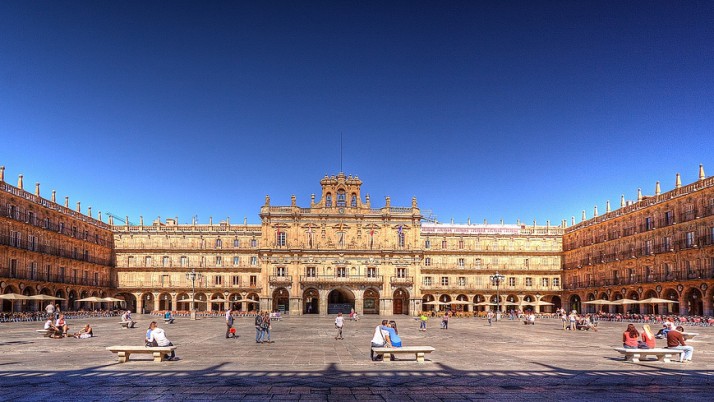
Universidad de Salamanca, inner patio
Language schools can be accredited by the Instituto Cervantes. Accredited centres pass an evaluation that is repeated every three years and can be recognised by the accreditation logo. Many universities, among them Salamanca, Granada and Santiago de Compostela, run their own Spanish courses for foreigners. SpainExchange lists Spanish language courses in Spain.

The University of Santiago de Compostela, Santiago Campus
Getting around and daily life
Spain’s main cities are linked by high-speed trains (AVE). According to the official tourism portal, the train from Madrid takes about 2 hours 30 minutes to Barcelona, Seville or Malaga, 1 hour 40 minutes to Valencia or Salamanca and 1 hour 35 minutes to Zaragoza. Domestic flights take less than two hours, except to the Canary Islands.

Driving can be hectic on the Gran Via in Madrid
In the large cities a car is rarely needed. Public buses usually run between 06:00 and 23:00, the metro tends to run later, and night buses cover the hours in between. Universities outside the centre, such as the Universitat Autònoma de Barcelona or the Universidad Autónoma de Madrid, are reached by commuter train or bus.
The daily timetable is later than in most countries. Restaurants tend to serve lunch between 13:00 and 16:00 and dinner between 20:00 and 23:30. Shops normally open from 10:00 to 21:00, some close between 14:00 and 17:00, and Sunday is the usual closing day. Spain uses UTC+1, and the Canary Islands are one hour behind.

Tapas
Meeting for tapas, small portions of food served with a drink, is a custom all over the country. Granada, Salamanca, Valladolid, Logroño, Zaragoza, León and Alcalá de Henares have a particular reputation for it, and in the Basque Country tapas are called pintxos.
Recognition of foreign degrees
A degree obtained abroad is not automatically valid in Spain. Royal Decree 889/2022 sets out three procedures:
- Homologación: recognition of a foreign degree as equal to the Spanish official degree that gives access to a regulated profession, such as medicine or architecture. The ministry may require extra training, for example a placement or university courses
- Declaración de equivalencia: a declaration that the foreign degree is equivalent to the Spanish academic level of bachelor’s or master’s degree. It does not give access to a regulated profession
- Convalidación: recognition of foreign university studies, or periods of study, towards a Spanish degree. This is decided by the universities, and it is the route for students who want to continue in Spain a degree started abroad. The final degree project cannot be recognised this way
Applications for the first two are made online to the ministry responsible for universities, and the decision must be notified within six months. Foreign qualifications that are a university’s own diploma rather than an official degree cannot be recognised by these procedures. As noted above, admission to a master’s degree or a doctorate does not require them: the university checks the level of the foreign degree itself.
More about: Studying in Spain · All blog posts