Gibraltar: Little Territory, Lot at Stake
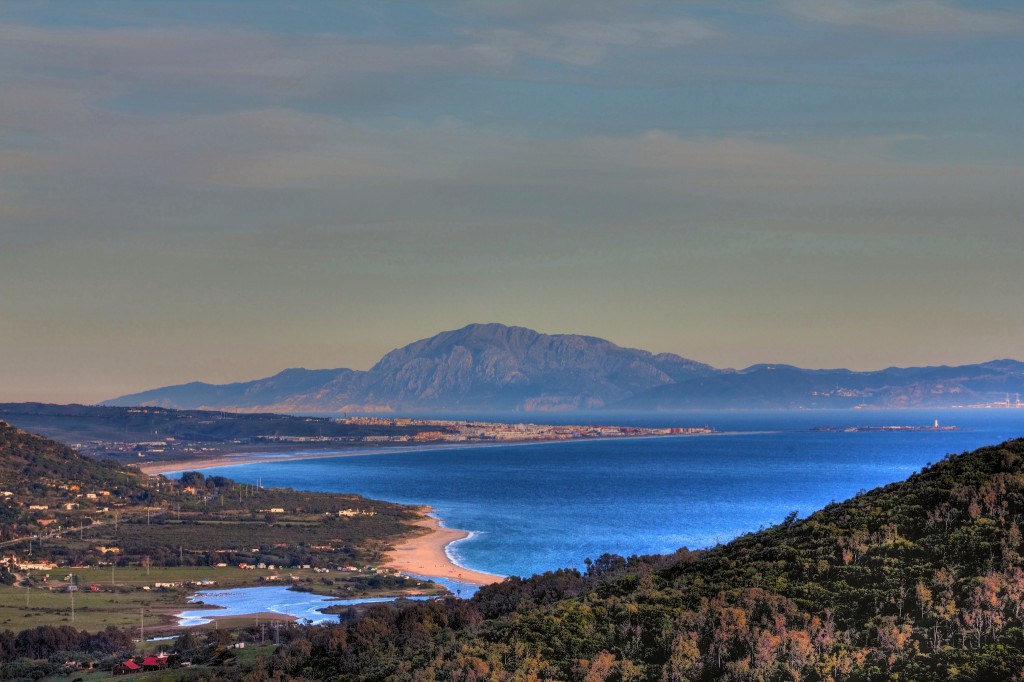
Gibraltar is a small peninsula at the southern end of the Iberian Peninsula, joined to the Spanish town of La Línea de la Concepción by a narrow isthmus. It is a British Overseas Territory, and Spain claims it. This post sets out the history in brief, the position of each party in its own words, what the agreement between the European Union and the United Kingdom on Gibraltar changed in July 2026, and what a visitor or student in Andalusia needs to know before walking across from La Línea.
Gibraltar in brief
The Gibraltar Tourist Board gives the population as about 36,000 and the height of the Rock as 426 metres. Spain lies to the north and Morocco to the south, 24 kilometres away across the Strait of Gibraltar. English is the official language and the school system follows the British one, but Spanish is widely spoken. Many residents also use Yanito (also written Llanito), a local mix of English and Spanish with some Italian words.
The UK government describes Gibraltar as a British Overseas Territory. It has its own government and parliament, headed by a Chief Minister. The legal tender is Gibraltar government sterling notes and coins, at par with UK sterling.
A short history
The Gibraltar Tourist Board’s history page dates the start of Muslim rule to 711, when the Berber leader Tarik Ibn Zeyad landed at the mountain that took his name, Jebel Tarik. Apart from a short Castilian occupation in the early 14th century, the Rock stayed under Moorish rule until Castilian forces took it in 1462.
The present dispute goes back to the War of the Spanish Succession. In August 1704 British and Dutch marines captured the Rock on behalf of Charles of Austria, one of the claimants to the Spanish throne. The war ended with the Treaty of Utrecht, signed on 13 July 1713. In Article X Spain ceded Gibraltar to the British Crown. Spain and France tried to retake it several times, most notably in the Great Siege of 1779 to 1783. Gibraltar became a crown colony in 1830.
During the Second World War most civilians were evacuated, and a runway was built on the isthmus between 1941 and 1944. After the war the question went to the United Nations. In a referendum on 10 September 1967, 12,138 Gibraltarians voted to keep the link with Britain and 44 voted for Spanish sovereignty, according to the Government of Gibraltar. A constitution giving internal self-government followed in 1969. In June of that year Spain, then under General Franco, closed the land crossing. It reopened to pedestrians on 15 December 1982 and fully on 5 February 1985.
Gibraltar entered the European Economic Community with the United Kingdom in 1973, and Spain joined on 1 January 1986. In a second referendum on 7 November 2002, held by the Government of Gibraltar, 98.9% of voters rejected a proposal for shared British and Spanish sovereignty. A new constitution took effect on 2 January 2007.
The positions of Spain, the United Kingdom and Gibraltar
The three governments describe the same facts differently. The summaries below give each position as its own government states it.
Spain
The Spanish Ministry of Foreign Affairs states that Gibraltar is a colony and that it has been on the United Nations list of non-self-governing territories since the 1960s. In Spain’s reading, the UN has indicated that the principle to apply is the restitution of Spain’s territorial integrity, not self-determination. The ministry cites General Assembly Resolution 2070 of 16 December 1965, which invited both governments to begin talks, and Resolution 2353 of 19 December 1967.
Spain also argues that the Treaty of Utrecht ceded only the city and castle of Gibraltar with its port, defences and fortresses. According to the ministry, the isthmus, the surrounding waters and the airspace were not ceded and remain Spanish. For that reason Spain does not recognise the fence as a border, and it asks the United Kingdom to resume bilateral talks on sovereignty.
The United Kingdom
The United Kingdom regards Gibraltar as British. In the Government of Gibraltar’s account of the talks of 1966, the British government made clear that it had no doubt about its sovereignty and proposed taking the legal questions to the International Court of Justice, which Spain rejected. The same account records the British view that decolonisation could not mean handing the people of Gibraltar to Spain against their wishes. The current government repeats the point in other words: the Foreign, Commonwealth and Development Office says the 2026 treaty was negotiated with Gibraltar’s government, with nothing agreed without its consent, and that it does not affect sovereignty.
Gibraltar
Gibraltar’s elected governments have argued since the 1960s that Gibraltarians are a people with the right to decide their own future, and they point to the referendums of 1967 and 2002. Chief ministers have repeatedly put this case to the UN Special Committee on Decolonisation and to the Fourth Committee of the General Assembly. On the 2026 treaty, Chief Minister Fabian Picardo said that it protects Gibraltar’s position on sovereignty.
The United Nations
Both sides cite the UN. Spain refers to the resolutions above. The Government of Gibraltar notes that the Fourth Committee declared the 1967 referendum to be in contravention of an earlier resolution and invited Spain and the United Kingdom to resume negotiations, a text the British government considered inconsistent with the UN Charter. The question remains on the UN decolonisation agenda and the sovereignty dispute is unresolved.
After Brexit: the EU–UK agreement on Gibraltar
When the United Kingdom left the European Union, Gibraltar left with it. Gibraltar was not covered by the EU–UK Trade and Cooperation Agreement, and a separate arrangement had to be negotiated. The steps, as the Spanish and British governments record them, were:
- the “New Year’s Eve Agreement” of 2020, an outline understanding;
- a political agreement announced on 11 June 2025;
- publication of the text of the agreement on 26 February 2026;
- signature in Brussels on 14 July 2026, with provisional application from 15 July 2026.
The treaty documents are published by the UK government. According to the official summaries, the main points are these:
- People. Routine passport checks at the land crossing between Spain and Gibraltar have gone. Spain’s ministry says Gibraltar is connected to the Schengen Area without being part of it. Both governments say about 15,000 people cross every day, and the UK adds that they are more than half of Gibraltar’s workforce.
- Airport and port. Passengers arriving at Gibraltar airport pass two controls: one by the Gibraltar authorities and a Schengen control by Spanish officers. The UK compares this to French officers working at London’s St Pancras station.
- Goods. A customs arrangement between the EU and Gibraltar removes goods checks at the land crossing. The Spanish ministry adds that Gibraltar introduces a “transaction tax” equivalent to VAT, starting at 15% and rising over three years.
- Sovereignty. Neither side gives up its position. The UK states that the treaty does not affect sovereignty in any way and protects its military facilities. Spain states that it maintains its claim to sovereignty intact.
The two governments also describe the result in different terms. Spain speaks of removing the last border fence in continental Europe; the UK speaks of a fluid border. The rules below reflect the official pages as they stood in October 2026. Provisional application means details can still change, so check the official guidance shortly before travelling.
Crossing from La Línea: practical notes
Gibraltar is an easy day trip from the Costa del Sol or from Cádiz province, and it fits well into a tour of the places to visit in Andalusia. Students based in Málaga can reach it along the A7 coast road.
- Getting there. By car, the Gibraltar Tourist Board gives the route as the A7 (the Cádiz–Málaga road), leaving at junction 119 for the N351 to La Línea. By bus, the crossing is a five-minute walk from La Línea bus station.
- Opening and cost. The land crossing is open 24 hours a day, seven days a week. There is no charge to enter and no limit on the number of crossings.
- Documents. There are no routine passport checks at the land crossing, but the Tourist Board tells travellers to carry valid travel documents and to comply with any checks the authorities carry out. Take the passport or national identity card used to enter Spain. Non-EU students should also carry their Spanish visa or residence card.
- The 90-day rule. For visitors who are not EU citizens, time in Gibraltar now counts together with time in the Schengen Area. The UK travel advice says British nationals may stay up to 90 days in any 180-day period, and that their passport must be less than 10 years old and valid for at least 3 months after departure.
- The runway. The road into town crosses the airport runway. Follow police directions, stay in lane, do not stop for long on the runway, and wait at the barrier when the lights turn red.
- Money. Prices are in pounds. The Tourist Board says credit cards and euros are widely accepted, and advises asking which exchange rate a shop applies before paying in euros. Power sockets are the British type G, so bring an adapter.
- Shopping and customs. Customs rules changed on 15 July 2026 and certain goods must be declared. Older guides to allowances may be out of date. Check current allowances with HM Customs Gibraltar before buying tobacco or alcohol.
Allow a full day for the town, the Upper Rock nature reserve and the walk across the runway.
For students
Gibraltar is a place to hear English and Spanish side by side. The Tourist Board’s study page lists English and Spanish courses at the University of Gibraltar Language Centre, including summer courses. Most international students, however, visit Gibraltar from a base in Spain. The directory lists Spanish language courses in Spain and schools in Spain, including many in Andalusia.
For history, politics or international relations students, the dispute is a live case study in treaty interpretation, decolonisation law and European integration. The Spanish, British and Gibraltarian official pages linked above can be read side by side as primary sources.
More about: Spanish Culture · All blog posts