The Architecture in Toledo, Spain
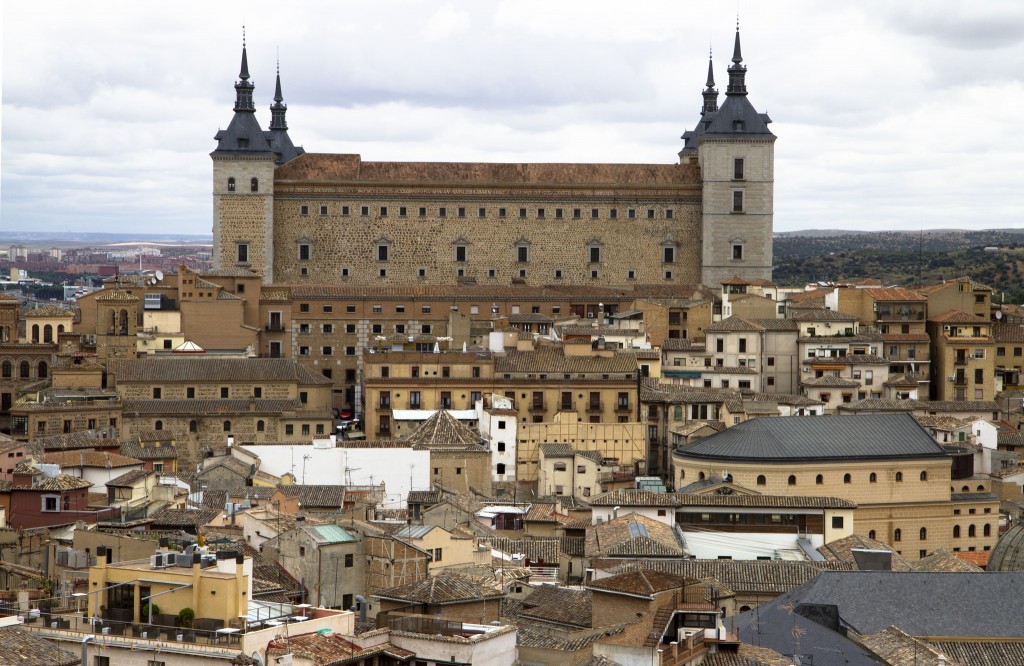
Toledo’s old town is a World Heritage site on a hill above the River Tagus, less than 80 kilometres from Madrid. Christians, Muslims and Jews lived side by side here for centuries, and the buildings they left stand a few minutes’ walk from each other: a 10th-century mosque, two medieval synagogues, a Gothic cathedral and the Renaissance works of the 16th century. This guide follows the main styles in order, names the buildings that show each one best, and gives the opening hours and ticket prices published in 2026 for the three that the post describes in detail: the Cathedral, the synagogue of Santa María la Blanca and the Hospital de Tavera.
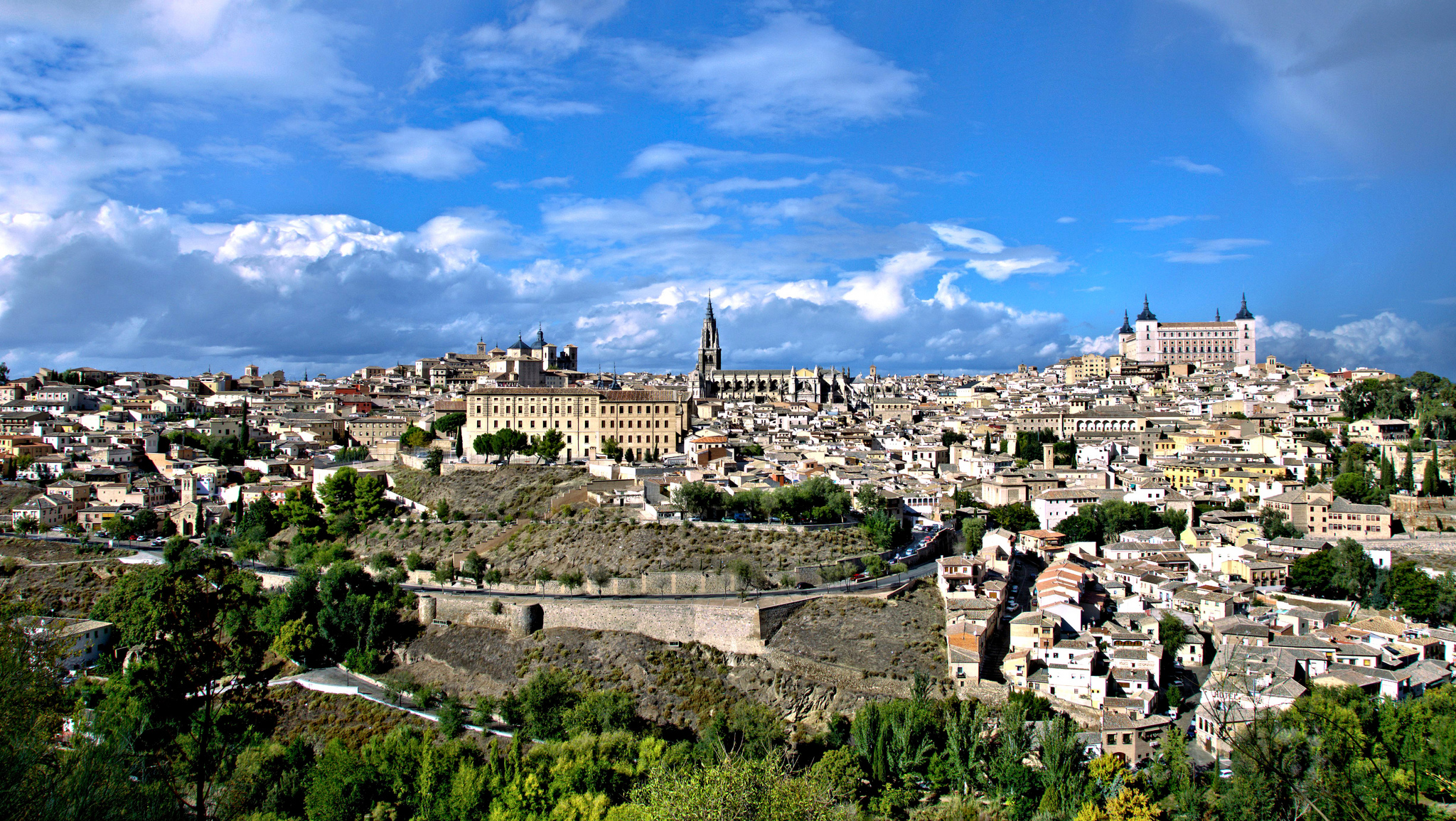
A view of Toledo, Spain
Roman, Visigothic and Islamic Toledo
Little is left standing from the Roman and Visigothic city. The Roman baths (Termas Romanas) are archaeological remains under the old town, and the Alcántara bridge is of Roman origin, although it was badly damaged and rebuilt in the 10th century. Finds from the Visigothic kingdom, which had its capital in Toledo, are shown in the Museo de los Concilios y la Cultura Visigoda inside the church of San Román.
The Islamic period is easier to see. The Mezquita del Cristo de la Luz was built in 999 and is one of the main works of Hispano-Islamic architecture in Spain. Inside the small square building, horseshoe arches carry nine vaults. When it became a church, a transept and a Mudéjar apse with blind arches were added. Other traces of the period are the Mezquita de Tornerías, dated by excavation to the 9th or 10th century, the church of El Salvador, which was a mosque from the 9th century, and the Puerta de Bisagra, a gate of Muslim origin that keeps remains of that time in its inner section.
Mudéjar: Toledo’s own style
Mudéjar art developed in the Iberian Peninsula between the 12th and 15th centuries, in parallel with the Romanesque and the Gothic. It grew out of the Muslim communities that stayed on under Christian rule, and in Toledo it means brick, bands of rough masonry, horseshoe and multi-lobed arches, and carved plaster. Good examples are:
- Santiago del Arrabal, a 13th-century church of brick and masonry with three naves, a triple apse and a tower from the 12th century
- San Román, an early Mudéjar church of the 13th century, now the Visigothic museum
- Santo Tomé, whose square Mudéjar tower dates from the early 14th century
- Taller del Moro, part of a noble house of the 14th century, now a museum
The two synagogues of the Jewish quarter belong to the same tradition. The Sinagoga del Tránsito, built in the 14th century as the synagogue of Samuel ha-Leví, has Mudéjar plasterwork with geometric and floral motifs and inscriptions in Arabic and Hebrew. It houses the Museo Sefardí. More on the area is in the post on La Judería, the Jewish quarter.
The synagogue of Santa María la Blanca
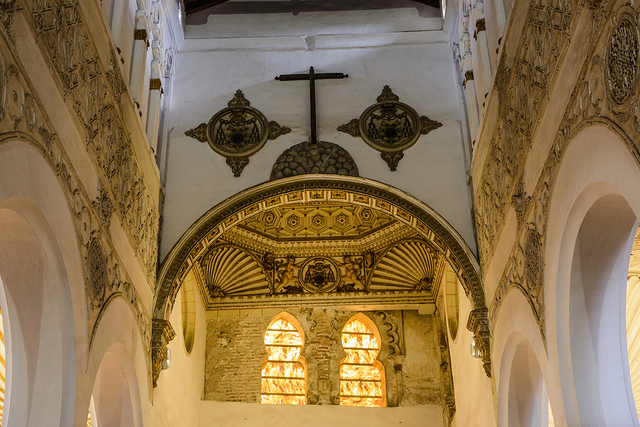
The synagogue of Santa María la Blanca, Toledo
Santa María la Blanca was the main synagogue of Toledo’s Jewish community. The city’s tourist board gives 1180 as the year of construction, from an inscription carved on a fragment of a beam. After a fire in 1250, King Alfonso X gave permission in 1260 to restore it. In the early 15th century it was converted into a church, which is where the present name comes from; the tourist board gives 1405 and the monument’s own site 1411. Renaissance alterations in 1554 added chapels and vaults. In the 19th century the building served as a barracks, and it was declared a national monument in 1930.
The ground plan is an irregular quadrilateral facing east, divided into five naves by octagonal pillars that carry horseshoe arches. The central nave is 12.50 m high. The thirty-two capitals are carved in limestone with pine cones and volutes, and the walls are plain white. A garden of cypress trees surrounds the building.
According to Toledo Monumental, which manages the visits, the synagogue opens every day from 10:00 to 18:45 between 1 March and 15 October, and from 10:00 to 17:45 between 16 October and the end of February. It is closed on 1 January and 25 December. General admission costs €4, and €3 for holders of a student card or the Carnet Joven; children up to 10 years old enter free. The address is Calle de los Reyes Católicos, 4.
Gothic: the Cathedral and San Juan de los Reyes
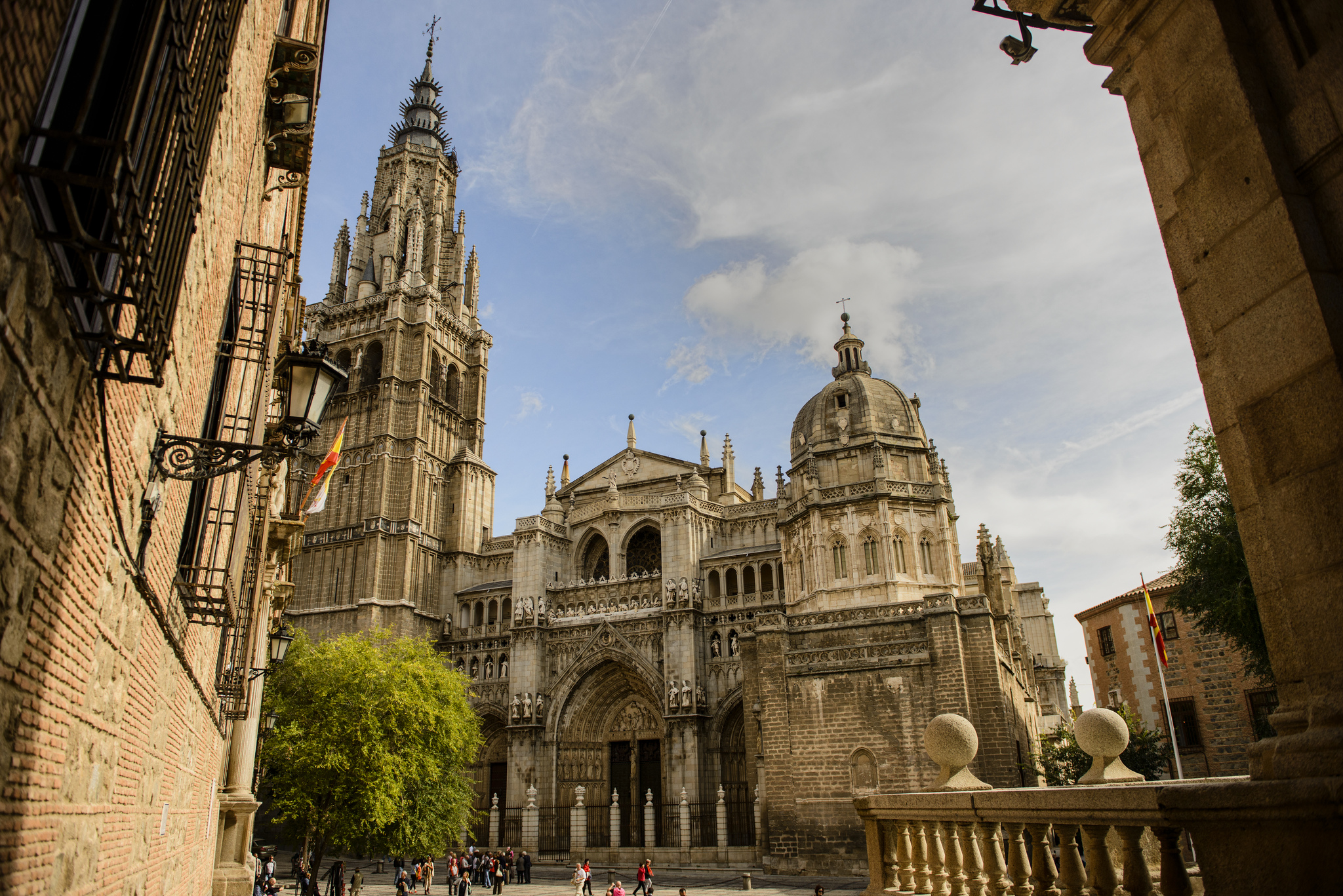
The Cathedral of Toledo, Spain
The Catedral Primada stands on the site of the Visigothic basilica of Santa María and, later, of the city’s main mosque. King Ferdinand III and Archbishop Rodrigo Jiménez de Rada began the present building in 1226, and work went on for more than two centuries until 1493. The design followed French Gothic models. It has five naves, a wide transept, an ambulatory and radial chapels; the church is 120 metres long and 59 metres wide, and 88 columns support the roof.
Later periods added to the Gothic structure. The stained glass dates from the 14th, 15th and 16th centuries. The altarpiece of the main chapel, commissioned by Cardinal Cisneros, was made between 1497 and 1504. The upper choir has 72 stalls designed in the 16th century by Alonso Berruguete and Felipe Vigarny. The Transparente, by Narciso Tomé, is Baroque, and the sacristy holds El Greco’s El Expolio. The cathedral marks 800 years since its first stone in 2026.
The cathedral’s ticket page lists these conditions for 2026:
- Visiting hours: Monday to Saturday 10:00 to 18:30, Sundays 14:00 to 18:30; entry closes 30 minutes earlier
- Basic ticket €12; reduced ticket €8 (over 65, Carnet Joven, students up to 18 years old, large families); €6 for children aged 8 to 14
- Closed on 1 January and 25 December, with shorter hours on some religious holidays
- Entrance through the Puerta Llana, Calle Cardenal Cisneros, 1
The post on the Cathedral of Toledo describes the interior in more detail.
The Monasterio de San Juan de los Reyes is the city’s other large Gothic work. The Catholic Monarchs founded it to commemorate the battle of Toro (1476), to a design by Juan Guas. The church has a single nave with side chapels between the buttresses, the cloister is late Gothic, and the ceiling of the cloister’s upper floor is Mudéjar.
Renaissance Toledo: the Alcázar, the Bisagra gate and the Hospital de Tavera
In the 16th century, under Emperor Charles V, the architect Alonso de Covarrubias gave Toledo its Renaissance face. He redesigned the Puerta de Bisagra, which was rebuilt under Charles V and Philip II: the outer side has an arch with the city’s coat of arms between two large round towers. He also rebuilt the Alcázar, the fortress on the highest part of the old town. The site was first built on in Roman times, and under Alfonso VI and Alfonso X it became a square fortress with a tower at each corner. Its Renaissance façades follow designs by Covarrubias and, later, Juan de Herrera. The Alcázar now houses the Museo del Ejército (Army Museum) and, on the upper floor, the regional library of Castilla-La Mancha. The tourist board lists the museum as open from Tuesday to Sunday, 10:00 to 16:30, for €5, with free entry on Wednesdays. Spain’s official tourism site reported in 2026 that the permanent exhibition was closed for renovation, so check before going.
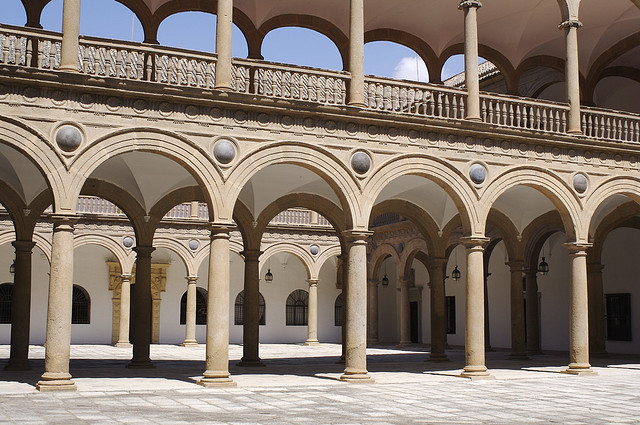
Hospital de Tavera in Toledo, Spain
The Hospital de Tavera, also called Hospital de San Juan Bautista, stands outside the walls, 300 metres from the Puerta de Bisagra. Covarrubias began it in 1541 for Cardinal Tavera, with two purposes: a hospital and a burial place for its founder. The cardinal is buried in the church, and his tomb is by Alonso Berruguete. El Greco also worked on the decoration of the building.
Today it is a museum of the Fundación Casa Ducal de Medinaceli. It shows paintings by El Greco, Ribera, Tintoretto, Luca Giordano and Canaletto among tapestries and furniture, and it keeps a library and the old hospital pharmacy with its jars of Talavera ceramics. Luis Buñuel shot two films here, Viridiana and Tristana.
The museum, church and pharmacy are visited in accompanied groups, and the visit takes about one hour. According to the foundation’s page, the hospital opens from Tuesday to Saturday from 10:00 to 18:00 and on Sundays from 10:00 to 14:00, and is closed on Mondays. Visits start on the hour. The full ticket costs €15 in 2026. The address is Calle Duque de Lerma, 2.
Planning an architecture visit
Toledo is an easy day trip from Madrid, though one day is short for all of the buildings above. The city’s tourist board gives these details in its visitor questions:
- High-speed Avant trains leave Madrid-Atocha about once an hour and take 25 minutes
- From the station, the old town is about 20 minutes on foot, using the escalators; a city bus to Plaza de Zocodover costs €1.40
- ALSA buses leave Plaza Elíptica in Madrid every 30 minutes; the direct ones take 1 hour
A tourist wristband sold by Toledo Monumental for €14 gives entry to seven monuments, among them Santa María la Blanca, San Juan de los Reyes, the Cristo de la Luz mosque and Santo Tomé. Single tickets to each of them cost €4. The Cathedral, the Hospital de Tavera and the Army Museum are not part of it and sell their own tickets.
Students should carry a student card or the Carnet Joven for the reduced prices. Those who plan a longer stay can read about studying in Toledo.
More about: Toledo, Tourism in Spain · All blog posts