Corpus Christi Day, Toledo, Spain
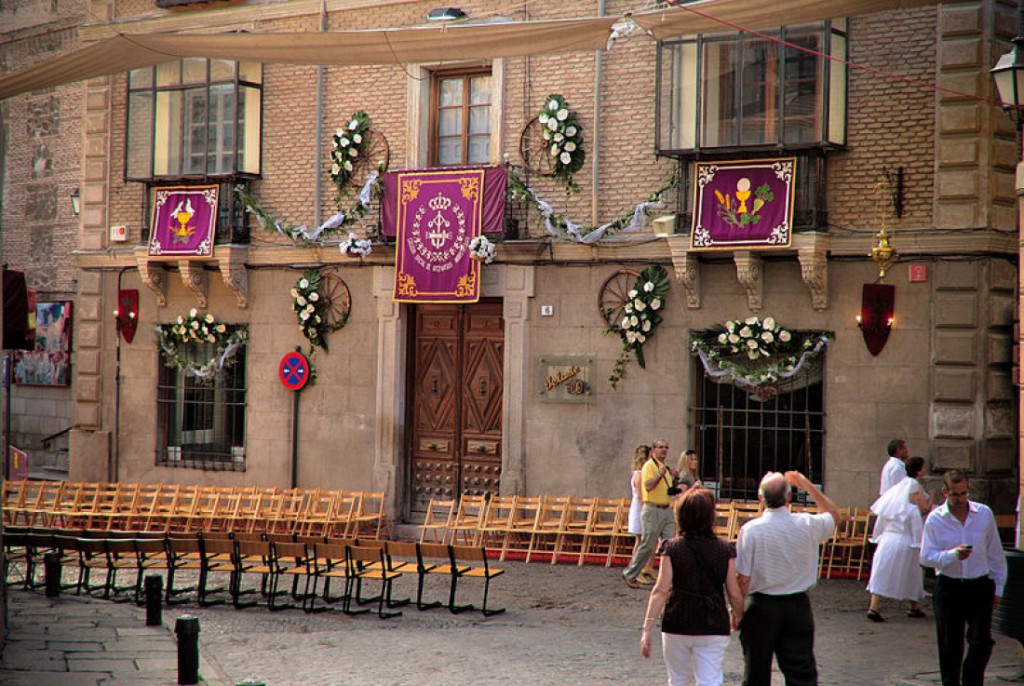
Corpus Christi is the main festival of Toledo and one of its oldest. On a Thursday in late spring a 16th-century monstrance of gold and silver is carried from the cathedral through streets covered with awnings, garlands and aromatic herbs. This post explains the origin of the festival, what happens before and during the procession, and how to see it.
An old festival
Spain’s official tourism website calls Corpus Christi Toledo’s most important festival. Its exact date of origin is unknown, but it is recorded as having been celebrated in the 15th century. It is a Festival of International Tourist Interest. The procession is presided over by the Archbishop of Toledo, the cardinal primate of Spain.
The day of the procession is the Thursday of Corpus Christi, the one that, in the Spanish saying quoted by the tourist office, “shines more than the sun”. The date moves with Easter. As an example, in 2025 the city’s main week of events, the Semana Grande, ran from 13 to 22 June. The programme for each year is published on the Toledo tourist office website.
The monstrance
The centre of the procession is the Custodia, the monstrance kept in Toledo Cathedral. It was made in the 16th century by the goldsmith Enrique de Arfe, who took seven years to finish it. According to Spain’s tourism website it is made of gold and silver and weighs about 160 kilos. Inside it stands an older Gothic monstrance made for Queen Isabella I by her jeweller.
The weeks before
About a month before the festival, the streets of the route are covered with the old awnings of the weavers’ and silk workers’ guilds. They form a canopy for the monstrance, known as the “cielo” (sky), almost two kilometres long. Then come awnings, embroidered hangings, garlands, natural flowers and wrought-iron lanterns. A proclamation in the Teatro de Rojas opens the main week, which also includes concerts, shows and sports events. The courtyards of the old houses are decorated and opened to visitors.
The eve
The day before the procession is the liveliest for families and students:
- Flower offering: in the morning, children who made their first communion that year cover the Puerta de los Reyes of the cathedral with flowers.
- The Tarasca and the giants: a parade of giant figures and big-headed figures leaves the Plaza del Ayuntamiento and follows the processional route. With them goes the Tarasca, a monster with the body of a turtle, the wings of a bat and the head of a snake. The oldest set of giants dates from the 18th century and represents the four continents known at the time. The newest pair, King Alfonso X and Violante of Aragon, joined in 2022 and are almost four metres tall.
- Opening of the route: the city council walks the route with an official who checks with a wooden gauge that the awnings hang high enough for the monstrance to pass.
The route is worth walking again after dark, when the lanterns are lit.
The procession
In the early hours of Thursday, Flemish tapestries of the 16th to 18th centuries are hung on the outer walls of the cathedral. They stay there only until the procession ends. The ground of the route is strewn with thyme, rosemary and lavender.
At 11:00 the monstrance leaves the cathedral by the Puerta Llana. Brotherhoods and guilds walk with it in ceremonial capes, habits and uniforms, and the boy singers of the cathedral, the seises, accompany it. Petals are thrown from the balconies. The route published by the city goes along Calle Martín Gamero, Plaza de las Cuatro Calles, Plaza de Zocodover, Calle Sillería, Plaza de San Vicente, Plaza Padre Juan de Mariana, Calle Rojas, Plaza del Salvador and Calle Arco de Palacio, and returns to the Puerta Llana.
How to see it
- Standing or seated: the streets are narrow, so arrive well before the start. Seats are set out along the route and can be paid for in advance at a booth in Plaza de Zocodover.
- Getting there: Renfe Avant trains link Madrid and Toledo in about 30 minutes, and the station is a 15-minute walk from the centre. Book train tickets early for the day of the procession.
- If the day itself is not possible: the decorated streets and courtyards can be seen during the whole main week.
For the rest of the city, see the post on the city of Toledo and the Toledo city page. The city’s other large religious festival is described in Holy Week in Toledo.
More about: Toledo · All blog posts