Plaza de Colón, Madrid
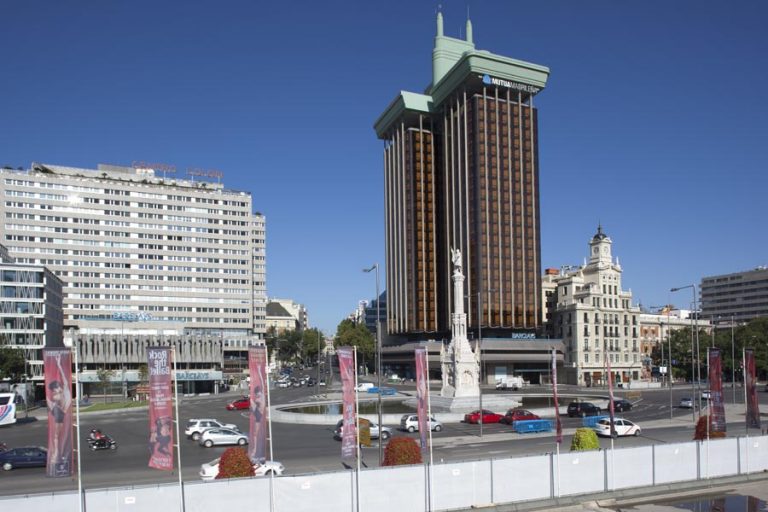
Plaza de Colón is a large square in central Madrid dedicated to Christopher Columbus, whose name in Spanish is Cristóbal Colón. This post describes its two monuments, the gardens, the sculpture and cultural centre that share the space, and what else is within a few minutes’ walk.
Where it is
The square is a junction of several main streets: Paseo de Recoletos, Paseo de la Castellana, Calle Génova, Calle Serrano and Calle Goya. Madrid’s official tourism website places it in the Barrio de Salamanca tourist area, and the Torres de Colón office towers stand on one side. Traffic runs around a fountain in the centre.
The Columbus monument
The monument to Columbus stands in the centre of the fountain, on a traffic island between Paseo de Recoletos, Paseo de la Castellana, Calle Génova and Calle Serrano. Together with its pedestal it is 17 metres high. According to the tourism website it was built in 1885 by Jerónimo Suñol, to mark the marriage of King Alfonso XII to María de las Mercedes de Orleans.
The statue itself is three metres high and carved in Carrara marble. Columbus wears a tunic and cloak. One hand holds a flag of Castile that rests on a globe, and the other is open and stretched forward. The base is of Gothic inspiration, and reliefs on its four sides show scenes related to the voyage to America.
Jardines del Descubrimiento
The Jardines del Descubrimiento (Gardens of the Discovery) opened in 1970 and cover 1.87 hectares. They are dedicated to the arrival of Columbus in America. Inside is the second monument of the square, by Joaquín Vaquero Turcios: three large concrete blocks that rise above a pool and carry reliefs related to the voyages. It was erected in 1977, when the remodelling of the square was completed.
The gardens are close to Calle Serrano, the National Library and the National Archaeological Museum, so they are a convenient place to rest between visits.
Julia, by Jaume Plensa
Since December 2018 the square has also held Julia, a 12-metre sculpture by the Barcelona-born artist Jaume Plensa, made from polyester resin and white marble dust. It stands on the pedestal that the Columbus statue used to occupy. The work is shown with the sponsorship of the Fundación María Cristina Masaveu Peterson and, according to the tourism website in October 2026, it will remain there until December 2027. It can be seen all day and free of charge.
Fernán Gómez. Centro Cultural de la Villa
Under the square is the municipal cultural centre that opened in 1977 as the Centro Cultural de la Villa and is now called Fernán Gómez. Centro Cultural de la Villa. Its programme includes theatre, dance, music, children’s shows and exhibitions. The main auditorium, the Sala Guirau, holds 682 people, and the exhibition hall extends over one thousand square metres.
The centre is open from Tuesday to Sunday, 10am to 10pm, and is closed on Mondays and on 24 and 31 December. Ticket prices depend on the show.
Nearby
- Museo Arqueológico Nacional, Calle de Serrano 13. General admission is €3; entry is free on Saturdays from 2pm and on Sunday mornings. It is open Tuesday to Saturday from 9:30am to 8pm, and on Sundays and public holidays from 9:30am to 3pm.
- Biblioteca Nacional de España, Paseo de Recoletos 20-22. Admission to its exhibitions is free; they open Monday to Saturday from 10am to 8pm and on Sundays and public holidays from 10am to 2pm.
Getting there
The nearest metro stations are Colón and Serrano, both on line 4. Cercanías suburban trains stop at Madrid-Recoletos, and many city bus lines pass through the square. BiciMAD bike-share docking stations are on Calle Goya, Calle Serrano and Paseo de la Castellana.
For students
The square, the gardens and the two monuments can be seen in half an hour at no cost. Combined with the archaeological museum or an exhibition at the library, they fill a morning. Students under 18 enter the museum free. More about the city is on the Madrid city page, and universities in Spain are listed under universities.
More about: Madrid · All blog posts