Puerta de Alcalá, Madrid
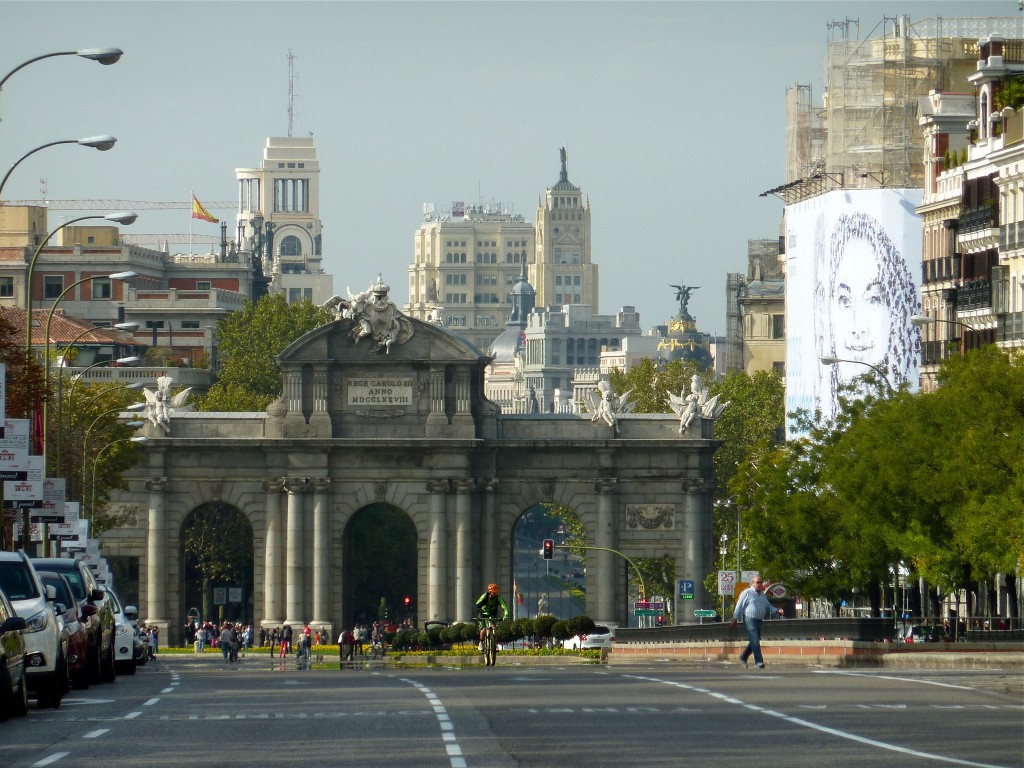
The Puerta de Alcalá is the granite triumphal arch in the middle of Plaza de la Independencia in Madrid, beside El Retiro Park. This post covers its history, what to look for on each of its two faces, the restoration completed in recent years and the practical details of a visit.
What it is and where it stands
According to Madrid’s official tourism website, the gate was once the main entrance to the city and was commissioned by King Charles III (Carlos III), who was not impressed by the gate that received him when he arrived in 1759. It takes its name from the road that led to Alcalá de Henares. Three well-known streets meet at the square: Calle de Alcalá, Calle de Alfonso XII and Calle de Serrano.
The gate has five openings instead of the three that were usual for a city gate, which sets it apart from the smaller Puerta de Toledo. The tourism website describes it as the first triumphal arch of its kind built after the fall of the Roman Empire, older than the Brandenburg Gate in Berlin and the Arc de Triomphe in Paris.
History
The city council’s heritage catalogue records an earlier Puerta de Alcalá, designed in 1599 by the Italian painter Patricio Cajés to mark the entry into Madrid of Queen Margarita de Austria, wife of Felipe III. It stood further west than the present gate and was built of brick, with three arches. That gate was altered, pulled down and rebuilt several times, and its last version stood until 1764, when Charles III ordered it to be demolished so that the street could be widened.
The design of the new gate was chosen in a competition held in 1769 between three court architects: Ventura Rodríguez, José de Hermosilla and the Palermo-born Francesco Sabatini, who won. According to the catalogue, the works did not start until 1774 for lack of funds and were finished in 1778, the year given in the inscription on the gate itself: REGE CAROLO III ANNO MDCCLXXVIII. More about the king is in the post on Carlos III.
The gate was part of the wall that surrounded Madrid, and its iron grilles were closed at ten at night in winter and at eleven in summer. French artillery left shrapnel marks on the stone on 3 December 1808. When the wall came down, a circular square was laid out around the gate in 1869 and named Plaza de la Independencia, so the arch has stood free ever since. It was declared a National Monument in 1976.
What to look for
The three larger, round-arched openings were for carriages and the two smaller, flat-topped ones at the ends were for pedestrians. The two faces are different:
- The outer face, looking east, was the first thing travellers saw on arriving in Madrid and is the richer one. It is crowned by the royal coat of arms, held by the winged figure of Fame and a child. Along the top stand four figures of children representing the cardinal virtues: Prudence, Justice, Temperance and Fortitude.
- The inner face, looking towards the city centre, is plainer. It carries military trophies such as flags, weapons, breastplates and helmets, and lion heads decorate the keystones of the arches.
Two sculptors worked on the gate. The French-born Roberto Michel carved the lion heads and the garlands, and Francisco Gutiérrez carved the coat of arms, the figure of Fame, the four children and the trophies. The same two sculptors worked on the fountain in nearby Plaza de Cibeles.
The restoration and the World Heritage listing
The gate is part of the Paseo del Prado and Buen Retiro, Landscape of Arts and Sciences, which was inscribed on the UNESCO World Heritage List in 2021. In 2022 Madrid City Council began a full restoration, in which more than 100 specialists took part and during which over 12,000 people climbed the scaffolding on guided visits, according to the European Heritage Awards. The project received a European Heritage Award / Europa Nostra Award in 2025, as well as that year’s Public Choice Award.
Visiting
The Puerta de Alcalá stands in a public square, so there is no ticket and no timetable. It sits on a traffic roundabout and is best seen from the pavements around the square or from the entrance to El Retiro. Ten to fifteen minutes are enough to walk round and see both faces.
- Address: Plaza de la Independencia
- Metro: Retiro or Banco de España, both on line 2
- Cercanías (local train): Madrid-Recoletos
- Bicycle: BiciMAD docking stations at Calle Serrano, 8 and Calle Alcalá, 95
The gate combines well with El Retiro Park, whose main entrance opens onto the same square. Entry to the park is free, and it opens from 6am to midnight from April to September and from 6am to 10pm from October to March. From the gate, Calle de Alcalá runs downhill to Plaza de Cibeles.
For students
For students of art history or architecture, the gate is a compact example of 18th-century neoclassical design that costs nothing to study on site, and the city council’s catalogue gives a detailed description in Spanish. It is also a common meeting point before a walk or a run in El Retiro. Universities and language schools in the city are listed on the Madrid page.
More about: Madrid · All blog posts