A Brief History of Caceres, Spain
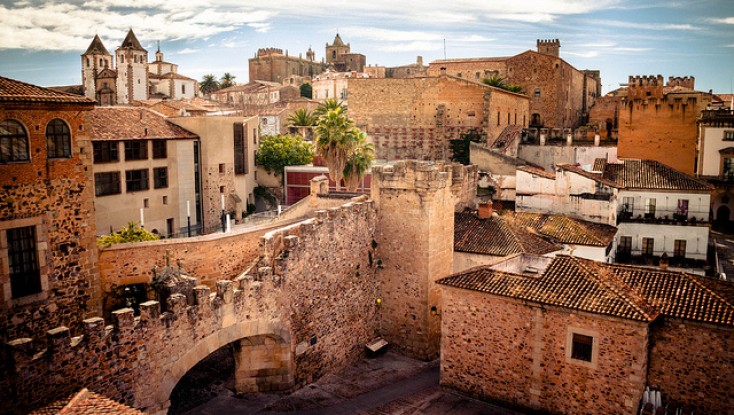
Cáceres is the capital of the province of the same name in Extremadura, in western Spain. Its walled old quarter has been a UNESCO World Heritage Site since 1986. This post follows the history of the city from its Roman foundation to the palaces of the 15th and 16th centuries, and says where each period can still be seen today.
Roman Norba Caesarina
People lived here long before the city existed: the Maltravieso cave, inside the modern town, has Palaeolithic cave paintings. The city itself goes back to 34 BC, when, according to the Extremadura tourist board, Gaius Norbanus Flaccus founded Norba Caesarina. The Romans settled on a hill near the Silver Way, the road that crossed the west of the peninsula from south to north.
The Roman town had a rectangular wall with three gates. Two of them, the Coria Gate and the Mérida Gate, have disappeared. Sections of dressed granite survive, and the best preserved is the gate known as the Arco del Cristo. The Roman period ended with the Visigothic invasion in the 5th century.
The Almohad stronghold
Under Muslim rule Cáceres became a fortress on the frontier with the Christian kingdoms. Ferdinand II of León took the city in 1169, and the troops of Caliph Abu Ya’qub won it back in 1173. The Almohads rebuilt the defences with a wall of sun-dried brick and a line of towers, many of which still stand.
The best known is the Bujaco Tower on the Plaza Mayor, which takes its name from the caliph. In the 17th and 18th centuries it was known as the Clock Tower. It is open to the public, houses the Three Cultures Visitor Centre and has views over the city. The other large survival is the Moorish cistern (aljibe) under the Palacio de las Veletas, which was built in the 15th century on the old Almohad citadel.
The Christian city of towers and palaces
Alfonso IX of León took Cáceres for good on St George’s Day, 23 April 1229. St George has been the patron saint of the city since then. In the following centuries noble families built fortified houses and towers inside the walls, such as the 14th-century Sande Tower and the Palacio de las Cigüeñas with its slender crenellated tower.
The city reached its peak under the Catholic Monarchs, in the 15th and 16th centuries, helped by the wealth that arrived from the Americas. Houses from this period include the Palacio de los Golfines de Abajo, the Carvajal Palace, the Casa del Sol with its Renaissance courtyard and the Toledo-Moctezuma Palace, home of a daughter of the Aztec emperor Moctezuma II.
The main churches belong to the same centuries. The Co-cathedral of Santa María is a Gothic building with three naves that keeps Romanesque remains from an earlier church. The Church of San Mateo was built on the ruins of a mosque. The Arco de la Estrella, the usual way into the old quarter from the Plaza Mayor, is later: it dates from the 18th century and was designed to let carriages pass. In 1822 Cáceres was named capital of Upper Extremadura.
Visiting the old quarter today
The old quarter is small and is best seen on foot. A walk from the Plaza Mayor through the Arco de la Estrella to the Plaza de Santa María, the Plaza de San Jorge and the Plaza de las Veletas passes most of the buildings named above.
- Museo de Cáceres: in the Casa de las Veletas and the 16th-century Casa de los Caballos, on Plaza de las Veletas. In 2026 Spain’s official tourism website reports that the museum is partly closed and that only the archaeological rooms and the cistern are open, so check before a visit
- By train: around three and a half hours from Madrid and less than 40 minutes from Mérida. The railway station and the bus station next to it are about two kilometres from the old town, half an hour on foot or a short ride on a city bus
- By coach: about four hours from Madrid
- Events: Holy Week in March or April, the Womad music festival in May, the Classical Theatre Festival in July and the Three Cultures Medieval Market in November
Cáceres for students
Cáceres is a university city: one of the four campuses of the Universidad de Extremadura is here. See the schools in Cáceres or the full list of schools in Spain. The Roman city of Mérida is a short train ride to the south and is described in the post on Mérida.
More about: History of Spain · All blog posts