3 Monuments in Spain You Shouldn’t Miss
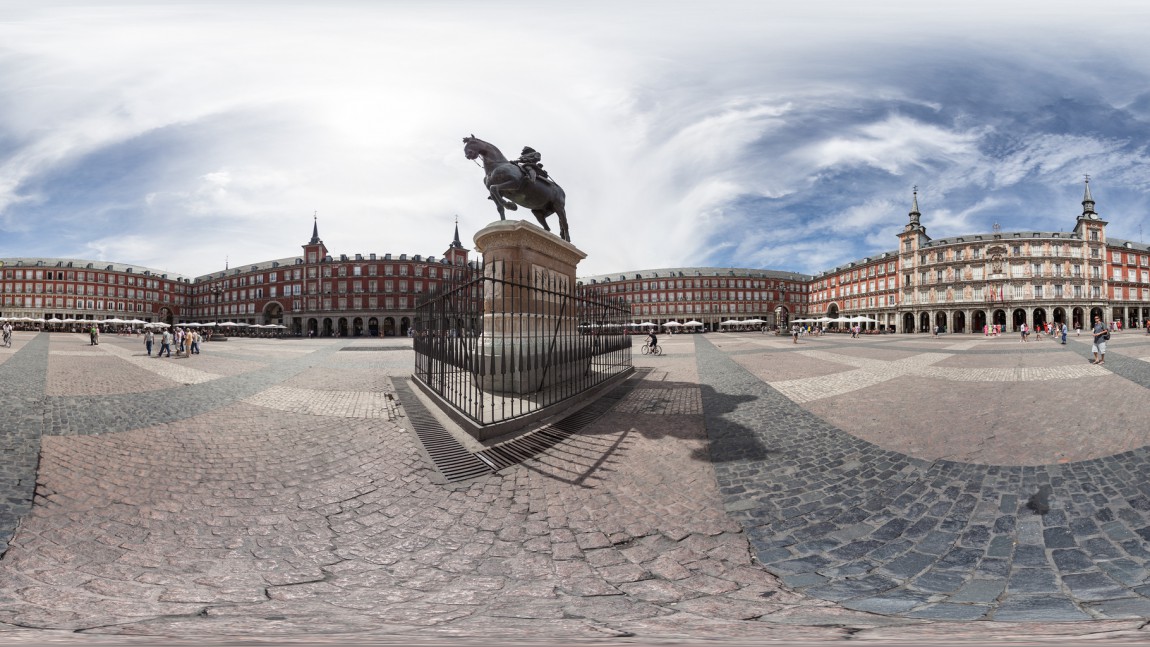
The three monuments in this post all stand in Salamanca, a university city in Castile and León, in the west of Spain. They are the Plaza Mayor, the Catedral Nueva (New Cathedral) and the Convento de San Esteban. All three lie within walking distance of each other in the old town, which was declared a World Heritage Site in 1988. The opening hours and prices below were checked in October 2026.
Plaza Mayor
The Plaza Mayor is the main square of Salamanca and one of the large works of the Spanish Baroque. According to the city’s tourist office, it was built between 1729 and 1755. The architect Alberto de Churriguera began the project and designed an arcaded square that is almost, but not quite, a regular quadrilateral. After he left the city, Andrés García de Quiñones finished the work, including the town hall on the north side.
The façades are three storeys high above a continuous arcade. Medallions between the arches show Spanish monarchs, soldiers and figures from Spanish culture. Today it is a pedestrian space lined with cafés and restaurants.
The tourist office suggests allowing 30 minutes. The square is open at all hours and there is nothing to pay.
Catedral Nueva
Salamanca has two cathedrals that share a wall. The Catedral Vieja (Old Cathedral) was begun in the 12th century and finished in the 13th. The Catedral Nueva was built next to it rather than in its place. According to the cathedral’s own website, work began in 1513 and the building was inaugurated in August 1733.
The church was begun in the late Gothic style, and the cathedral chapter kept to that style until the end, although Renaissance and Baroque elements were added. The choir stalls, built from 1710 to 1733 to designs by Joaquín Benito and Alberto de Churriguera, are among the main Baroque works in the building. On the Puerta de Ramos, visitors look for the figure of an astronaut. It is not medieval: it was added with other modern figures when the doorway was restored in the 1990s.
One ticket covers both cathedrals, the cloister, the chapter rooms and the exhibitions in the Episcopal Palace, with an audio guide included. The cathedral’s visitor page gives these details:
- Monday to Saturday from 10:00 to 20:00, last admission at 19:15
- Sunday from 10:00 to 18:00, last admission at 17:15
- General ticket €10; students and visitors over 65 pay €9
- Children aged 7 to 16 pay €7; children up to 6 enter free
Convento de San Esteban
San Esteban is a Dominican convent, sometimes called a monastery in English. The Dominicans arrived in Salamanca around 1225. The present building was begun in 1524 on the initiative of Cardinal Juan Álvarez de Toledo. The architect Juan de Álava designed the church, and it was consecrated in 1610. The church has a Latin cross plan with a single nave 87 metres long.
The façade is one of the best-known examples of the Plateresque style in Spain. It is laid out like a large stone altarpiece, with the martyrdom of Saint Stephen at its centre. The visit also takes in the Claustro de los Reyes and the Escalera de Soto, a cantilevered granite staircase dated 1553.
The convent is linked to Christopher Columbus. According to the tourist office, he was received here between 1486 and 1487, when he came to Salamanca to seek support for his voyage, and the prior, Diego de Deza, became one of his main supporters before Queen Isabella. The Salón de Profundis, one of the oldest rooms of the convent, is normally closed to visitors.
The tourist office lists opening hours from Monday to Sunday, 10:00 to 14:00 and 16:00 to 20:00. The individual ticket costs €4.75, and students pay €3.75. Hours can change with the season, so it is worth checking before going.
For students
The University of Salamanca dates from 1218. All three monuments can be seen in one day on foot, and the student prices above apply with a valid student card. More about the city, its universities and its language schools is on the Salamanca city page. The directory also lists Spanish language courses in Spain.
More about: Tourism in Spain · All blog posts