Barcelona, Spain
Barcelona is the capital of Catalonia and lies on the Mediterranean coast in the north-east of Spain. This post gives a short history of the city, describes four places that most visitors see first, lists the main festivals and gives practical details on tickets and transport, checked in October 2026.
A short history
According to the city’s tourist board, the Roman colony of Barcino was founded by the Emperor Augustus around 10 BC, near an older Iberian settlement called Barkeno. The colony stood around Mount Tàber and was enclosed by a wall with four gates. Remains of the Temple of Augustus can still be seen close to the cathedral.
The modern city took shape in the 19th and 20th centuries. The Universal Exposition of 1888 was held in the Ciutadella park and the International Exposition of 1929 on Montjuïc. Around the turn of the century the Catalan form of Art Nouveau, called Modernisme, produced the buildings of Antoni Gaudí, Lluís Domènech i Montaner and Josep Puig i Cadafalch. In 1986 Barcelona was selected to host the 1992 Olympic Games, which led to the renewal of the seafront and the building of the Vila Olímpica and the Port Olímpic.
Places to visit
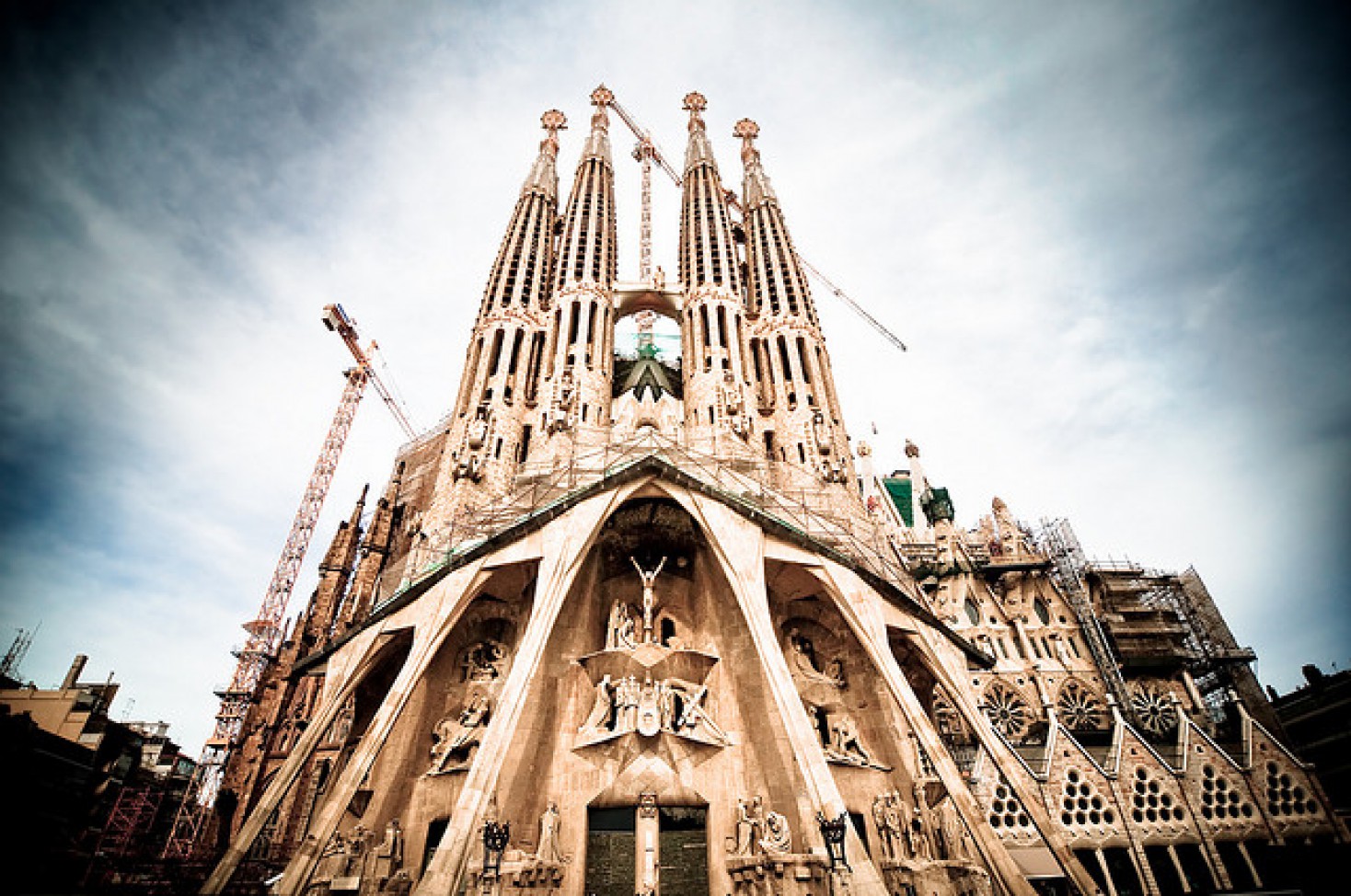
Sagrada Família
Gaudí took over the building of this basilica in 1883 and worked on it until his death. Work still continues. Spain’s official tourism website states that the Tower of Jesus Christ, 172.5 metres high, was completed in 2026 and makes the Sagrada Família the tallest church in the world.
The basilica’s own site gives these opening hours: from November to February, Monday to Saturday from 9:00 am to 6:00 pm; in March and October, Monday to Friday until 7:00 pm; from April to September, Monday to Friday until 8:00 pm. On Saturdays it closes at 6:00 pm all year, and on Sundays it opens at 10:30 am. Tickets are sold online only. According to the price list, the individual ticket with the audioguide app costs €26.00, or €24.00 for visitors under 30 and holders of a student card. With a visit to the towers the base price is €36.00. Metro lines L2 and L5 stop at Sagrada Família station.
Barcelona Cathedral
The cathedral stands on Pla de la Seu in the Gothic Quarter, on the site of an early Christian basilica. It is mainly Gothic. The main façade is much later, from the late 19th and early 20th century, although it follows a project from 1408. The cloister and the chapel of Santa Lucía are part of the visit.
La Rambla
La Rambla is the long promenade that runs through the old town down to the port. The Boquería market and the Gran Teatre del Liceu, the city’s opera house, are the best-known stops on the walk, and Gaudí’s Palau Güell is next to it. At the seaward end stands the Columbus Monument, built for the 1888 exposition, with a viewpoint 60 metres above the city.
Montjuïc
The hill of Montjuïc rises above the port. It holds the German Pavilion by Mies van der Rohe and Lilly Reich, built for the 1929 exposition, and the Olympic Ring with the Estadi Olímpic Lluís Companys and the Palau Sant Jordi. Parc de Montjuïc is also one of the city’s large parks.
Festivals
- Sant Jordi, 23 April: the streets fill with stalls selling roses and books.
- Festa Major de Gràcia, around 15 August: for about a week the residents of the Gràcia district decorate their streets and squares and organise concerts, dances and communal meals. The first record of the festival dates from 1817.
- La Mercè, late September: the main city festival, with around five hundred activities including street arts, traditional culture and concerts. In 2026 it ran from 23 to 27 September, according to the City Council.
Catalan traditions that appear at these festivals include castells (human towers), the sardana circle dance, parades of giants and correfocs, in which people dressed as devils run through the streets with fireworks.
Getting there and around
Barcelona-El Prat Airport is 12 kilometres from the city. Spain’s official tourism website states that the centre can be reached in about 35 minutes or less by Aerobus, train line R2 North or metro line L9 Sud. High-speed trains to Madrid, Valencia, Seville, Zaragoza and France use Barcelona-Sants station, on metro lines 3 and 5. The Hola Barcelona travel card gives unlimited travel on metro, bus, tram and train for 2, 3, 4 or 5 days. Large parts of the city are a Low Emission Zone, so public transport is the practical choice.
For students
Barcelona is one of the main study destinations in Spain, with public and private universities, business schools and many Spanish language schools. See the schools in Barcelona, the list of language courses in Spain or all schools in Spain. Classes may be taught in Catalan, Spanish or English, so check the language of a course before applying.
More about: Tourism in Spain · All blog posts