The Island of Mallorca, Spain
Mallorca is the largest of the Balearic Islands, in the western Mediterranean. This guide covers its capital Palma, the Serra de Tramuntana mountains, the villages of Valldemossa, Deià and Sóller, the historic Sóller train with its 2026 fares, and how to reach and get around the island.
Palma, the capital
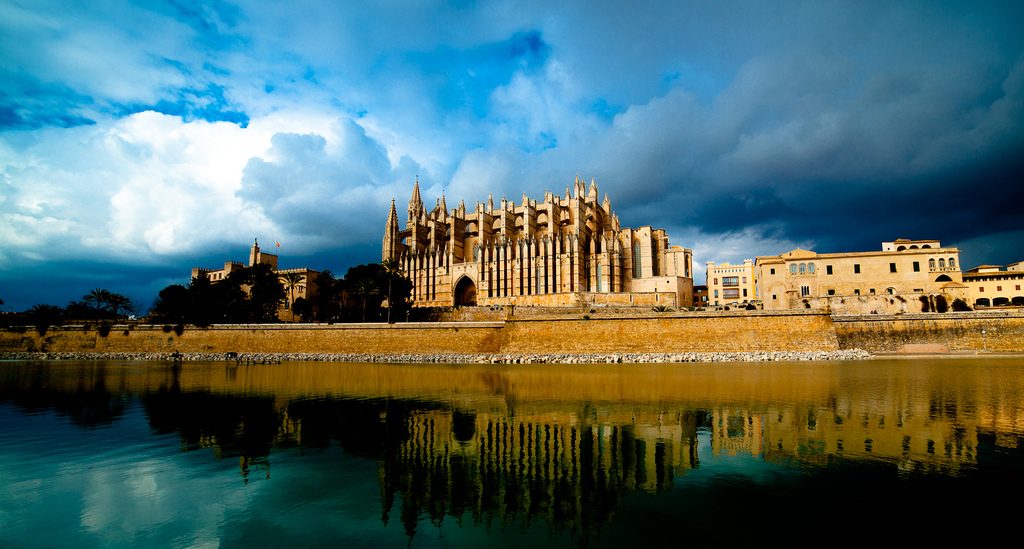
Palma lies on the bay of the same name and has a mild climate, with an average annual temperature of 17.9 °C according to Spain’s official tourism website. The old town is easy to explore on foot. Its main monument is the Gothic cathedral, built over the city walls beside the sea. Construction began during the reign of Jaime II. The architect Antoni Gaudí carried out reforms in the early 20th century, and the artist Miquel Barceló added a large ceramic mural in one of the chapels. The bell tower holds nine bells; the largest weighs 4,517 kilos.
Next to the cathedral stands the Almudaina Royal Palace. Other places to see in Palma are Bellver Castle, a Gothic castle on a hill, the Es Baluard museum of modern and contemporary art, and the Fundació Pilar i Joan Miró.
The Serra de Tramuntana and its villages
The Serra de Tramuntana runs along the northwest coast, with mountains that reach about 1,500 metres. On 29 June 2011 UNESCO declared it a World Heritage Site as a cultural landscape, shaped by centuries of terraced farming and water management. Hikers can follow the Dry Stone Route (GR 221). According to the Serra de Tramuntana consortium, 183.3 kilometres of the route are open and signposted, and its highest point is a little over 1,200 metres.
- Valldemossa, 17 kilometres from Palma, is known for its Carthusian monastery, which housed monks between 1399 and 1835. The composer Chopin and the writer George Sand stayed there
- Deià is a village of stone houses on a hill above the sea, traditionally home to painters and other artists
- Sóller lies in a valley of citrus and olive orchards and has a 14th-century parish church, Sant Bartomeu
Inland, the island is flatter, with towns such as Sineu and Petra.
The Sóller train
The wooden train between Palma and Sóller was inaugurated in 1912 and crosses the mountains by way of Bunyola. A historic tram continues from Sóller to Port de Sóller. Fares in 2026, according to the operator:
- Palma to Sóller: €23 one way, €30 return
- Tram between Sóller and Port de Sóller: €10 each way
- Combined train and tram ticket, Palma to Port de Sóller and back: €40
There are only a few departures a day, so check the timetable before going.
Getting there and around
Son Sant Joan Airport is 8 kilometres from Palma and is linked to the city by bus lines A1, A2 and 34. Ferries connect Palma with the other Balearic Islands and with Barcelona, Valencia, Alicante and Denia.
On the island, the public trains of Transports de les Illes Balears run on three lines, to Inca, Sa Pobla and Manacor. Palma has two metro lines; line M1 runs from the city centre to the campus of the Universitat de les Illes Balears (UIB), which is useful for students. The city also has more than 50 kilometres of cycle lanes.
Students who are choosing where to study can compare Spanish cities on the cities page or browse all schools in Spain. Another Balearic island is described in the post on Ibiza.
More about: Tourism in Spain · All blog posts