The Royal Monastery of Our Lady of Guadalupe, a UNESCO World Heritage Site
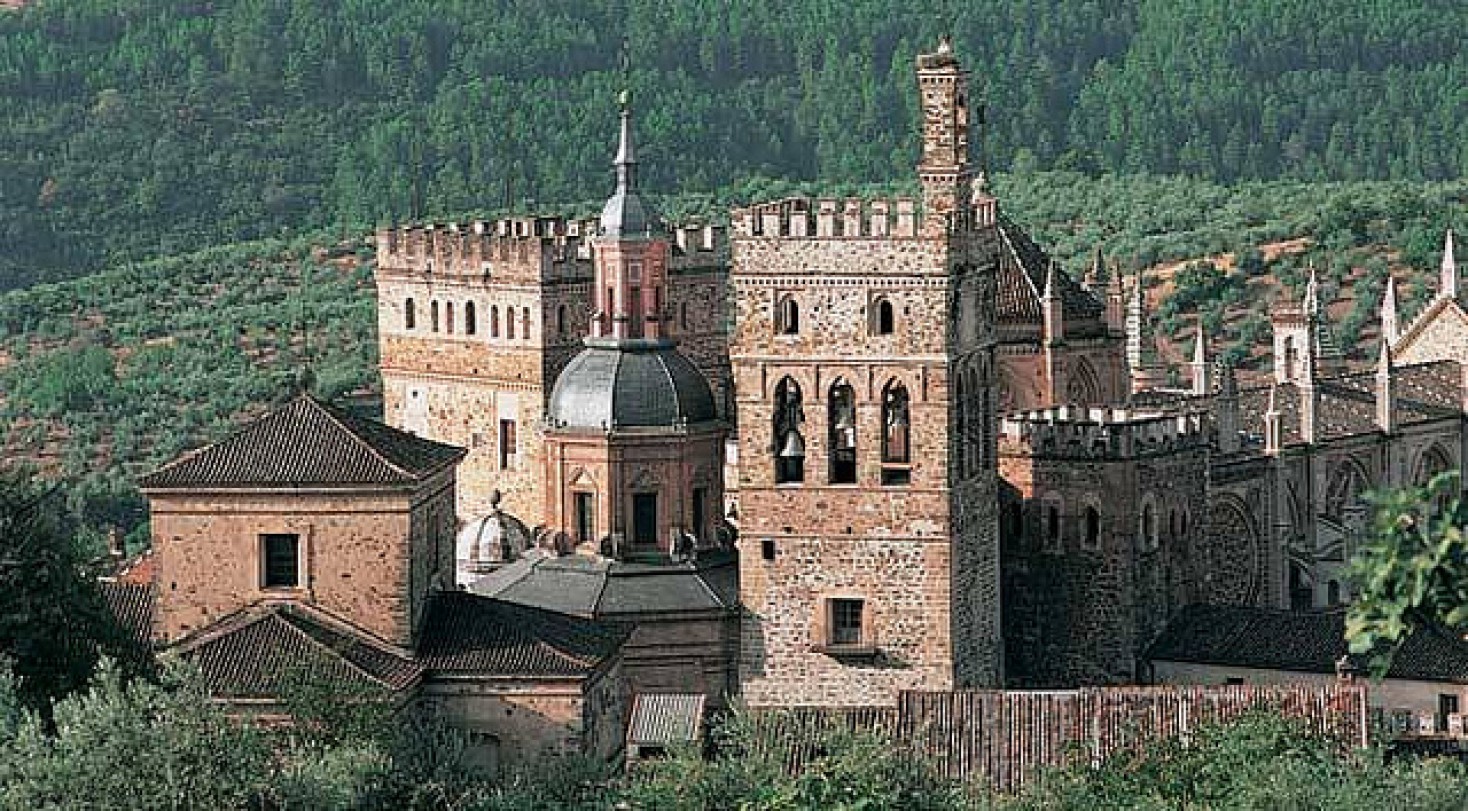
The Real Monasterio de Santa María de Guadalupe stands in the small town of Guadalupe, in the province of Cáceres in Extremadura. It has been a UNESCO World Heritage Site since 1993 and is still a working sanctuary, parish and Franciscan convent. This post covers its history, what a visit includes, and the opening hours and prices published by the monastery in 2026.
Legend and history
The monastery owes its existence to a statue of the Virgin. According to the legend told by the monastery, clerics fleeing Seville around the year 714 hid the image beside the Guadalupe river, where a shepherd named Gil Cordero later found it. The image venerated today is a Romanesque carving in cedar from the 12th century.
The sanctuary began at the end of the 13th century as a small hermitage. King Alfonso XI visited Guadalupe in 1335, found the hermitage in ruins and arranged for its restoration. The town, the Puebla, was founded in 1337, and building of the monastery started in 1340 on the king’s orders. In 1389 the sanctuary was handed to the Order of Saint Jerome, which stayed for four centuries until the disentailment of 1835. The Franciscan Order arrived in 1908 and has run the monastery ever since.
Guadalupe is also tied to the voyages to America. Spain’s official tourism website records that the Catholic Monarchs received Christopher Columbus here, and that the first Native Americans he brought back from his second voyage were baptised in the square in front of the monastery, where the fountain of Tres Caños stands.
The complex was declared a National Monument in 1879 and a World Heritage Site in 1993. The Virgin of Guadalupe has been patron saint of Extremadura since 1907.
What to see
The monastery has four parts: the church (basilica), the auditorium building, the Mudejar cloister and the Gothic cloister. It is built in Gothic-Mudejar style and flanked by eight towers. The main points of a visit are:
- The Mudejar cloister, with a small pavilion (templete) in the centre that the monastery describes as the only one of its kind.
- The sacristy, decorated with a series of paintings by Francisco de Zurbarán showing scenes from the life of the Hieronymite monks. The chapel of San Jerónimo holds his “Apotheosis of Saint Jerome”.
- The Camarín, the octagonal Rococo chamber of the Virgin, with paintings by Luca Giordano.
- The museums: an Embroidery Museum with liturgical robes from the 15th to 19th centuries made in the monastery’s own workshop; a Museum of Illuminated Manuscripts with more than ninety volumes produced in the monastery scriptorium; and a Sculpture and Painting Museum with works by Goya and El Greco and a marble crucifixion attributed to Michelangelo.
Visiting in 2026: hours and prices
According to the monastery’s own timetable page, the museums are open every day from 9:30 to 12:50 and from 15:30 to 17:50. They close on 1 January and 25 December.
- Adults: €7.00
- Visitors over 65: €6.00
- Children aged 4 to 13: €3.00; under 4 free
- Groups of more than 30 people: €6.00 per person
Tickets are sold in the monastery shop in order of arrival and cannot be reserved. The visit is made in a group of about 40 to 50 people accompanied by monastery staff, and lasts an estimated 45 to 50 minutes. Mass is held from Monday to Saturday at 12:00 and in the evening, with extra services on Sundays; check the Mass times before planning to see the church.
A Guadalupe Jubilee Year runs from 30 August 2026 to 8 September 2027, and the monastery expects many pilgrims during those months. Allow extra time if visiting then.
The town and its surroundings
Guadalupe lies in the district of Las Villuercas, at the foot of the Sierra de Altamira. The town is a declared Historic-Artistic Site with cobbled streets and houses with wooden balconies. Opposite the monastery, the former hospital of San Juan Bautista, built in the 14th and 15th centuries, is now a Parador hotel. The main local fiesta honours the Virgin of Guadalupe on 8 September, which is also the regional day of Extremadura; 12 October is the second big date in the town’s calendar.
Just over 20 kilometres away is the Villuercas-Ibores-Jara Geopark, a mountain area of more than 2,500 square kilometres recognised by UNESCO for its geology. Half a day is enough for the monastery itself; a full day or an overnight stay allows time for the town and a walk in the hills.
For students
Guadalupe is a long day trip rather than a study destination. Cáceres is the provincial capital; see the Cáceres city page and the post on the history of Cáceres. Students of art history and Spanish colonial history will find the Zurbarán paintings and the Columbus connection the most relevant parts of the visit. Schools across the country are listed under study in Spain.
More about: Tourism in Spain · All blog posts