Granada, Spain
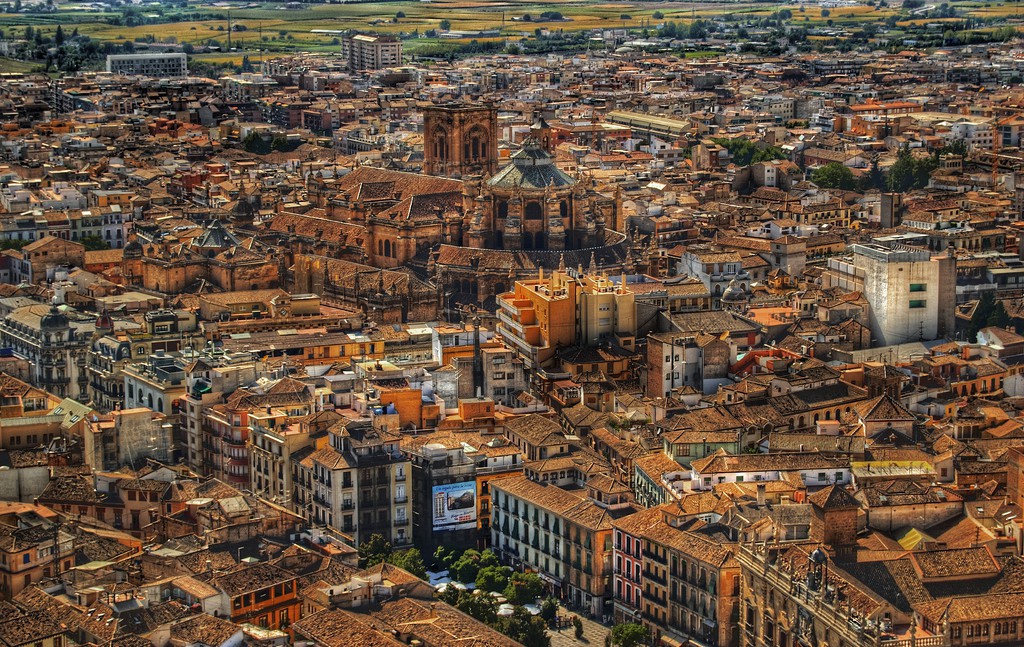
Granada lies in eastern Andalusia, at the foot of the Sierra Nevada mountains and between the rivers Darro and Genil. This post covers the city’s history, the Alhambra and the Generalife, the other main monuments, the tapas custom, festivals and excursions, with ticket and transport details checked in October 2026.
A short history
After the end of the Caliphate of Córdoba in 1031, the Zirid rulers of the Taifa kingdom of Granada set up their court in the old fortress of the Albaicín quarter, and the city grew around it. In the 13th century Al-Ahmar, founder of the Nasrid dynasty, moved the court to the hill opposite and began the Alhambra that stands today. According to the Patronato de la Alhambra y Generalife, the complex reached its full splendour in the second half of the 14th century, under Yusuf I and Muhammad V.
Granada was the last city taken by the Catholic Monarchs, in 1492. The Alhambra then became a royal household, and in 1526 Emperor Carlos V decided to build the Renaissance palace that bears his name inside it. In 1812 the withdrawing French army demolished part of the fortress. The Alhambra was declared a monument in 1870. Today the Alhambra, the Generalife and the Albaicín are a World Heritage Site.
The Alhambra and the Generalife
The Alhambra was a palace, citadel and fortress, the residence of the Nasrid sultans and their court. The oldest part is the Alcazaba citadel, with the La Vela tower and its view over the city. The Nasrid Palaces are built around rectangular courtyards with fountains, among them the Court of the Myrtles and the Court of the Lions. The Generalife, built between the 13th and 14th centuries on the slopes of the Cerro del Sol, was the sultan’s country residence and orchard. Its entry point is the Acequia Courtyard, a long court with a pool in the middle.
Tickets and how to visit
- The general day ticket for the Alcazaba, the Nasrid Palaces and the Generalife costs €22.27 on the Patronato’s site in October 2026.
- Tickets can be bought up to three months in advance through the official website. Buying early is advised, because availability on the day is not guaranteed.
- Only the Nasrid Palaces have a fixed time slot. It is given at the time of purchase and cannot be changed, so the rest of the visit has to be planned around it.
- The visit takes about three hours. From the entrance it is 15 minutes on foot to the Generalife, 17 minutes to the Nasrid Palaces and 20 minutes to the Alcazaba.
- Children under 12 enter free but need a ticket. Visitors must show an ID card or passport with the ticket.
- The Palace of Charles V and the Alhambra Museum are freely accessible.
- City buses C30, C32 and C35 run from Plaza Isabel la Católica in around 15 to 20 minutes. The walk up from Paseo de los Tristes or Plaza del Realejo takes about 20 minutes. Private cars cannot drive up from the city centre.
More detail is on Spain’s official tourism website, in its guide to buying tickets for the Alhambra.
Other places to visit
- Cathedral. A Renaissance church on Gran Vía de Colón. The architect Diego de Siloé combined a Renaissance dome with a Gothic floor plan. The main façade is Baroque, and the main chapel has paintings by Alonso Cano.
- Royal Chapel. The burial place of Queen Isabella and King Ferdinand, next to the cathedral. In 2026 the chapel’s site gives opening times of 10:15 to 18:30 from Monday to Saturday and 11:00 to 18:00 on Sundays. The individual ticket costs €5 with an audio guide, with a reduced price for students up to 25 years of age.
- La Cartuja Monastery. Begun in the 16th century and entirely Baroque inside. Its sacristy is considered one of the major works of Spanish Late Baroque.
- Albaicín. The old quarter of narrow cobbled streets and white houses facing the Alhambra. The viewpoint of San Nicolás is the best-known place to watch the sunset over the Alhambra and the Sierra Nevada.
- Sacromonte. The neighbourhood next to the Albaicín, known for live flamenco. Sacromonte Abbey can be visited with a ticket from the Archdiocese, which also sells a combined ticket for several monuments.
Tapas
Granada keeps the custom of going from bar to bar for tapas, the small hot or cold dishes that are usually served as a courtesy with each drink. Typical choices are beans with ham, fried fish, “poor man’s potatoes”, cured meats and cheeses. The squares of Romanilla and Pescadería, close to the cathedral, are convenient places to start. The blog also describes tapas in Madrid.
Festivals
- Easter week. The next dates are 21 to 28 March 2027.
- Corpus Christi. Held in May and June, with concerts, shows and marquees at the fairground. The next dates are 22 to 30 May 2027.
- International Festival of Music and Dance. The summer festival held its 75th edition in 2026.
- Granada International Jazz Festival. From 29 October to 7 November 2026.
Getting there and around
According to Spain’s official tourism website, Federico García Lorca Granada-Jaén Airport is 15 kilometres from the city, with buses timed to the flights. The railway station is in the city centre, on Avenida Andaluces, and high-speed trains take just over three hours to Madrid. The city is easy to explore on foot, and minibuses climb the hill to the Alhambra and the Generalife. The Granada Card combines tickets to the main sights with public transport.
Around Granada
- Sierra Nevada. The national park, about 40 kilometres away, has the highest peaks in continental Spain. The ski resort advertises more than 112 km of slopes.
- Fuente Vaqueros. The village where the poet Federico García Lorca was born. The house is now a museum, the Museo Casa Natal. In the city itself, his family’s summer house at the Huerta de San Vicente is also a museum.
- The coast. Almuñécar is 80 kilometres from Granada and Motril 65 kilometres. Córdoba, at about 200 kilometres, is a longer trip.
For students
Two days are enough for the Alhambra, the cathedral and the Albaicín, but the city rewards a longer stay. The Universidad de Granada and a number of Spanish language schools are based here. See the schools in Granada or all schools in Spain.
More about: Tourism in Spain · All blog posts