Toledo, Spain
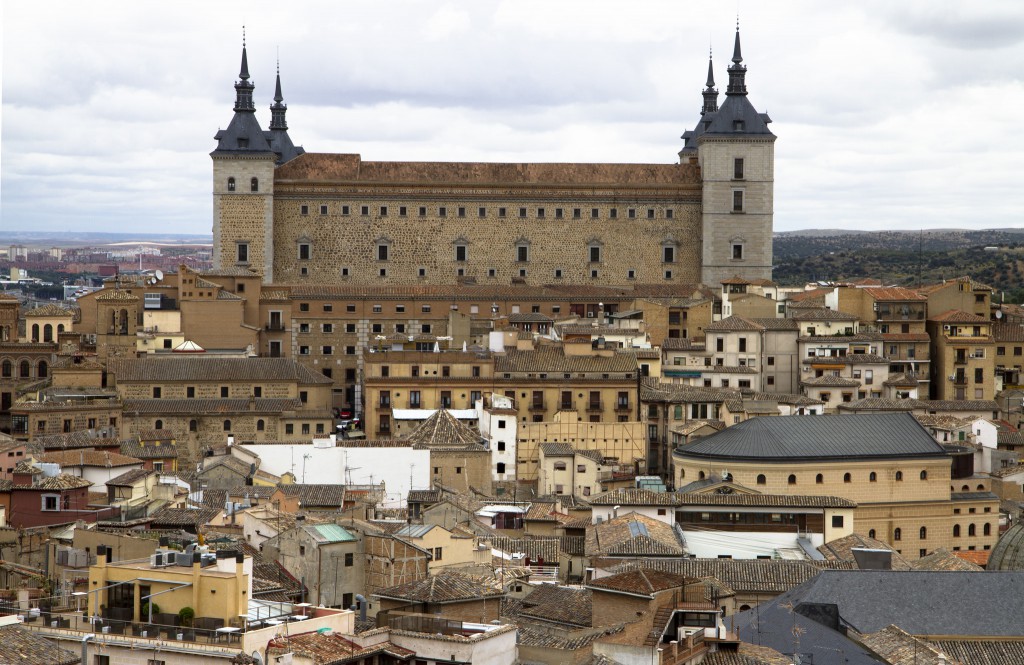
Toledo is a walled city on a hill above the River Tagus, about 70 kilometres from Madrid. Christians, Muslims and Jews lived side by side here for centuries, and a Gothic cathedral, a 10th-century mosque and two synagogues stand within a few minutes’ walk of each other. This post describes the old town and three of its main monuments, with prices and opening hours for 2026 and the practical details of the trip from Madrid.
The city of the three cultures
The historic quarter of Toledo is a UNESCO World Heritage Site. It keeps the street plan it had in the Middle Ages: a maze of narrow lanes that climb and drop inside the city walls. Three of the old gates, Bisagra, Cambrón and Sol, are still in use.
The oldest standing monument is the mosque of Cristo de la Luz, which dates from the year 999 and was later consecrated as a church. The former Jewish quarter has two synagogues: Santa María la Blanca, the oldest in the city, and El Tránsito, which now houses the Sephardic Museum. The Christian legacy includes the cathedral, the Monastery of San Juan de los Reyes, built to honour the Catholic Monarchs, and the Alcázar, the fortress that dominates the skyline.
Toledo was once an Imperial City, and it is closely tied to the painter El Greco, who lived and worked here. A museum in the Jewish quarter is devoted to him, and his paintings hang in the cathedral and in the church of Santo Tomé. The city is also known for its crafts. Shops still sell swords and damascened metalwork.
Toledo Cathedral
The history of the Cathedral of Toledo, Primate of Spain, begins in 1226, when King Ferdinand III laid the first stone with Archbishop Rodrigo Jiménez de Rada. It stands on the site of a Visigothic basilica and of the city’s Great Mosque. Building went on for more than two centuries, and the cathedral was consecrated in 1493. In 2026 the cathedral marks its eighth centenary with exhibitions, music and a jubilee year.
The style is Gothic, inspired by French models, with later Renaissance, Baroque and Neoclassical additions. The church has five naves and measures 120 metres long and 59 metres wide, and its roof rests on 88 columns. The stained glass dates from the 14th, 15th and 16th centuries. Things to look for inside:
- the altarpiece of the main chapel, made between 1497 and 1504, with scenes from the New Testament
- the choir, with upper stalls by Alonso de Berruguete and Felipe Vigarny
- the Transparente, a Baroque work by Narciso Tomé
- the Custodia, a monstrance by Enrique de Arfe
- the Sacristy, with The Disrobing of Christ by El Greco and paintings by Goya, Raphael, Titian and Caravaggio
The cultural visit is open Monday to Saturday from 10:00 to 18:30 and on Sundays from 14:00 to 18:30. Access closes 30 minutes earlier. The cathedral is closed to visitors on 1 January and 25 December, and hours are shorter on some feast days. The basic ticket costs €12. The reduced ticket costs €8 and applies to people aged 65 and over, youth card holders and students up to 18 years old, among others. Children aged 8 to 14 pay €6 and younger children enter free. The entrance for visitors is the Puerta Llana on Calle Cardenal Cisneros.
The Church of Santo Tomé
The church of Santo Tomé dates from the 12th century and was completely rebuilt at the start of the 14th century by order of Gonzalo Ruiz de Toledo, Lord of Orgaz. Its tower is one of the best examples of the Mudéjar style in Toledo: the two upper sections are of brick, with windows framed by horseshoe and lobed arches.
Most visitors come for one painting. The Burial of the Count of Orgaz, by El Greco, shows the burial of the nobleman who rebuilt the church, and his remains lie here. The painting is displayed in a room of its own. The parish gives the opening hours as 10:00 to 18:45 from 1 March to 15 October and 10:00 to 17:45 from 16 October to 28 February. The address is Plaza del Conde 4.
The Synagogue of Santa María la Blanca
Santa María la Blanca was the main synagogue of Toledo. It is a Mudéjar building of 1180 with five naves separated by pillars that carry horseshoe arches. In the 15th century it was converted into a church. Today it is a monument open to visitors, with a coffered wooden ceiling and an altarpiece by the school of Berruguete. It stands at Calle de los Reyes Católicos 4, in the Jewish quarter.
Tickets and the tourist wristband
Santo Tomé and Santa María la Blanca belong to a group of seven monuments that share a ticket system. In October 2026 a single ticket costs €4 and the Toledo tourist wristband, which covers all seven, costs €14. The other five are the Monastery of San Juan de los Reyes, the mosque of Cristo de la Luz, the Jesuit church of San Ildefonso, the church of El Salvador and the Real Colegio de Doncellas Nobles. The towers of the Jesuit church give one of the best views over the city. The cathedral is not part of the wristband.
Getting there and getting around
The city’s tourist office gives these details:
- Train: Avant high-speed trains leave Madrid-Atocha about once an hour and take 25 minutes.
- From the railway station: the old town is about 20 minutes on foot, using the escalators at Plaza del Granadal. City buses 5, 511, 61 and 62 go to Plaza de Zocodover, and a ticket costs €1.40. Buses do not take card or phone payments, and drivers do not accept notes above €5. A taxi to Zocodover costs about €6.
- Coach: buses leave Madrid’s Plaza Elíptica every 30 minutes. The direct service takes one hour.
- Car: parking in the historic centre is almost entirely reserved for residents. The tourist office recommends the free open-air car parks outside the walls, 15 to 20 minutes’ walk from the centre.
A day is enough for the cathedral and two or three other monuments. Staying overnight leaves time for the Mirador del Valle, the viewpoint across the river, and for the city after dark. Local food includes carcamusas, migas and marzipan.
For students
Toledo is one of the easiest day trips from Madrid, and the 25-minute train makes it possible even on a free afternoon. Bring a student or youth card for the reduced price at the cathedral. Those thinking of a longer stay can look at the Toledo city page and at the post on the El Greco Museum.
More about: Toledo · All blog posts