Toledo Train Station, Toledo, Spain
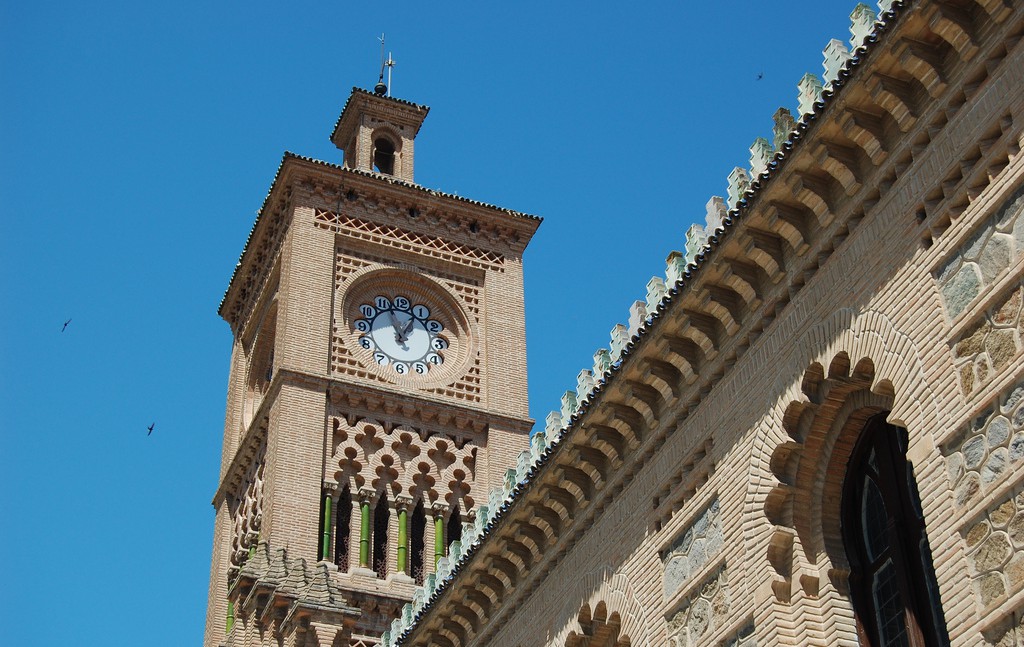
Most visitors who come to Toledo by rail from Madrid arrive at the Estación de Ferrocarril de Toledo, at the end of Paseo de la Rosa. The station is a listed monument in its own right, built in the Neo-Mudéjar style in the early 20th century. This post describes the building and its history and gives the practical details for 2026: trains from Madrid, and how to get from the platform to the old town.
History of the station
The railway reached Toledo in 1858. According to the heritage catalogue of the regional government of Castile-La Mancha, the first station was built in 1859 and was a small, simple building. From 1916 it was replaced by the present station, designed by the architect Narciso Clavería and opened by King Alfonso XIII.
The station was declared a Bien de Interés Cultural (asset of cultural interest) in the category of monument; the declaration was published in the regional gazette on 18 December 1991. It is still a working station and is now served by high-speed trains from Madrid.
The building
The station lies outside the city walls, on the plain of the river Tagus. It is a terminus: trains enter and leave only on the east side. The regional catalogue gives its area as 12,600 square metres.
Clavería designed it in the Neo-Mudéjar style, which looks back to the medieval architecture of the city. The façades use brick and banded masonry, with small stone columns in several colours. Features to look for:
- The central hall. A large nave with five multifoil arches on each façade, front and back, rising through both storeys.
- The ceiling. A large coffered wooden ceiling with inlay and marquetry work.
- Tiles and ironwork. Ceramic tiles cover the lower part of the walls, and the grilles, railings and lamps are of iron.
- The clock tower. A square brick tower of five sections on the left of the façade, decorated with multifoil arches and with a clock on each of its four sides.
- The platform canopy. It rests on cast-iron columns typical of the period.
- The fence. The iron fence around the grounds is the work of the Toledo smith Julio Pascual.
Three smaller detached buildings stand beside the main one, in the same style. Other buildings in the city are described in The Architecture in Toledo.
Trains from Madrid
High-speed Avant trains run between Madrid-Atocha and Toledo. Toledo’s tourist office states that they leave about once an hour and take 25 minutes. Times and prices are on the Renfe website; the tourist office does not publish a fare. Background on the Madrid end of the journey is in the post on Estación de Atocha.
The alternative is the bus. ALSA services leave the Plaza Elíptica interchange in Madrid every 30 minutes. Direct buses take 1 hour, and services with stops take 1 hour 30 minutes. They arrive at Toledo’s bus station, which is a different building, about 12 minutes on foot from the old town.
From the station to the old town
The station is separated from the old town by the Tagus. Spain’s official tourism site puts it about 2 kilometres, or a 25-minute walk, from the cathedral. There are three ways to cover the distance:
- On foot. About 20 minutes to the centre, using the escalators at Plaza del Granadal, according to the tourist office’s travel questions page.
- By city bus. Lines 5, 511, 61 and 62 stop outside the station and go to Plaza de Zocodover, in the centre. A single ticket costs €1.40 in 2026. The buses do not take cards or phone payments, and the driver does not accept notes larger than €5 for a single journey.
- By taxi. There is a rank at the station door. The fare to Plaza de Zocodover is about €6.
The tourist office also lists a left-luggage service opposite the station, at Paseo de la Rosa, 88, and a free open-air car park on Paseo de la Rosa with 150 spaces.
For students
The short journey makes Toledo an easy day trip for anyone studying in Madrid, and the station itself is a useful first stop for students of architecture or art history. Carry some coins or small notes for the city bus. A guide to the city’s monuments is in The City of Toledo, and schools and courses there are listed on the Toledo city page.
More about: Toledo · All blog posts