Palacio Arzobispal, Toledo, Spain
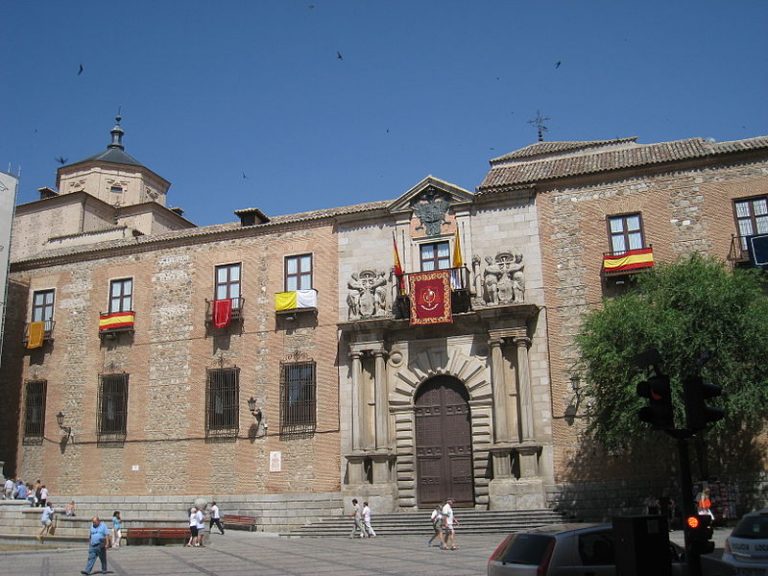
The Palacio Arzobispal (Archbishop’s Palace) stands opposite the cathedral in the old town of Toledo and closes one side of the Plaza del Ayuntamiento. This post covers its history, what to look for on each of its façades, and how to fit it into a visit to the city.
History
The palace was not built in one campaign. The regional heritage description, published in Spain’s official gazette, calls it one of the largest buildings in Toledo and says that several artistic styles are layered in it.
In the 13th century King Alfonso VIII gave Archbishop Rodrigo Jiménez de Rada some houses in front of the cathedral. Later archbishops enlarged the site step by step, and the palace took shape gradually. In the second half of the 15th century Cardinal Mendoza built the first arco de palacio, a covered passage that joins the palace to the cathedral across the street. An arch still links the two buildings.
From 1541 the palace was remodelled in depth to designs by Alonso de Covarrubias, the architect who also worked on the Puerta de Bisagra. A further remodelling followed at the end of the 18th century under Cardinal Lorenzana.
In 1996 the regional government opened proceedings to declare the palace a bien de interés cultural in the category of monument, the highest level of heritage protection in Spain.
The main façade on Plaza del Ayuntamiento
The main façade faces the Plaza del Ayuntamiento. It was begun in 1543, in the time of Cardinal Tavera, to a design by Covarrubias. The doorway has these parts:
- a large round arch in granite, framed by heavy cushioned blocks
- two pairs of fluted columns with Ionic capitals, standing on tall bases
- a Doric frieze carried by the columns
- pairs of nymphs at each end, holding the coat of arms of Cardinal Tavera
The doorway was moved to its present position at the beginning of the 17th century. Shortly afterwards a wide balcony with a plain iron railing was added above it. The balcony is flanked by double pilasters and topped by a triangular pediment with a coat of arms bearing a two-headed eagle.
The east and north façades
The east façade belongs to Cardinal Lorenzana’s remodelling at the end of the 18th century. It is symmetrical and regular. Its tall doorway is a round arch framed by pilasters of large cushioned blocks, and it leads through a vaulted passage to the courtyard. The rest of the wall is plain stone and brick on a high ashlar base, in three storeys. The lowest has straight-topped windows and the second has balconies with triangular pediments.
The north façade is the entrance to the chapel, which was built at the end of the 18th century. Its doorway has two levels. Below, a round arch with rosettes in the spandrels is framed by Doric half-columns and a frieze of triglyphs. Above, a smaller level holds a niche with a statue of the Immaculate Conception.
Seen as a whole, the palace is a complex group of rooms that look outward through many windows and are joined inside by corridors.
Visiting
The palace is a working building. The Archdiocese of Toledo gives its address as Calle Arco de Palacio, 3, a street named after the arch. Toledo’s tourist board does not list the palace among the museums and monuments with opening hours, so visitors see it from outside. A walk around it takes about 15 minutes.
The best view of the main doorway is from the Plaza del Ayuntamiento, which the palace shares with the town hall and the west front of the cathedral. The cathedral is the natural visit to combine with it. In 2026 the basic ticket for the cathedral costs €12, and the visit is open Monday to Saturday from 10:00 to 18:30 and on Sunday from 14:00 to 18:30.
Getting there
Toledo is 25 minutes from Madrid-Atocha by Avant high-speed train. From Toledo station the walk to the old town takes about 20 minutes with the escalators. City buses run from the station to Plaza de Zocodover for €1.40, and the Plaza del Ayuntamiento is a short walk from there through the old streets.
For students
For students of architecture and art history, the palace shows in one building how Renaissance and neoclassical work was added to a medieval core. The Covarrubias doorway is a good subject for a sketch or a short field report. More buildings to compare are in Monuments in Toledo, and the Toledo city page lists places to study there.
More about: Toledo · All blog posts