Puente de San Martin, Toledo, Spain
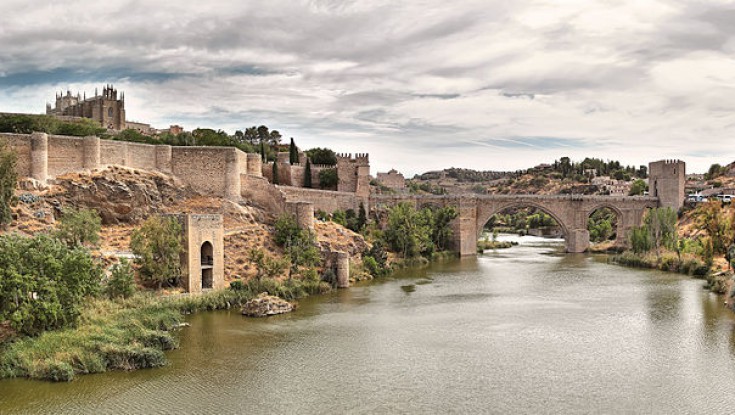
The Puente de San Martín is the medieval bridge over the Tagus on the west side of Toledo. It has five arches and a tower at each end, and it has been a National Monument since 1921. This post covers its history, what to look at on the bridge, what else is close by and how to reach it.
Where it is and why it was built
The bridge stands on the western side of the city, opposite the Puente de Alcántara on the eastern side. The city’s tourist board lists it in the Judería, the old Jewish quarter. It takes its name from the parish of San Martín, to which it belonged.
The heritage catalogue of Castilla-La Mancha describes it as a late medieval work of military architecture. Its purpose was to defend the territory of Toledo by controlling a crossing of the Tagus. It also let people and livestock pass to the lands west of the city, the Montes de Toledo.
History
The first document that mentions the bridge dates from 1301 and is a privilege granted by King Fernando IV. According to the tourist board, the bridge replaced an earlier bridge of boats near the same spot. The heritage catalogue considers it likely that the builders took the Puente de Alcántara as their model. They needed more arches because the Tagus is wider at this point.
The bridge was damaged in the fighting between Pedro I of Castile and his half-brother Enrique de Trastámara. Around 1355 Pedro I is said to have set fire to its gates, and in 1368 it was damaged again. Archbishop Pedro Tenorio had it restored. Around 1390 he built a large central arch and the two crenellated towers at the ends.
Inscriptions on the bridge record a restoration in 1690, during the reign of Carlos II. The roadway was paved around 1760, which ended the works.
What to look at
The bridge is built of ashlar stone. It has five slightly pointed arches, and the central one is much larger than the others.
- The western tower, or Torre del Campo, is the one farthest from the city and dates from the 14th century. It has a hexagonal plan and four interior spaces covered by ribbed brick vaults, with a portcullis in the centre. A sculpture of San Julián and several inscriptions are on its inner face.
- The eastern tower, or Torre de la Ciudad, stands at the city end. The heritage catalogue gives it a pentagonal plan and calls it simpler than the other, while the tourist board describes both towers as hexagonal. The side facing the city has a small altarpiece with an image of the Virgin. The opposite side carries the coat of arms of the city between two seated kings.
- The deck between the towers has the same width all along, except for one wider section that works as a viewpoint over the river and rests on three cutwaters.
Close to the bridge
The Monasterio de San Juan de los Reyes is in the same Judería area, at Calle Reyes Católicos 17. The Catholic Monarchs had it built to commemorate the battle of Toro (1476), to a design by Juan Guas. According to the tourist board in 2026, it opens every day from 10:00 to 16:45, closes on 1 January and 25 December, and costs €4. The ticket is included in the tourist wristband (Bono Pulsera Turística) of €14.
The Puerta del Cambrón, on Paseo de Recaredo, was the main entrance to the Jewish quarter. It was rebuilt in the second half of the 16th century and has a double gate and four towers.
Getting there
The tourist board publishes no opening hours or ticket price for the bridge itself.
The Avant high-speed train from Madrid-Atocha runs about once an hour and takes 25 minutes to Toledo. ALSA buses leave Plaza Elíptica in Madrid every 30 minutes. City buses cost €1.40 per ticket and do not take card or mobile payment.
One of the two sets of escalators up to the historic centre is on Paseo de Recaredo. It runs from 7:00 to 23:00 from Monday to Thursday, and from 8:00 to 23:00 on Sundays and public holidays. The streets of Toledo are steep and cobbled, so comfortable shoes are advisable.
Students who want to stay longer can look at the Toledo city page or at the language courses in Spain.
More about: Toledo · All blog posts