Puerta de Alfonso VI, Toledo, Spain
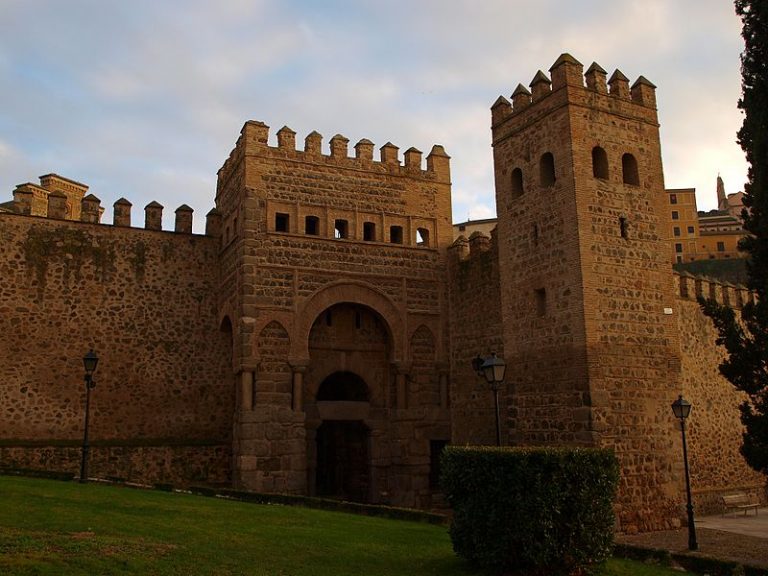
The Puerta de Alfonso VI, also called Puerta Vieja de Bisagra (old Bisagra gate), is a medieval gate in the north wall of Toledo. It was the main entrance to the Islamic city and is far less visited than its 16th-century neighbour. This post covers its history, its architecture and the practical details of a visit. It is one of the monuments in Toledo that can be seen at any time from the street.
Two names
The regional heritage catalogue of Castilla-La Mancha explains both names. “Vieja de Bisagra” marks the gate as older than the Puerta Nueva de Bisagra, built very close by in the 16th century. It also recalls the original name, written “Bib-xacra” in 12th-century documents, which means “gate of the Sagra”, the plain north of Toledo.
The second name refers to King Alfonso VI. According to tradition, he rode through this gate when he took the city from its Muslim rulers in 1085.
History
The heritage catalogue dates the gate to the 10th century and says its builders reused the remains of earlier buildings. The upper part was altered in Mudejar style, not before the 13th century. Spain’s official tourism site gives an earlier date, the 9th century, so the exact age is best treated as approximate.
While Toledo was under Muslim rule, this was the main way into the city from the Vega, the low ground beside the Tagus. After the new Bisagra gate was built, the old one stayed shut and was opened only on special occasions. It slowly fell into neglect until it was restored and reopened in 1905. The long closure had one useful effect: according to the tourism site, the front is preserved practically in its original state.
The gate has been listed as a Bien de Interés Cultural since 1921. The tourism site describes it as the only surviving part of the Arab wall.
What to look at
The gate has a rectangular plan. The details below follow the heritage catalogue.
- The north front has a horseshoe arch crossed by a lintel, set inside a second arch of brick framed by an alfiz, the rectangular moulding around an arch. The catalogue compares the design to the gates of Córdoba of the 9th and 10th centuries.
- The upper part is a row of six brick openings, each framed by an alfiz, under a flat roof protected by battlements.
- The masonry comes from several periods: reused Visigothic blocks and columns in the lower and middle parts, brick of Arab origin in the vaults and inner arches, and Mudejar rubble with bands of brick in the walls.
The old post on this page described a triumphal arch, round towers and a large imperial coat of arms. Those belong to the Puerta Nueva de Bisagra, not to this gate.
Getting there and visiting
The gate is on Calle Alfonso VI, a short walk west of the Puerta Nueva de Bisagra along the outside of the wall. It stands in the open, and the sources list no ticket and no opening hours. Ten to fifteen minutes is enough to see both sides.
Toledo is less than 80 kilometres from Madrid. According to the Toledo tourist board, the Avant train from Madrid-Atocha takes 25 minutes, and ALSA buses leave Plaza Elíptica every 30 minutes, with a direct journey of one hour. The walk from the train station to the old town takes about 20 minutes and from the bus station about 12 minutes. A city bus ticket costs €1.40 in 2026, paid in cash. The public escalators of Paseo de Recaredo, which carry visitors up into the old town, open at 7:00 from Monday to Friday.
For students
For students of art history or architecture, the two Bisagra gates make a good pair: an Islamic-period gate with horseshoe arches and reused Visigothic stone beside a Renaissance gate built as a show of imperial power. Both can be seen in under an hour and at no cost. The history of Toledo gives the background, and the Toledo city page lists study options in the city.
More about: Toledo · All blog posts