Puerta del Sol, Toledo, Spain
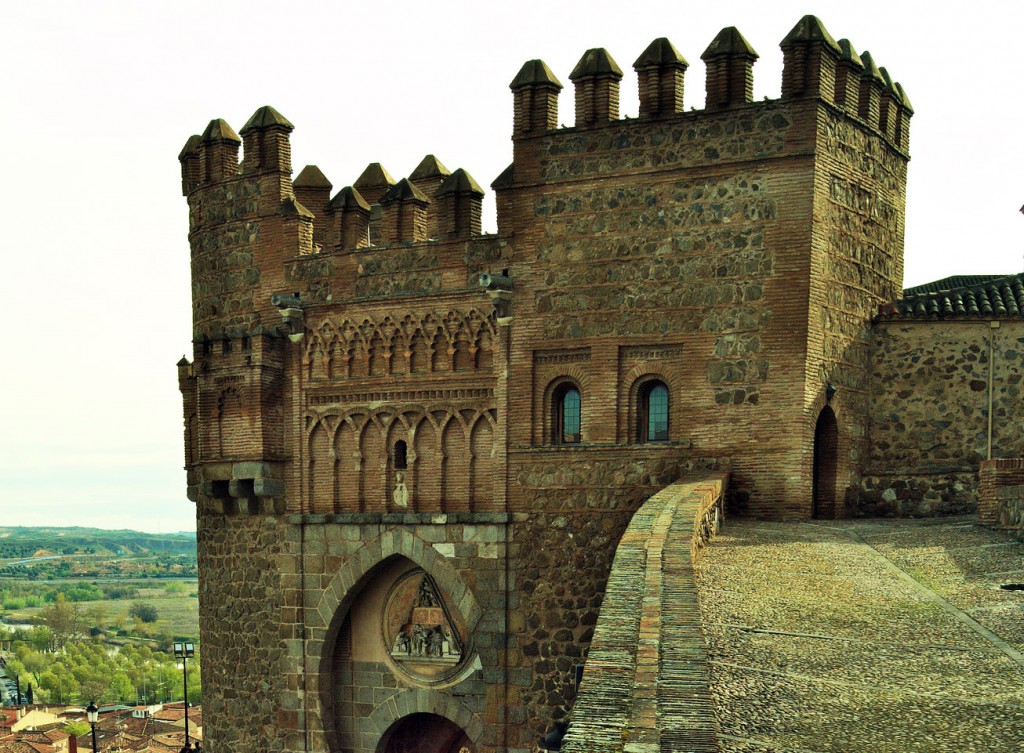
The Puerta del Sol is a fortified gate on the north side of Toledo, on the road that climbs from the Puerta de Bisagra to Plaza de Zocodover. It is one of the best examples of Toledo’s Mudejar brickwork. This post covers its history, the details to look for and the practical side of a visit. Other gates and bridges are described in monuments in Toledo.
History
The sources do not fully agree on who built the gate. Spain’s official tourism site calls it the gate of the Knights Hospitaller and says they built it in the 13th century as an entrance to the walled city. The heritage catalogue of Castilla-La Mancha tells a longer story and dates the present building to the 12th to 14th centuries:
- A simple tower of large stone blocks, attached to the Roman wall, already stood here in the 1st century AD.
- In the Islamic period it became a strong square tower.
- In the last third of the 14th century, under Archbishop Pedro Tenorio, it appears as one of the most important gates into the city.
- In the 16th century the governor Gutiérrez Tello added the large marble medallion to the north front.
- In the 17th century the figures of the Sun and the Moon were painted on it. The present name comes from them.
The gate was declared a protected monument in 1878 and is listed today as a Bien de Interés Cultural.
What to look at
The gate has a central section between two towers. One tower is rectangular and built into the wall; the outer one is semicircular, with machicolations, the projecting galleries from which defenders could drop missiles.
- The arches. The main front faces north. A large pointed horseshoe arch, framed by an alfiz, encloses a second, smaller horseshoe arch of Islamic type.
- The brickwork. Above the arches runs a panel of interlaced blind arches in brick, typical of Toledo’s Mudejar style. The lower parts and the jambs use large granite blocks from earlier periods.
- The medallion. The marble relief shows the Virgin placing the chasuble on Saint Ildefonsus, a scene that is also the emblem of Toledo Cathedral.
- The sarcophagus. Among the blind arches are the remains of an early Christian sarcophagus of the 4th century.
- The defences. The gate keeps its portcullis, a heavy metal grille ending in points.
Inside, the gate has two levels and a flat roof ringed with battlements. The catalogue describes the roof as a viewpoint over the Arrabal quarter. The sources consulted give no opening hours for the interior, so plan to see the gate from the street.
Getting there and visiting
The address is Calle Carretas. The gate stands in the public street, with no ticket and no closing time. According to the tourism site it is about 300 metres from the Puerta de Bisagra and 200 metres from both the church of Santiago del Arrabal and the Mosque of Cristo de la Luz. Fifteen minutes is enough for the gate itself.
The Mosque of Cristo de la Luz, built in 999, is the natural second stop. In 2026 the Toledo tourist board lists a ticket price of €4 and opening hours from 10:00 to 17:45, every day except 1 January and 25 December. Check the hours before going, as they change with the season.
Toledo is less than 80 kilometres from Madrid. The Avant train from Madrid-Atocha takes 25 minutes, and ALSA buses leave Plaza Elíptica every 30 minutes, with a direct journey of one hour. From the train station the walk to the old town takes about 20 minutes; from the bus station it takes about 12 minutes. A city bus ticket costs €1.40, paid in cash.
For students
The Puerta del Sol shows several layers of the city in one building: reused stone from earlier periods at the base, Islamic arches, Mudejar brick and a Renaissance medallion. That makes it a compact case study for students of art history. It lies on the usual walking route from the stations to the centre, so it adds no time to a day trip. The Toledo city page lists schools in the city.
More about: Toledo · All blog posts