The Transit Synagogue, Toledo, Spain
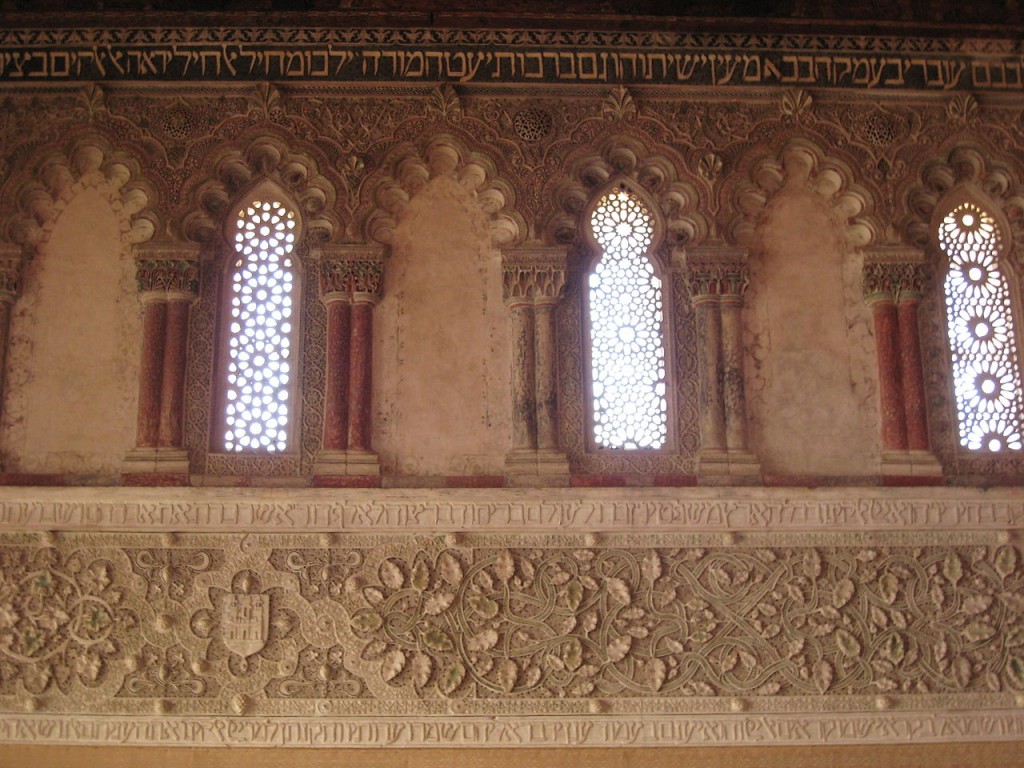
The Transit Synagogue, in Spanish the Sinagoga del Tránsito, is the popular name of the Synagogue of Samuel ha-Leví in Toledo’s old Jewish quarter. Built in the 14th century and decorated in the Mudejar style, it now houses the Museo Sefardí (Sephardic Museum), a state museum about the history of the Jews in Spain. This post covers the building’s history, what the museum shows, and the opening hours and prices published in 2026.
A synagogue built by the king’s treasurer
The synagogue was commissioned by Samuel ha-Leví, who held several high posts at the court of King Pedro I of Castile, including judge, diplomat and royal treasurer. The Red de Juderías de España, the network of Spanish cities with Jewish quarters, dates the construction to between 1355 and 1357. Spain’s official tourism website calls it the most important example of Hispano-Jewish art.
After the expulsion of the Jews in 1492, the Catholic Monarchs gave the building to the Order of Calatrava. Two years later it became part of the Priory of San Benito. The rabbinical school and the Women’s Gallery were turned into a hospital and home for knights of the order, and the prayer hall became a church and burial place.
How it came to be called El Tránsito
In the 16th century the building became a church only. A Plateresque doorway to the sacristy and a niche for an image of the Virgin were added, and the Women’s Gallery was walled up and used as a dwelling. In the 17th century the church of San Benito became popularly known as El Tránsito, after the painting The Transit of the Virgin by Juan Correa de Vivar that hung over the altar. The painting is now in the Museo Nacional del Prado in Madrid.
During the Napoleonic wars the synagogue served as a military barracks, and it deteriorated for most of the 19th century. It was declared a National Monument in 1877. In 1910 it was entrusted to the board of the Museo del Greco, led by the Marquis of Vega-Inclán, who restored it. The Museo Sefardí was created by decree in 1964 and opened to the public in 1971. Today it belongs to Spain’s Ministry of Culture.
What to see
The visit starts in the Prayer Hall, the main space of the synagogue. Its walls carry Mudejar plasterwork with geometric and floral motifs and inscriptions in Arabic and Hebrew, under a carved wooden ceiling. The museum treats the synagogue itself as the main piece of its collection.
The permanent exhibition then follows the history of the Jews in the Iberian Peninsula:
- Room I: the origins and traditions of the Jewish people
- Room II: the arrival of the Jews in Roman Hispania
- Room III: Jews in the Christian kingdoms from the 12th to the 15th century, including converts, the Inquisition and the expulsion
- Room IV: the Sephardim, the descendants of the Jews expelled from Spain
- Room V, the Women’s Gallery: the life cycle and festivals of the Jewish community, with Sephardic objects, language and literature
- North courtyard: gravestones from different parts of Spain, laid out as a necropolis
- East courtyard: results of the archaeological excavations on the site
Featured pieces named by the museum include a Hebrew Bible, a Scroll of Esther, a marriage contract and a trilingual basin. A free multimedia guide works on visitors’ own phones over the museum’s wifi, and a free app for iOS and Android includes routes, plans and audio description.
Visiting: hours, prices and how to get there
The Museo Sefardí is at Calle Samuel Leví. It opens Tuesday to Saturday from 9:30 to 20:00 and on Sundays and public holidays from 10:00 to 15:00. The ticket desk closes 15 minutes earlier. The museum is closed on Mondays, on 1 and 6 January, 1 May, 24, 25 and 31 December and on one local holiday.
The general ticket costs €3 and the reduced ticket €1.50. Entry is free on Saturdays from 14:00 and on Sundays. With proof, it is free at any time for under-18s, over-65s, university students aged 18 to 25 and holders of a youth card. A pass for the Museo Sefardí and the nearby Museo del Greco costs €5 and is valid for five days. Individual tickets are sold only at the museum’s ticket desk.
From March to June the museum is busy. It recommends visiting from 9:30 to 11:00 or from 15:00 to 17:00.
From Toledo’s train and bus stations, city buses run to Plaza de Zocodover; the single ticket costs €1.40 and is paid in cash. The museum is in the Jewish quarter of the old town. The post on La Judería describes the neighbourhood, and Spanish courses and schools in the city are on the Toledo city page.
More about: Toledo · All blog posts