Hospital de Santa Cruz, Toledo, Spain
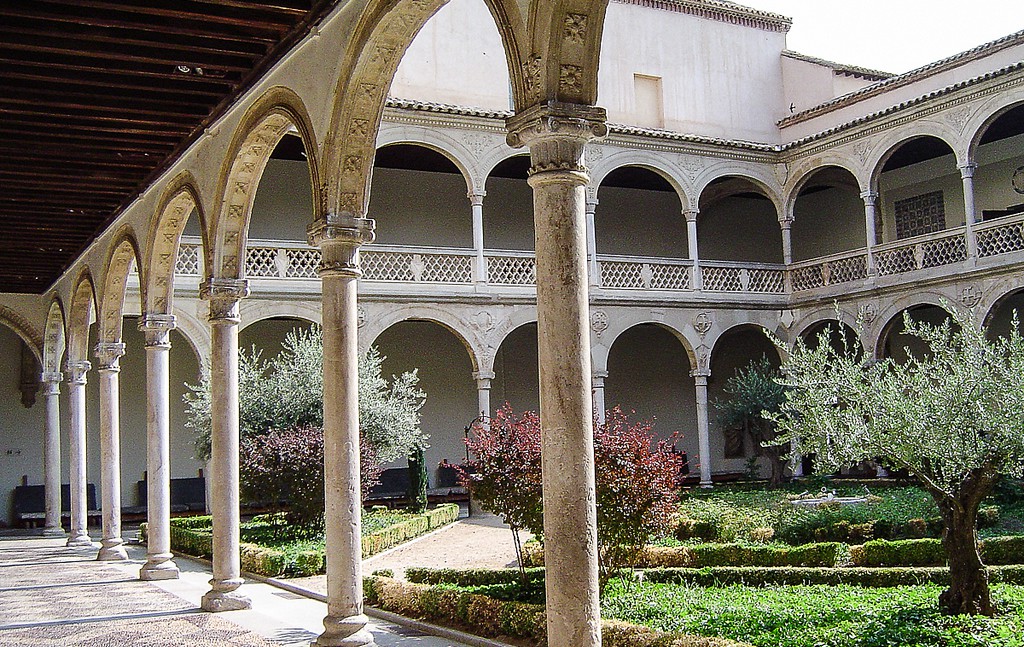
The Hospital de Santa Cruz is a Renaissance building a few steps from Plaza de Zocodover in Toledo. It was founded as a hospital by Cardinal Mendoza and today houses the Museo de Santa Cruz, a museum of archaeology, fine arts and decorative arts run by the regional government of Castilla-La Mancha. This post describes the building and the collections, and explains what is open in 2026, when part of the museum is closed for building works.
A hospital founded by Cardinal Mendoza
The museum takes its name from the old Hospital de Santa Cruz. Cardinal Pedro González de Mendoza (1428-1495) founded it as a general hospital and as a home for abandoned children. The building went up in the first decades of the 16th century, after the founder’s death. The museum describes it as one of the masterpieces of Spanish Renaissance architecture.
The plan is a Greek cross on two floors, with a large central crossing open to both levels. The halls are covered with wooden ceilings, and two cloistered courtyards sit between the arms of the cross. Antón and Enrique Egas, Toledo architects of Flemish origin, and Alonso de Covarrubias worked on the design and construction.
Three parts of the building are singled out by the museum as worth the visit on their own:
- the Plateresque main doorway, dedicated to the Holy Cross
- the main cloister
- the staircase by Covarrubias in the main courtyard
The collections
Spain’s official tourism website describes three sections in the Museo de Santa Cruz:
- Archaeology: objects from the Roman, Visigothic, Arab and Mudejar cultures
- Fine arts: Toledo painting of the 16th and 17th centuries, with works by artists such as El Greco
- Industrial arts: popular culture and local craft traditions in ceramics, glass, textiles, ironwork and goldsmithing
The museum’s own list of essential pieces gives an idea of the range. It includes a mosaic of the four seasons, a cistern well-head, the banner of the Battle of Lepanto, a bust of Juanelo Turriano, an altarpiece of the Immaculate Conception and Saint Veronica with the Holy Face.
What is open in 2026
Since 2 April 2024 the lower and upper crossings and the open storage area have been closed while the floor structure of the crossing is reinforced. In October 2026 the museum’s website still lists these areas as closed. The temporary exhibition hall, the Sala Carranza and the Covarrubias cloister remain open, so a visit currently centres on the cloister, the staircase and the temporary exhibitions. Check the museum’s page before going to see a particular work.
Hours and prices
The museum opens Monday to Saturday from 10:00 to 18:00 and on Sundays from 09:00 to 15:00. Last admission is 15 minutes before closing. It is closed on 1, 6 and 23 January, 1 May and 24, 25 and 31 December.
In October 2026 the museum lists admission as temporarily free. The regular prices are €4 for the general ticket and €2 for the reduced one. Under the regular prices, entry is free on Wednesdays from 16:00 and on Sundays, and at any time for under-18s, over-65s, students aged 18 to 26 and holders of a youth card, with proof.
The museum also has a library specialised in history and art. Its books can be consulted on site, not borrowed, from 10:00 to 14:00.
Getting there
The address is Calle Miguel de Cervantes, 3, next to Plaza de Zocodover. City buses 5, 511, 61 and 62 run from Toledo’s train station to Zocodover; the ticket costs €1.40 and is paid in cash. On foot, the old town is about 20 minutes from the station using the escalators.
The Alcázar is a short walk away, and other sights are covered in the post on monuments in Toledo. Schools and courses in the city are listed on the Toledo city page.
More about: Toledo · All blog posts