Segobriga Archaeological Park, a prominent city during the Roman Empire in Spain
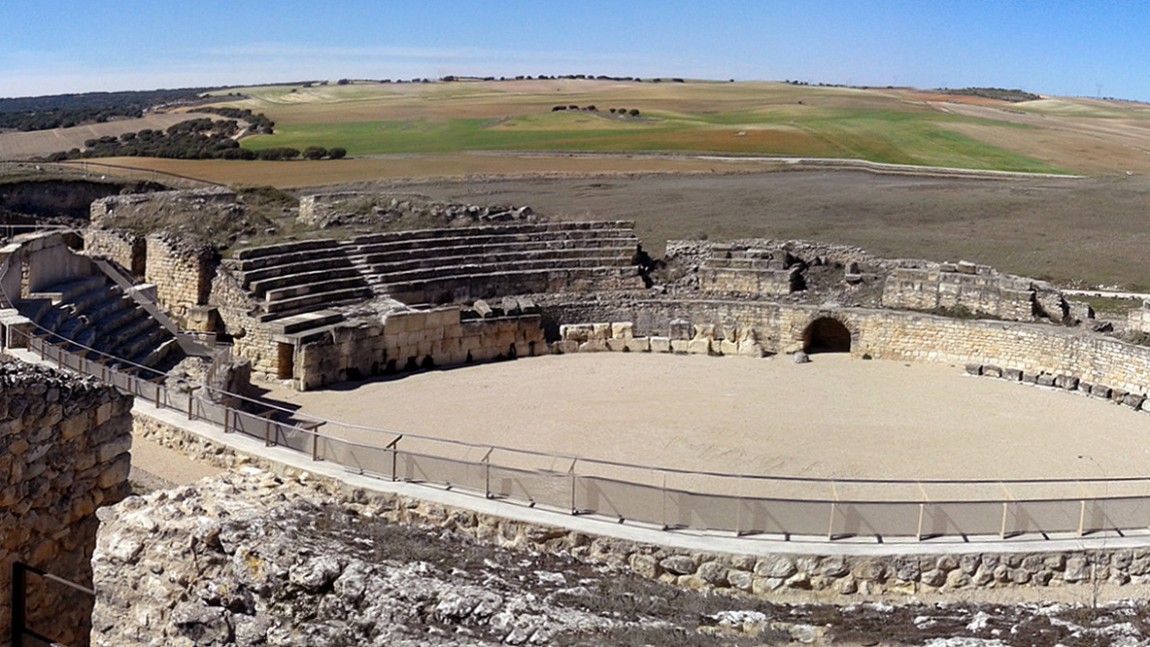
Segóbriga is a Roman city on a hill near the village of Saelices, in the province of Cuenca. No later town was built on top of it, so the theatre, amphitheatre, forum, baths and walls can be seen in their original setting. This post explains what the Segóbriga Archaeological Park contains, how the city rose and declined, and what a visit costs and when the park opens in 2026.
From Celtiberian hill fort to Roman city
The site began as a Celtiberian hill fort. After the Roman conquest at the start of the 2nd century BC it became a town, and after the Sertorian Wars, around 70 BC, it controlled a wide territory as the capital of this part of the Meseta. Under Augustus it became a municipium, a town of Roman citizens. Its wealth came from its position at a crossing of roads and from the mining of lapis specularis, a translucent gypsum used to glaze windows.
Segóbriga was still an important town in Visigothic times, and its bishops attended the Councils of Toledo between 589 and 693. The decline began in the Islamic period. After the Christian conquest the population moved to the present village of Saelices and the hill became known as Cabeza del Griego. The ruins were declared a national historic monument in 1931 and the archaeological park opened to the public in 2002.
What to see
A circular route starts and ends at the Interpretation Centre at the entrance and takes in 16 buildings and open spaces. The main ones are:
- Theatre. One of the smallest in Roman Spain, inaugurated around AD 78 under the emperor Vespasian. The seating was divided into three sections that separated the social classes.
- Amphitheatre. Built under Vespasian opposite the theatre. It has an irregular elliptical shape, is 75 metres long and held 5,500 spectators.
- Walls and north gate. The wall ran for 1,300 metres and was built around 50 BC. The north gate was the monumental entrance to the forum.
- Forum and basilica. The forum was a nearly square plaza with a double colonnade on three sides, laid out around 15 BC. The basilica on its eastern side housed business deals and the magistrates’ courts.
- Monumental baths. Built in the 1st century AD for bathing, leisure and business, they were the largest baths in the city.
- Circus. Built in the mid-2nd century AD for chariot races, with a track 400 metres long and 74 metres wide.
- Visigothic basilica. Outside the walls, surrounded by a large cemetery. It was the first building on the site to be excavated, in 1789.
Opening hours and prices in 2026
The park opens from Tuesday to Sunday. According to the park’s own visitor page, the 2026 timetable is:
- 1 October to 31 March: 10:00 to 18:00, last entry at 17:00
- 1 April to 30 June and 13 August to 30 September: 10:00 to 19:30, last entry at 18:30
- 1 July to 12 August: 9:00 to 15:00, last entry at 14:00
It is closed on Mondays (except national public holidays), on 1 January and on 24, 25 and 31 December.
General admission costs €6. The reduced ticket costs €3 and applies, among others, to students up to 25 years old, holders of a youth card and people over 65. Children under 8 enter free. Individual visitors also enter free on Tuesday and Friday afternoons from 16:00 (except public holidays); between 1 July and 12 August, when the park closes at 15:00, the free day is Wednesday.
Planning the visit
The park is in the municipality of Saelices, about 4 km south of the village, on the road from Carrascosa de Campo to Villamayor de Santiago. The park estimates 2 to 4 hours for the whole route, and visitors must stay on the paved paths. An audio guide is available in English and Spanish. Eating is not allowed inside the archaeological area, but there are picnic areas. Groups of more than 15 people need a reservation. The information desk answers on 629 75 22 57.
For students
Segóbriga shows a complete Roman town plan, and it combines well with a visit to the walled city of Cuenca, the provincial capital. Background on Roman Spain is in the post on the Roman legacy of Spain. Study options in the province are listed on the Cuenca city page.
More about: Tourism in Spain · All blog posts