The Remarkable Walled City of Cuenca
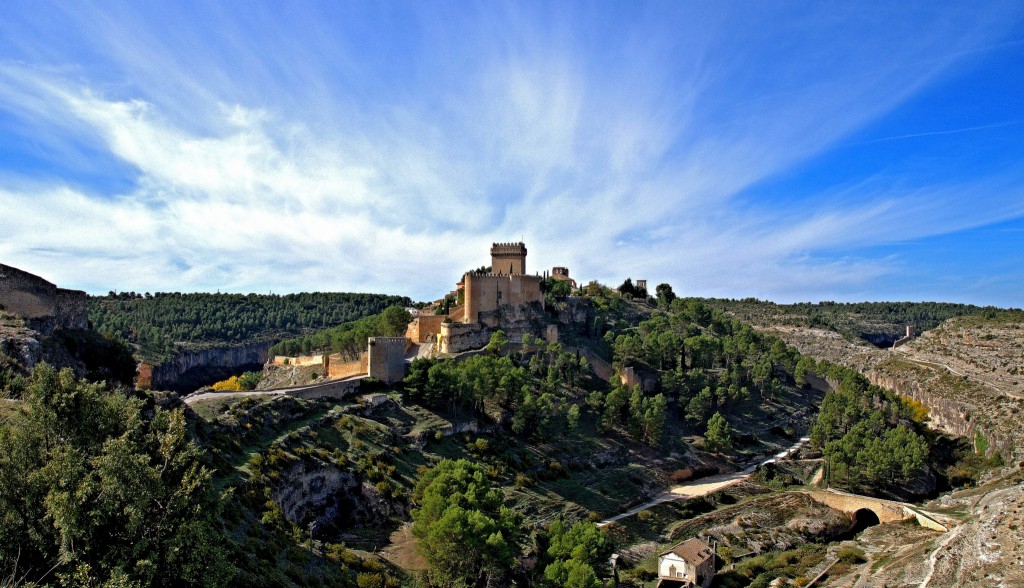
Cuenca is the capital of the province of the same name in Castilla-La Mancha. Its old town stands on a ridge of rock between the gorges of the Júcar and Huécar rivers, and some of its houses are built right on the edge of the drop. This post describes the main sights of the old town, the museums and their opening hours, and how to reach the city from Madrid.
A World Heritage city between two gorges
UNESCO added Cuenca to the World Heritage List on 6 December 1996. The city’s tourist office gives the reasons: the original townscape and the medieval fortress are well preserved, and the old town holds civil and religious buildings from the 12th to the 18th centuries.
The usual route on foot goes up to the Plaza Mayor, with the arcaded Town Hall and the cathedral, and continues to the Castillo district at the top, where there are viewing points over the gorge.
The Hanging Houses and the Puente de San Pablo
The Casas Colgadas (Hanging Houses) are the best-known buildings in the city. Their balconies project over the Huécar gorge. Their origin is not known exactly: some date them to the Muslim period and others to the 14th or 15th century. The group consists of three former mansions, which for a time served as the town hall and were fully restored in the 1960s. One of the houses, the Casa de la Sirena, holds a restaurant, and two hold the Museum of Spanish Abstract Art.
The classic view of the houses is from the Puente de San Pablo, the iron footbridge across the gorge. A stone bridge was built here in the 16th century to link the town with the Convent of San Pablo, and it was demolished at the end of the 19th century. The present bridge opened on 19 April 1903. It is 40 metres high and 110 metres long. The convent at the far end is now a Parador hotel.
Museum of Spanish Abstract Art
The Museo de Arte Abstracto Español was founded by the artist Fernando Zóbel in 1966. In 1980 he donated his collection to the Fundación Juan March, which has run the museum since. It shows paintings and sculptures by Spanish abstract artists such as Antoni Tàpies, Antonio Saura, Eduardo Chillida and Pablo Serrano.
Entry is free. In 2026 the museum opens Tuesday to Friday and on public holidays from 10:00 to 14:00 and 16:00 to 18:00, on Saturdays from 10:00 to 14:00 and 16:00 to 20:00, and on Sundays from 10:00 to 14:30. It is closed on Mondays. The last admission is 20 minutes before closing.
The cathedral
The cathedral stands on the Plaza Mayor. The tourist office calls it the Catedral de Santa María y San Julián. Building began at the end of the 12th century, after the Christian conquest of the city, and the core dates from the 13th century. The style is Gothic with clear French influence. The plan is a Latin cross with a seven-sided polygonal apse, and the triforium survives from the original structure.
The façade is not medieval. An 18th-century front had to be pulled down at the start of the 20th century, and the present neo-Gothic façade is by the architect Vicente Lampérez. Inside, look for the neoclassical main altar designed by Ventura Rodríguez, the iron grilles that close the chapels and the Arco de Jamete that leads to the cloister.
Other museums
- Museo de Cuenca (Calle Obispo Valero 12): archaeology of the province on three floors, including sculpture from the Roman cities of Segóbriga, Valeria and Ercávica. Open Tuesday to Saturday from 10:00 to 14:00 and 16:00 to 19:00, and Sundays and holidays from 10:00 to 14:00. Closed on Mondays.
- Museo de las Ciencias de Castilla-La Mancha (Plaza de la Merced): a science museum with an astronomy section and a planetarium.
- Fundación Antonio Pérez (Ronda de Julián Romero 20): contemporary art in more than 30 rooms, with works by Manuel Millares, Gustavo Torner and Andy Warhol, among others.
Getting there and what to eat
High-speed trains link Madrid’s Atocha station with Cuenca in less than an hour, according to Spain’s official tourism website. They stop at the Fernando Zóbel station, about 6 kilometres from the centre, which is connected to the bus and coach station by city bus route 1. High-speed trains also connect Cuenca with Valencia and Alicante. Coaches from Madrid’s Estación Sur take just over two hours and arrive at the station on Calle Fermín Caballero, next to the centre.
Local dishes include morteruelo (a meat dish), ajoarriero (a cod dish), the liqueur resolí and alajú, a dessert.
Students based in Madrid can see Cuenca in a day, and the abstract art museum costs nothing. Those who want to stay longer can look at the Cuenca city page or browse schools in Spain.
More about: Tourism in Spain · All blog posts