Torres Kio, Madrid, Spain
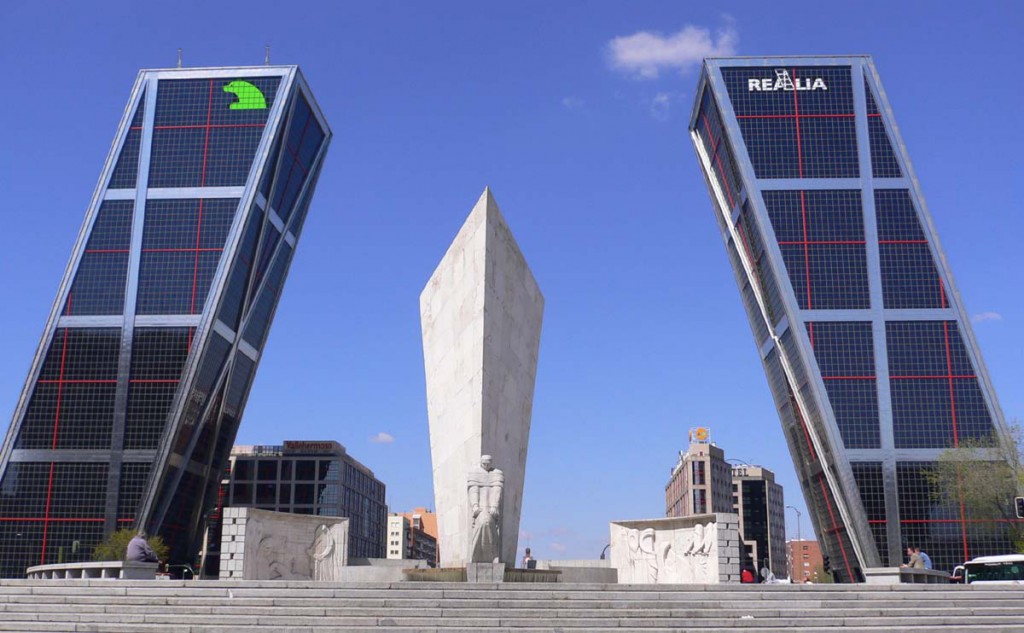
The Torres Kio, officially the Puerta de Europa (Gate of Europe), are two leaning office towers on Plaza de Castilla in the north of Madrid. This post explains what they are, how they were built, what else stands nearby on the Paseo de la Castellana and how to reach them. The towers are office buildings and are seen from the street; the Madrid tourist board lists no visiting hours or admission.
What the Torres Kio are
The two towers face each other across the Paseo de la Castellana and lean towards one another, so that together they form a kind of gateway over the avenue. The official name, Puerta de Europa, comes from that shape. The popular name comes from KIO, the main shareholder of the group that developed the project.
According to the Madrid tourist board, each tower is 115 metres high and leans at an angle of 14.3 degrees. The bases are square, with sides of 35 metres. The towers are symmetrical with respect to the axis of the Castellana.
Design and construction
Construction started in 1990, to a design by the New York studio John Burgee Architects, and finished in the autumn of 1995. Each tower has three basements, a ground floor, an equipment floor and 24 office floors. The roof of each tower holds a heliport.
The lean shapes the inside of the buildings. Eight lifts serve the upper floors, but four of them reach only the 13th floor. Every floor is different from the others, because its limits shift with respect to the central lift core. The façades combine glass, aluminium and stainless steel. The steel forms the bright bands that make the towers easy to recognise from a distance.
What is nearby
Plaza de Castilla lies on the northern stretch of the Paseo de la Castellana, the long avenue that runs through Madrid’s business districts. A walk along it takes in several groups of tall buildings:
- Next to the towers on Plaza de Castilla is the Canal Foundation, which usually holds exhibitions.
- To the north, the Castellana ends at the Cuatro Torres Business Area, built between 2004 and 2008 on the former Real Madrid sports grounds. A fifth tower, Caleido, was inaugurated in 2021.
- To the south is AZCA, the financial complex with the Torre Picasso and Torre Europa, and near it the Santiago Bernabéu stadium.
Seen together, these three points show how Madrid’s skyline grew northwards. The Torres Kio are the middle step between the AZCA towers and the Cuatro Torres. For the older side of the city, see the post on monuments in Madrid.
How to get there
The address is Paseo de la Castellana, 189-216, 28046 Madrid.
- Metro: Plaza de Castilla (lines 1, 9 and 10) is at the square. Chamartín (lines 1 and 10) is also close.
- Cercanías suburban trains: Madrid-Chamartín station.
- Bus: many city lines stop at the square, among them 5, 27, 42, 49, 66, 67, 70, 147 and 149.
- BiciMAD: the public bike-share scheme has a docking station at Paseo de la Castellana, 216.
Plaza de Castilla also has a bus station with regional lines to towns north of Madrid, such as lines 720 and 724 to Manzanares El Real, so the towers are an easy stop before or after a day trip to the mountains.
For students
The towers take a few minutes to see and cost nothing. They are useful as a reference point in the north of the city, close to Chamartín, one of Madrid’s two main railway stations. Architecture and engineering students can combine them with AZCA and the Cuatro Torres in a single trip on metro line 10, which serves Nuevos Ministerios and Santiago Bernabéu for AZCA, Plaza de Castilla, and Begoña for the Cuatro Torres. Information on studying in the city is on the Madrid page, and the directory lists schools in Spain.
More about: Madrid · All blog posts