Biblioteca Nacional de España, Madrid
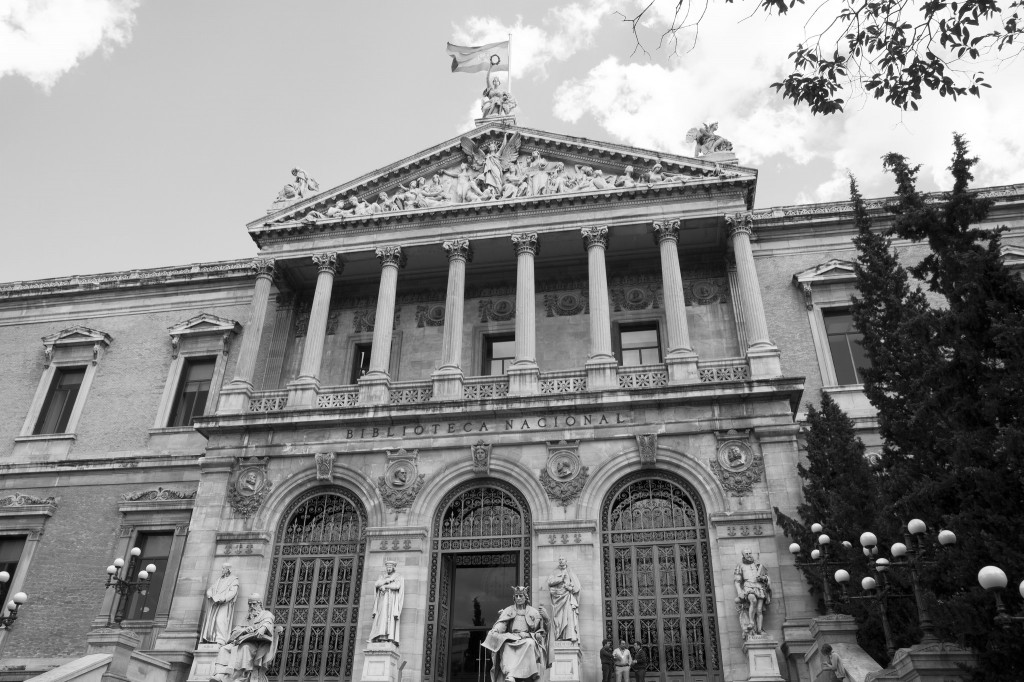
The Biblioteca Nacional de España (BNE, National Library of Spain) stands on the Paseo de Recoletos in central Madrid, next to Plaza de Colón. It keeps a copy of every book published in Spain and is the country’s main bibliographic institution. This post covers its history, the building, what a visitor can see without a reader’s card, opening hours and how to get there.
History
The library was created in 1711 by Philip V, the first Bourbon king of Spain, as the Real Biblioteca Pública (Royal Public Library). It opened its doors to the public on 1 March 1712. In 1716 a royal privilege obliged printers to deposit in the library a copy of everything printed in Spain. That privilege is the origin of legal deposit, which today is regulated by Law 23/2011 and also covers electronic publications and websites.
In 1836 the library passed from the Crown to the Ministry of the Interior of the time (Ministerio de la Gobernación) and was renamed Biblioteca Nacional. During the 19th century it grew with the libraries of nobles and scholars and with collections that came from the confiscation of church property. The name Biblioteca Nacional de España dates from 2009. The library is now governed by its own law, Law 1/2015, which sets out its history and functions.
The BNE has two sites. The building on the Paseo de Recoletos opened to the public in 1896. A second site in Alcalá de Henares was inaugurated in 1993.
The building
The library occupies a rectangular neoclassical building between the Paseo de Recoletos and Calle Serrano. According to Spain’s official tourism website, work on it began in 1866 and was completed in 1892. The main façade has a broad exterior staircase and a Corinthian portico topped with sculptures by Agustín Querol. The National Archaeological Museum is directly alongside.
What to see
The reading rooms are for registered users: consulting the collections requires a reader’s or researcher’s card. The collections include incunabula, manuscripts, prints, drawings, photographs, maps, sound recordings and scores. The library also holds the national newspaper and periodicals collection (Hemeroteca), part of which has been digitised since 2007 and can be read online.
Visitors without a card can see the exhibition rooms, which are open to the public. The permanent exhibition is El Infierno y las Maravillas (The Inferno and the Wonders), on floor -1. It was inaugurated on 27 February 2024 and replaced the former library museum. Its four rooms follow the history of writing and books, from the first alphabets to digital memory, using pieces from the library’s own collections. The name refers to the “inferno”, the place where libraries used to keep their forbidden books. Temporary exhibitions are held in other rooms.
Practical information
The details below are those published by the Madrid tourist board in 2026. Check before a visit, because exhibition hours can change.
- Address: Paseo de Recoletos, 20-22.
- Admission: free.
- Library and reading rooms: Monday to Friday, 9:00 to 20:00. Users are advised to request documents in advance.
- Exhibitions, including the permanent one: Monday to Saturday, 10:00 to 20:00; Sundays and public holidays, 10:00 to 14:00.
- Guided visits of the building are offered; conditions and booking are on the library’s website.
- Metro: Colón and Serrano (line 4). Cercanías suburban trains: Recoletos station.
- Bus: lines 1, 5, 9, 14, 19, 21, 27, 37, 45, 51, 53, 74 and 150.
- Accessibility: access for people with reduced mobility from the ground floor, lifts, and two wheelchairs available.
Allow about an hour for the permanent exhibition and the façade, or longer with a temporary exhibition.
For students
Students who need the collections for research can apply for a reader’s or researcher’s card; the library also offers remote services, bibliographic information and inter-library loans. For everyone else, the free exhibition is a short stop that combines well with the Archaeological Museum next door and other museums in Madrid. The second site is in Alcalá de Henares. Degree programmes in the capital and elsewhere are listed under universities in Spain.
More about: Madrid, Tourism in Spain · All blog posts