Cerro de los Ángeles, Madrid, Spain
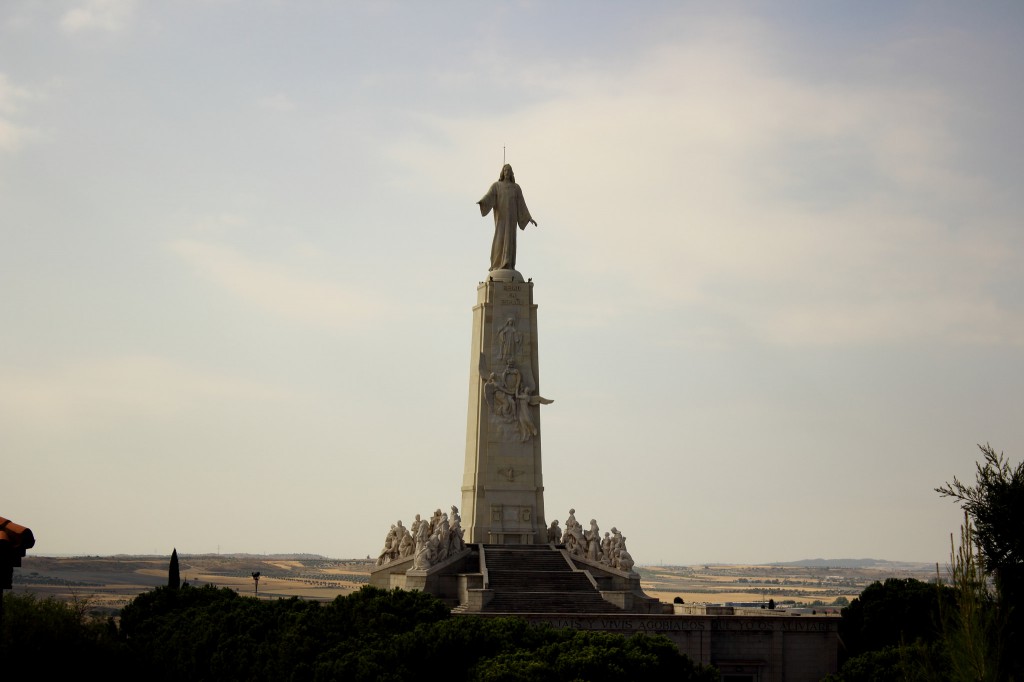
The Cerro de los Ángeles is a hill in Getafe, south of Madrid, traditionally regarded as the geographic centre of the Iberian Peninsula. On top stand a large monument to the Sacred Heart of Jesus, a basilica, a 17th-century hermitage and a Carmelite convent, surrounded by woods and a picnic area. This post explains what is there and how to visit in 2026.
Why the hill matters
The sanctuary describes the hill as the central point of the map of the peninsula, and it takes its name from the hermitage of Nuestra Señora de los Ángeles. It is a place of pilgrimage for Spanish Catholics and also a green space used by people from Getafe and the south of Madrid for walks and picnics. The sanctuary’s address is kilometre 13.5 of the A-4 motorway (Carretera de Andalucía).
The hermitage of Nuestra Señora de los Ángeles
According to the sanctuary, a modest hermitage was first built here after Alfonso VI took Madrid, on a watchtower site that was already considered the centre of Spain. That building was destroyed at the end of the 14th century and the present one was later raised on the same spot. Getafe town council dates the construction of the hermitage to 1610, and the wooden image of the Virgin venerated inside is from the same year.
The hermitage has a single nave 36 metres long and 11 metres high, built of limestone and exposed brick, with slate-covered spires. Nuestra Señora de los Ángeles is the patron of Getafe and of its diocese.
The monument to the Sacred Heart
The first monument was the joint work of the architect Carlos Maura Nadal and the sculptor Aniceto Marinas. King Alfonso XIII inaugurated it on 30 May 1919. It was destroyed on 7 August 1936, in the first weeks of the Spanish Civil War.
The monument seen today is a larger replica. Work began in 1944 to a design by the architects Pedro Muguruza and Luis Quijada Martínez. The statue of Christ with open arms, again by Aniceto Marinas, is 11.50 metres tall and stands on a pedestal of 26 metres. It was inaugurated in 1965. Four groups of sculptures by Fernando Cruz Solís stand around the base, with figures a little more than twice life size.
The monument rests on a church, now a basilica, that did not exist in the first project. Its crypt was inaugurated in 1975. The church has a square plan of 42.40 by 42.40 metres and three naves of equal width. In front of it lies a rectangular esplanade of 130 by 80 metres, laid out for large pilgrimages.
The Carmelite convent
The convent of Discalced Carmelites on the hill was founded in 1924 by Saint Maravillas de Jesús, who left the convent at San Lorenzo de El Escorial with three other nuns to start the new community. The nuns still live here. The convent has a small shop that sells handicrafts and souvenirs, and Mass is said in its church at 8:30.
Visiting in 2026
- Grounds: the perimeter of the hill, including the picnic area and the woods, is open until 21:30; the sanctuary’s home page gives 8:00 as the opening time
- Basilica: open from 9:00 to 21:15
- Mass in the basilica: Monday to Saturday at 12:30 and 19:30; Sundays at 10:00, 11:30, 13:00 and 19:30
- Information booth: open from Wednesday to Sunday in the morning
- By bus: line 447 from Legazpi in Madrid stops at the foot of the hill; from there it is a walk up to the sanctuary
- By train: the Cercanías stations Getafe Industrial and El Casar are the nearest, but the sanctuary warns that the walk from them is long
The sanctuary’s timetable page offers a leaflet in English, a plan of the site and an audio guide for mobile phones. Visitors who are not attending a service should avoid walking around the basilica during Mass.
For students
The hill is a half-day outing from Madrid that needs little planning: a bus ride and a walk up to the esplanade. It also gives a compact lesson in 20th-century Spanish history, since the same monument was built, destroyed and rebuilt within fifty years. Other places within reach of the capital are listed in the post on villages in the Madrid area, and the Madrid page covers studying in the city.
More about: Madrid · All blog posts