Casón del Buen Retiro, Madrid
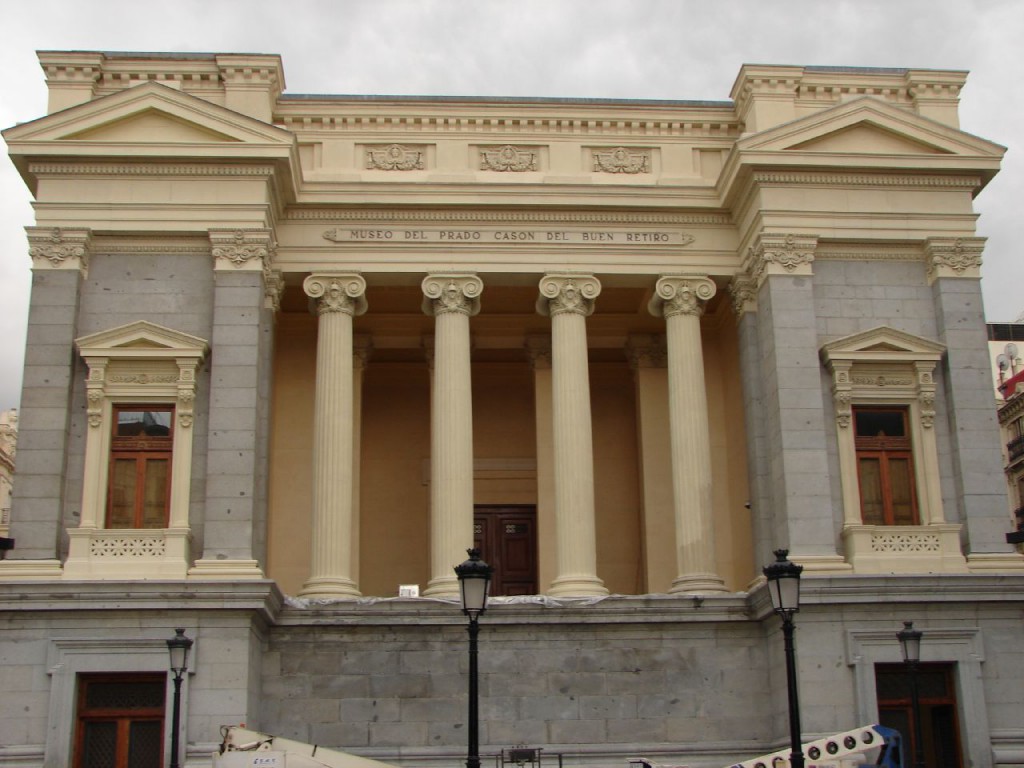
The Casón del Buen Retiro is a 17th-century building opposite El Retiro Park in Madrid. It belongs to the Museo del Prado and today holds the museum’s study centre and art library, under a ceiling painted by Luca Giordano. This post explains what the building was, what it holds now, and how to get in, either as a library reader or on the guided visit to the vault.
From palace ballroom to museum building
The Casón was built in 1637 to a project by the architect Alonso Carbonell. It was the ballroom of the Palacio del Buen Retiro, the royal palace whose gardens became today’s park. According to Madrid’s official tourism website, it is one of only two buildings that survived the destruction of that palace, and it takes its name from it.
The main façade, which faces west, is later: it was designed by Ricardo Velázquez Bosco, the architect of the Palacio de Cristal and the Palacio de Velázquez inside the park.
For several decades the Casón displayed the Prado’s collection of 19th-century painting, around 3,000 works. It also showed Picasso’s “Guernica” after the painting arrived from the United States. In 1992 “Guernica” moved to the Museo Reina Sofía and the Casón closed for a long renovation. The most recent restoration, by Jaime Tarruel, was completed in 2007. The 19th-century paintings are no longer shown here.
The Luca Giordano vault
The main reason to go inside is the ceiling of the former ballroom. Luca Giordano (1634-1705) painted it in fresco in the 1690s with the Allegory of the Golden Fleece. The subject honours the Spanish monarchy under the last king of the Spanish Habsburgs. It recalls the founding of the Order of the Golden Fleece by the dukes of Burgundy, an order that King Carlos I brought to Spain.
The tourism website suggests that the value of this ceiling is why the Casón was kept when the other remains of the palace disappeared with the building of the Jerónimos district. The restoration carried out during the renovation consolidated the original painting, of which almost 80% survives.
The Prado’s library
The reading room and an open-access reference library now occupy the old ballroom, directly under the vault. The library specialises in painting and sculpture from the Middle Ages to the 19th century, with further holdings on drawings, prints, classical sculpture and decorative arts. It holds:
- more than 100,000 books, including monographs and reference works
- 1,500 periodicals and 260 auction catalogue titles
- 7,000 volumes of prints and manuscripts produced before 1910, among them treatises on painting and architecture
Visiting: access, hours and price
There are two ways in, and both are free of extra charge.
- As a library reader. Entry is free. Use the door on Calle de Alfonso XII and show an ID card, passport or equivalent document at the security desk.
- On the guided visit to the vault. It takes place on Sundays at 12:00 and is free for visitors who hold a Prado entrance ticket. A pass is needed, handed out on the same day from 10:00 at the Jerónimos Digital Door counter of the museum, one per person. General admission to the Prado costs €15 and the concession ticket €7.50, as listed by the tourism website in 2026.
Usual library and archive hours are Monday and Wednesday 8:30 to 17:00, Tuesday and Thursday 8:30 to 14:30 and Friday 8:30 to 14:00. Reduced hours, Monday to Friday 8:30 to 14:00, apply from 1 June to 30 September, from 16 December to 15 January and at Easter. The library is closed at weekends. Madrid’s tourism website last updated these details in October 2025, so confirm them with the library ([email protected]) before a special trip.
Getting there
The address is Calle de Alfonso XII, 28. The nearest metro stations are Retiro and Banco de España (both line 2) and Estación del Arte (line 1). Cercanías trains stop at Madrid-Atocha. The main building of the Prado Museum is a few metres away, and El Retiro Park and its Palacio de Cristal are across the street.
For students
The Casón is of most use to students of art history, fine arts, conservation and related fields, who can consult a specialised collection in a reading room that is itself a work of art. Students of other subjects will get more from the Sunday guided visit combined with a Prado ticket. The Madrid city page and the list of universities in Spain show where such degrees are taught.
More about: Madrid · All blog posts