Estación de Atocha, Madrid
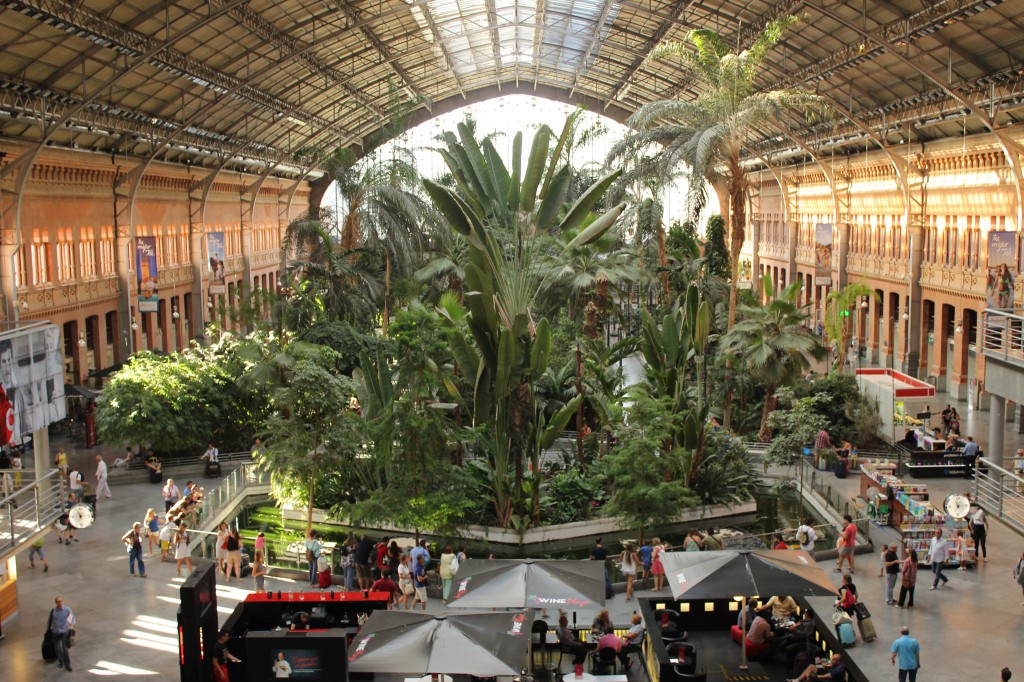
Atocha is Madrid’s largest railway station and the one most visitors use: high-speed and long-distance trains, the Cercanías commuter network and Metro line 1 all meet here, at the southern end of the Paseo del Prado. Since November 2022 its official name is Madrid – Puerta de Atocha – Almudena Grandes, after the Madrid writer who died in 2021. This post explains how the station is organised, which trains leave from it, how to reach it, and what there is to see, including the memorial to the victims of the attacks of 11 March 2004.
Two stations in one
Atocha is a complex of two stations side by side. Renfe, the main Spanish rail operator, describes them as follows:
- Madrid Puerta de Atocha – Almudena Grandes handles most long-distance and AVE high-speed trains.
- Atocha Cercanías handles the Cercanías commuter trains, Media Distancia regional trains and some long-distance trains.
The address is Glorieta del Emperador Carlos V, and the station is open every day from 5.00am to 1.00am. It has left-luggage lockers, a lost property office, shops, restaurants and paid parking. Premium toilets with showers and a nursing room can be used for €1, which is returned as a discount in the station’s shops.
Trains from Atocha
Madrid is the hub of the Spanish rail network, and its two main stations, Atocha and Chamartín, are both termini for AVE trains. The station is printed on the ticket and should be checked before setting out. Besides Renfe, the private operators OUIGO and IRYO run high-speed trains. The city’s tourist board gives these approximate journey times from Madrid:
- Zaragoza: 1 hour and 20 minutes; Barcelona: around 3 hours
- Córdoba: 1 hour and 50 minutes; Seville: 2 hours and 40 minutes; Málaga: 2 hours and 30 minutes
- Valencia: 1 hour and 35 minutes
- Marseille: a daily Renfe AVE from Puerta de Atocha, a 7-hour journey with stops in other French cities
The Cercanías network has nine lines, and all of them start from or stop at Atocha. Trains start between 5am and 6am and stop at around midnight, usually every 10 to 30 minutes. In 2026 a single ticket costs from €1.70 for one or two zones to €5.50 for seven zones. Cercanías is the simple way to reach Alcalá de Henares, Aranjuez and El Escorial, and it is faster than the Metro between Atocha and Chamartín.
Getting to the station
Metro line 1 stops at Atocha and at Estación del Arte. Many EMT buses stop outside, among them the free line 001 between Atocha and Moncloa, which runs every 7 to 8 minutes from 7am to 11.30pm. The Airport Express bus links the terminals with a stop next to the station during the day; single tickets cost 5 euros and are bought on the bus.
History and architecture
The first station opened on 9 February 1851 with Spain’s second railway line, between Madrid and Aranjuez. It was the capital’s first railway station, at first no more than a stop with a wooden platform, and it was known as the Estación del Mediodía. It was enlarged in 1865 and again in 1892.
The iron and glass roof of the central hall dates from 1892. Designed by the French engineer Henri de Saint-James, it is 152 metres long, 48 metres wide and 27 metres high. Between 1984 and 1992 the architect Rafael Moneo remodelled the complex: a new station took over the rail traffic, and the old hall became a concourse with shops, cafés and a tropical garden of more than 100 species. In 2026 the tropical garden is temporarily closed for works.
The memorial to the victims of 11 March 2004
The terrorist attacks that Madrid suffered on 11 March 2004 are remembered at Atocha. The glass cylinder that stood outside the station as a monument from 2007 to 2023 was dismantled because of the extension of Metro line 11. Its place has been taken by a space of remembrance in the hall between the railway and Metro stations, directly below the old monument. It was inaugurated on 10 March 2024, for the twentieth anniversary.
The space covers 2,000 m². Its cobalt blue walls carry the names of those who died and some of the messages from the earlier monument, and 193 lights in the ceiling stand for each of the people killed. A commemorative plaque and a black stone stand for flowers and candles were added on 10 March 2026. Entry is free, every day from 6:00 to 01:30. The Bosque del Recuerdo in the Retiro park is a second memorial to the victims.
For students
For students Atocha is mainly the place where long-distance trains arrive and where day trips by Cercanías start. Renfe points out that the Reina Sofía museum, the Prado and the Retiro park are close to the station, which makes a wait between trains easy to fill. More on studying in the city is on the Madrid city page.
More about: Madrid · All blog posts