Plaza Mayor, Madrid
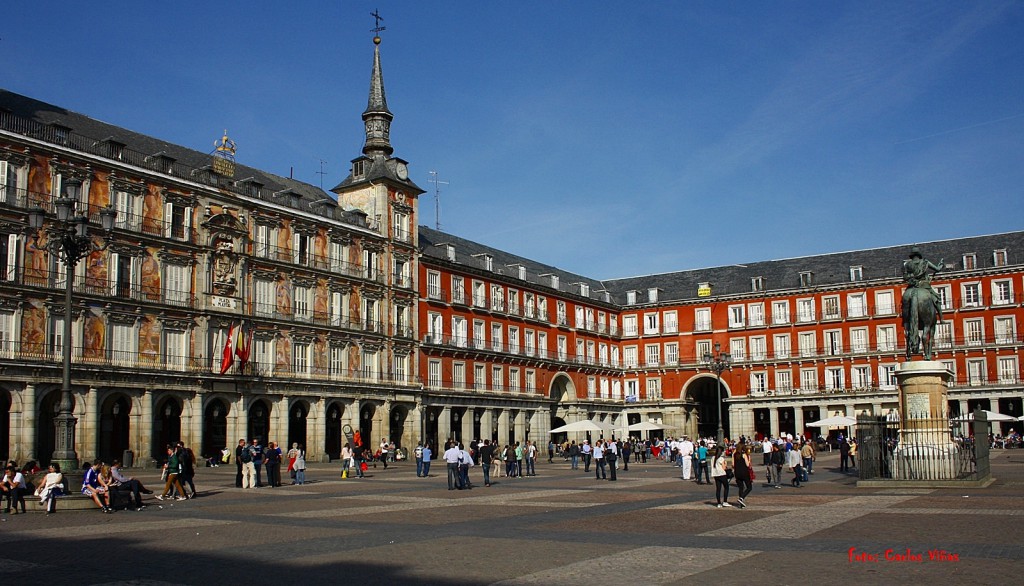
The Plaza Mayor is the large arcaded square in the oldest part of Madrid, the area known as Madrid de los Austrias (Habsburg Madrid). This post explains how the square was built, describes its main buildings, arches and statue, and gives practical details for a visit in 2026, including the tourist information centre and the Christmas market.
History of the square
The Plaza Mayor stands on the site of the former Plaza del Arrabal, where the town’s main market was held. King Philip II moved the Spanish court from Toledo to Madrid in 1561 and began to plan a remodelling of the square. The new square was only built under his son and successor, Philip III. The architect Juan Gómez de Mora designed it and gave the open space a uniform architecture. According to Spain’s official tourism website, the square was officially opened in 1620.
The square is rectangular and lined with pillars and arches. It has been used for local festivities, bullfights, processions, theatre, beatifications and coronations, and also for trials of the Inquisition and executions.
Several fires damaged the square. The worst was in 1790 and almost destroyed it. Juan de Villanueva, the architect of the Prado Museum, directed the rebuilding. He reduced the number of floors of the buildings, closed the square at its four corners and built nine arches as entrances. The square seen today is largely the result of his work.
What to see
Casa de la Panadería
The Casa de la Panadería was built by Diego Sillero around 1590. Only the cellar and the ground floor of the original building remain. It was the town’s main bakery, which set the price of bread, and it later housed royal chambers, the Real Academia de Bellas Artes de San Fernando and the Academy of History. The frescoes on the façade were painted in 1992 by the artist Carlos Franco. They show mythological figures linked to the history of Madrid, such as the goddess Cybele.
Casa de la Carnicería
On the opposite side stands the Casa de la Carnicería, with a design that is almost a copy of the Casa de la Panadería. It was the seat of the butchers’ guild and the place where meat was stored and sold. Today it houses a hotel.
Arco de Cuchilleros
The best-known of the nine arches is the Arco de Cuchilleros. Its steep steps lead down to Calle de los Cuchilleros, because the arch was built to make up for the difference in level between the street and the square. The name comes from the knife makers who had their workshops there and supplied the butchers of the Plaza Mayor.
Statue of Philip III
The equestrian statue in the centre shows King Philip III. The sculptor Giambologna started it and his disciple Pietro Tacca finished it in 1616. It first stood at the entrance to the Casa de Campo. Queen Isabella II had it moved to the Plaza Mayor in 1848.
Visiting in 2026
The square is a public space with no ticket and no opening hours. Under the arcades there are traditional shops, bars and restaurants with terraces, and street musicians and artists work in the square.
The Plaza Mayor Tourist Information Centre is in the Casa de la Panadería, at Plaza Mayor, 27. It is open 365 days a year from 10am to 8pm and its service is free. Staff give advice in several languages, and the centre has free Wi-Fi, a souvenir shop with work by local artisans and a ticket office for several municipal theatres. On 24 and 31 December it closes at 5pm, and on 25 December and 1 January it opens at 11am.
The nearest metro stations are Sol (lines 1, 2 and 3), Ópera (lines 2 and 5) and Tirso de Molina (line 1). Cercanías commuter trains stop at Madrid-Sol. There are BiciMAD bike-share stations at Calle Mayor, 6 and Calle Mayor, 16.
Events through the year
The square hosts outdoor concerts and a drum parade (Tamborrada) on Easter Sunday; the next one is on 28 March 2027. The largest event is the Plaza Mayor Christmas Market, which in 2026 runs from late November to 31 December. Its 104 stalls sell Nativity scene figures, Christmas decorations, musical instruments, toys and joke items. Entry is free. The market is open from 10am to 9pm from Sunday to Thursday and from 10am to 10pm on Fridays, Saturdays and the eves of public holidays.
For students
The Plaza Mayor is a practical first stop for a new arrival: the tourist information centre gives out advice on the city and sells the Madrid City Card. The Mercado de San Miguel is about 100 metres away, and the Puerta del Sol is a short walk in the other direction. Universities and Spanish courses in the city are listed on the Madrid city page.
More about: Madrid · All blog posts