Banco de España, Madrid
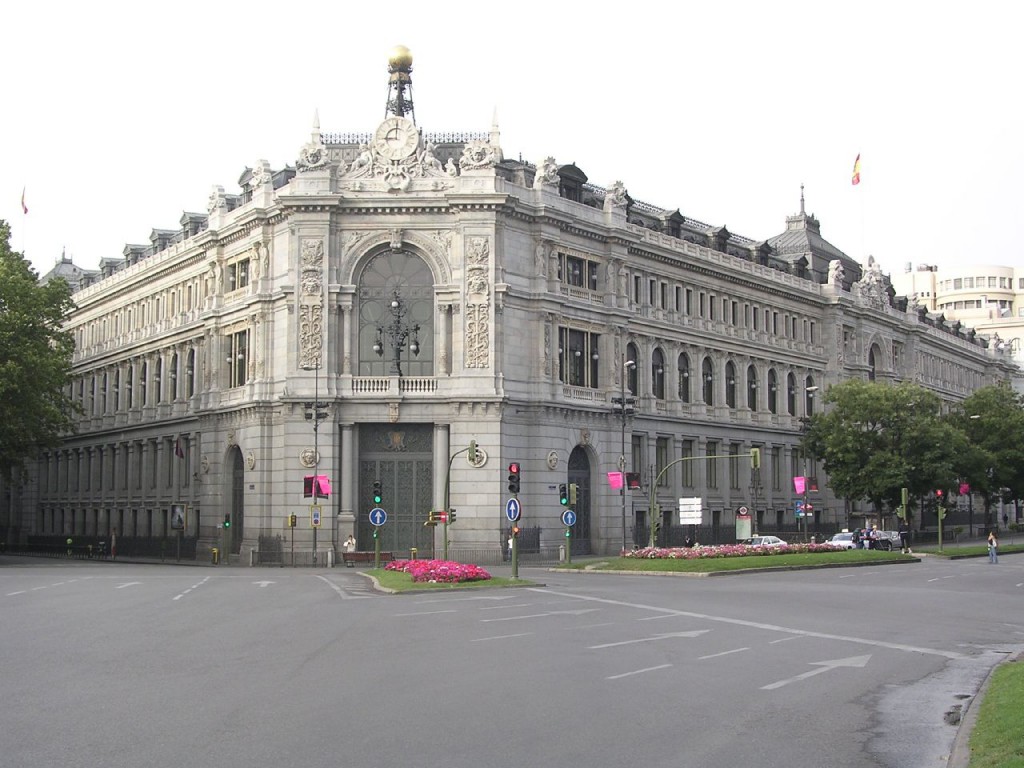
The Banco de España is Spain’s national central bank. Its head office stands on Plaza de Cibeles in Madrid, in a building opened in 1891 that is listed as a Site of Cultural Interest. This post covers the history of the bank, the building and its art, and how to visit it on the free guided tours.
What the Banco de España is
The Banco de España describes itself as a public law entity that performs the functions of a national central bank in Spain. It also supervises the Spanish banking system. It carries out these tasks as a member of the European System of Central Banks, the Eurosystem, the Single Supervisory Mechanism and the Single Resolution Mechanism. The bank has two head offices in Madrid and 15 branch offices across Spain.
History of the bank
According to the bank’s own history, the institution began as the Banco Nacional de San Carlos, founded on 2 June 1782 by a Royal Warrant signed by King Carlos III. The project came from the Count of Cabarrús. The bank had private capital divided into shares and issued the first Spanish banknotes. Wars with France and England weakened it, and the government could not repay its debt to the bank.
The main later steps were these:
- 1829: the bank waived almost 310 million reales owed by the government, and the Banco Español de San Fernando was created as a bank of issue
- 1847: the Banco de Isabel II, founded in 1844, merged with the Banco Español de San Fernando
- 1856: the Law of 28 January gave the bank its present name, and the first branch offices opened in Alicante and Valencia
- 1874: the Banco de España received the monopoly on issuing banknotes in mainland Spain and its islands
- 1962: the bank was nationalised and ceased to be a public limited company
- 1994: the Law of Autonomy made the bank independent of the government in monetary policy
- 1999: the euro became the currency of Spain and ten other EU countries on 1 January
The building on Plaza de Cibeles
The bank’s architecture pages state that the design was approved at the end of 1883 and that the first phase of building work was completed in 1891. The chief architect was Eduardo de Adaro, assisted by Severiano Sainz de la Lastra and, after his death, by José María de Aguilar y Vela. The building was listed as a Site of Cultural Interest in 1999, in the historical monument category.
The complex grew in four phases. The first extension, approved in 1927, was designed by José Yarnoz Larrosa. He built the façade on Calle Alcalá in the style of the original and added the art deco Trading Hall, which stands above the Gold Chamber. A second extension, begun in the mid-1960s by Javier Yarnoz Orcoyen, closed the building on Calle Madrazo and Calle Marqués de Cubas. In 2006 Rafael Moneo closed the block with a new corner building.
Inside, the bank highlights three parts of the original design:
- The Grand Staircase in Carrara marble
- The former Cash Hall, now the Library, with a cast iron structure made in the Mieres Factory
- The symbolist stained glass windows made by the House of Mayer in Munich
The bank also owns an art collection. Madrid’s tourist board mentions paintings by Goya, Mengs, Maella and Vicente López.
Visiting the Banco de España
The bank runs an Open Doors programme of guided tours through the most important rooms of the head office. Admission is free, but prior booking is required. The tour lasts about 90 minutes. The details published in October 2026 are these:
- Individual visits on Friday afternoons and on Saturdays and Sundays, with a first tour at 9:45 am and a last tour at 7:15 pm at weekends
- Monday tours at 4 pm and 4:45 pm led by volunteers from the bank
- A maximum of 4 tickets per booking
- Entrance at Calle de los Madrazo, 29; the bank recommends arriving 10–15 minutes early for the security checks
- Every adult must show a valid national identity card, foreign resident identity card or passport; photocopies and photos on a phone are not accepted
- Photos are allowed without flash
Places are limited and the bank has no waiting list. New dates are announced on its website.
The bank’s exhibition hall shows temporary exhibitions from its collection. The exhibition “The Pliable Plane. The Banco de España’s Textile Collection” runs from 28 September 2026 to 28 March 2027. It opens Tuesday to Saturday from 11 am to 2 pm and from 4 pm to 8 pm and is closed on Mondays. The Madrid tourist board lists admission as free, with reservation.
Getting there
The address is Calle de Alcalá, 48. The nearest metro station is Banco de España on line 2. The Cercanías stations Madrid-Recoletos and Madrid-Sol are also listed for the building. The bank stands on Plaza de Cibeles, opposite the Palacio de Comunicaciones and a short walk from the Prado Museum.
For students
The Open Doors programme includes visits for educational institutions, among them universities and vocational training centres. These take place on Wednesdays and Thursdays at 4 pm for groups of up to 35 people, and the teacher in charge makes the booking. Students of economics, history or architecture who are in the city on their own can book an individual tour. More on studying in the capital is on the Madrid city page.
More about: Madrid · All blog posts