Iglesia de Santa Bárbara, Madrid
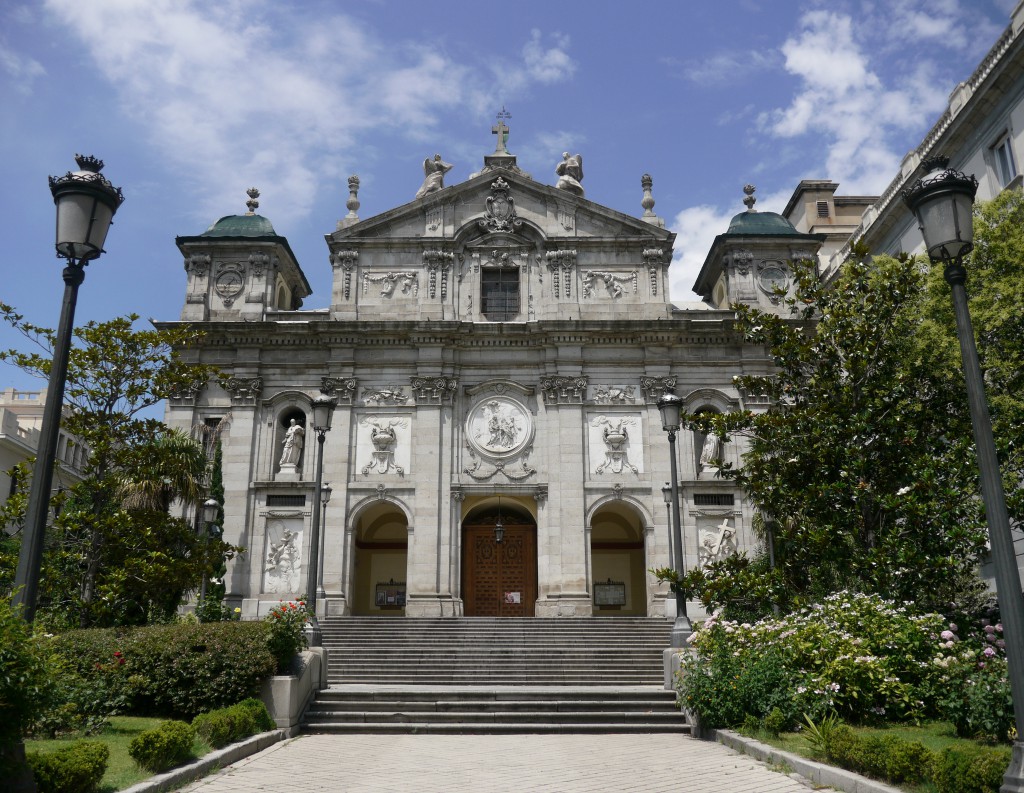
The Iglesia de Santa Bárbara is the church of the former Salesas Reales convent in central Madrid. It was founded in the 18th century by Queen Bárbara de Braganza and King Fernando VI, who are both buried in it. This post covers the history of the church, what to see inside, and the opening hours and transport.
History of the church and convent
The parish’s own history explains that the monarchs, who reigned from 1746 to 1759, had two aims. They wanted a burial place, because as they were not the parents of a king they would have no tomb in the royal pantheon of El Escorial. They also wanted to bring the Salesian nuns to Spain to educate the daughters of the nobility. The founding deed was signed on 6 December 1747 and the building work ran from 1750 to 1757.
The church and convent were designed by the French architect François Carlier. The work was supervised by the Spanish master builder Francisco Moradillo, who changed the original plan slightly. The decoration was entrusted to the Italian sculptor Gian Domenico Olivieri, a native of Carrara. A small palace for the queen was added on the other side of the convent, with a passage to the royal gallery of the church.
In 1870 the convent and school were turned into the Palace of Justice. The building is now the seat of the Supreme Court. The nuns moved to a new convent built on Calle Santa Engracia in 1880. The church stayed open for worship and, according to the Madrid tourist board, became a parish church dedicated to Saint Barbara in 1891.
What to see
A flight of steps leads up to the forecourt of the church. The present steps date from 1930 and replaced the original ones when Calle de Bárbara de Braganza was opened. The façade has a triple portico under a round relief of the Visitation of the Virgin, with sculptures by Olivieri.
The church has a single nave in the shape of a Latin cross, with a marble floor in several colours. Marble takes the place of the wooden altarpieces that were usual in Spanish churches of the time. The main points of interest are these:
- The high altarpiece, with columns of green marble around a painting of the Visitation by the Neapolitan painter Francesco de Mura
- The tomb of Fernando VI, to the right of the altar, made of porphyry and marble by Francisco Gutiérrez to designs by Francisco Sabatini
- The tomb of Queen Bárbara, in the side chapel, also designed by Sabatini and carved by Juan de León
- The tomb of Leopoldo O’Donnell, Duke of Tetuán, by Jerónimo Suñol, to the left of the high altar
- The vault paintings by the brothers Luis, Alejandro and Antonio Velázquez, with scenes from the life of Saint Francis de Sales
- Paintings by Charles Joseph Flipart, Corrado Giaquinto and Giambettino Cignaroli
The parish describes the tomb of Fernando VI as one of the main works of Spanish Neoclassicism. The queen’s tomb is in a more rococo style. Since 2002 the former crypt of the convent has been used as a columbarium.
Opening hours and admission
Entry to the church is free. The parish timetable gives these opening hours:
- Monday to Friday: 9:00 to 13:00 and 17:30 to 20:00
- Saturdays, Sundays and public holidays: 10:00 to 13:30 and 18:00 to 20:00
This is a working parish, so visitors should avoid the times of services. Mass is held at 10:30 and 19:30 from Monday to Saturday, and at 11:00, 12:00, 13:00 and 19:30 on Sundays and holy days. Half an hour to an hour is enough to see the nave, the side chapel and the tombs.
Getting there
The address is Calle de General Castaños, 2, in the Salesas district. The nearest metro stations are Alonso Martínez (lines 4, 5 and 10), Chueca (line 5) and Colón (line 4). The Cercanías station Madrid-Recoletos is also close. Plaza de Colón and the Biblioteca Nacional de España are in the same part of the city.
For students
The church costs nothing to visit and is useful for anyone studying art history or Spanish history. It shows French architecture, Italian sculpture and Spanish painting of the mid-18th century in one building. It combines well with a walk through Salesas and Chueca. More sights are listed in the post on monuments in Madrid, and study options are on the Madrid city page.
More about: Madrid · All blog posts