Iglesia de San Jerónimo el Real, Madrid
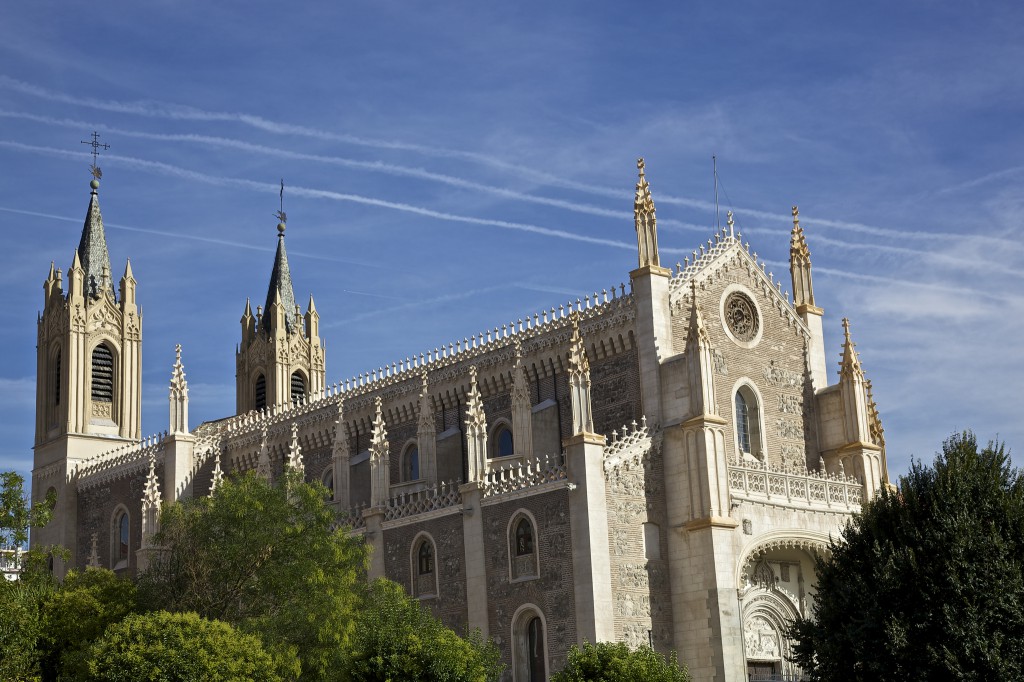
The Iglesia de San Jerónimo el Real, known in Madrid as “Los Jerónimos”, is a parish church directly behind the Museo del Prado. It is the main surviving part of a royal Hieronymite monastery that hosted the ceremonies of the Spanish Crown for centuries. This post covers its history, what to look at inside and outside, and the opening and Mass times the parish publishes in 2026.
From a riverside monastery to a royal church
According to the parish’s own history, the monastery was founded by Enrique IV of Castile, who ordered it built in 1462 near the Manzanares river and entrusted it to the Hieronymite order. In 1464 the king ordered that it be known as San Jerónimo el Real. The riverside site proved unhealthy for the monks, and a papal bull of Alexander VI in 1502 allowed the move to the present site on the east side of the city. The monks built the new monastery themselves in brick and masonry, reusing materials from the old one.
Next to the church stood the Cuarto Real, a set of royal rooms where the monarchs stayed for religious ceremonies and before formal entries into Madrid. Felipe II enlarged it with the architect Juan Bautista de Toledo. Under Felipe IV the Palacio del Buen Retiro grew up around it, and the church became the main chapel of that palace.
The nave was also used for politics. The Cortes met here, and in 1528 the future Felipe II took the oath as Prince of Asturias in the church. From then until Isabel II in 1833, every heir to the Crown was sworn in at San Jerónimo el Real.
Destruction and rebuilding
With the French invasion of 1808 the monks were expelled and the artillery of General Murat occupied the monastery. The Gothic portal, statues, altarpieces, chapels and tombs were destroyed. After the disentailment laws of 1835 the buildings served as barracks, an artillery depot and a cholera hospital.
Reconstruction of the church began in 1854 under the patronage of Francisco de Asís de Borbón, consort of Isabel II. The architect Narciso Pascual Colomer added the two towers and the exterior ornament, and the present portal and the relief in its tympanum were entrusted to the sculptor Ponzano. In 1878 the Crown handed the church and what remained of the monastery to the archdiocese, and a further restoration started in 1880.
Two later dates matter for the building. In 1906 Alfonso XIII and Victoria Eugenia of Battenberg were married here, and the monumental entrance staircase was built for the wedding. On 27 November 1975, five days after his proclamation, Juan Carlos I attended a solemn Mass in the church with heads of state from around the world. The most recent restoration, of both exterior and interior, ran from 2007 to 2011 under the architect Francisco Jurado.
What to see
- The exterior: the 1906 staircase, Pascual Colomer’s two towers and the 19th-century portal. The roofline crestings were recovered in the 2007–2011 restoration.
- The nave: a long, wide nave with a transept, an apse, large side chapels and a raised choir at the west end, all covered with rib vaults. The parish notes that this structure has not changed substantially since the monks built it.
- The high altar: the painting “La última comunión de San Jerónimo” by Rafael Tejeo, first placed here in 1829 by order of Fernando VII and returned to the high altar in the latest restoration.
- The transept: the altarpiece panels by José Méndez, a Cristo de la Buena Muerte that the parish attributes to Pedro de Mena, and a Virgen de los Dolores by Jerónimo Suñol.
- The organ: commissioned by the Royal Household for the 1906 wedding from the organ builder Ricardo Rodríguez and enlarged from 1956. It has a neo-Gothic case, three manuals and 37 stops.
The monastery cloister is no longer part of the church. It deteriorated during the 19th century and, after an agreement with the church authorities, was restored and incorporated into the Museo del Prado in 2008. It now stands beside the museum extension designed by Rafael Moneo, which holds temporary exhibitions.
Visiting: opening and Mass times
San Jerónimo el Real is a working parish at Calle Moreto 4, 28014 Madrid. The parish timetable gives these opening hours in 2026:
- 16 September to 14 June: every day, 09:30–13:00 and 17:00–19:45
- 15 June to 15 September: every day, 09:30–13:00 and 17:30–20:45
From 16 September to 14 June Mass is said from Monday to Saturday at 10:00, 12:00 and 19:00, and on Sundays and public holidays at 10:00, 12:00, 13:00, 14:00 and 19:00. In summer the weekday Masses are at 12:00 and 20:00. Visitors who come to look at the building should avoid these times and keep quiet inside. The parish also celebrates weddings in the church.
The church stands just behind the Prado. For the museum, Madrid’s tourist office lists the metro stations Banco de España (line 2), Estación del Arte (line 1) and Atocha (line 1).
For students
The church fits easily into a day in the museum district: it stands between the Prado Museum, the Casón del Buen Retiro and the Retiro park. It is a useful stop for anyone studying Spanish history or art history, because the Habsburg court, the Napoleonic occupation and the 19th-century Gothic revival can all be read in a single building. Schools and universities in the city are listed on the Madrid city page.
More about: Madrid · All blog posts