Campo del Moro, Madrid, Spain
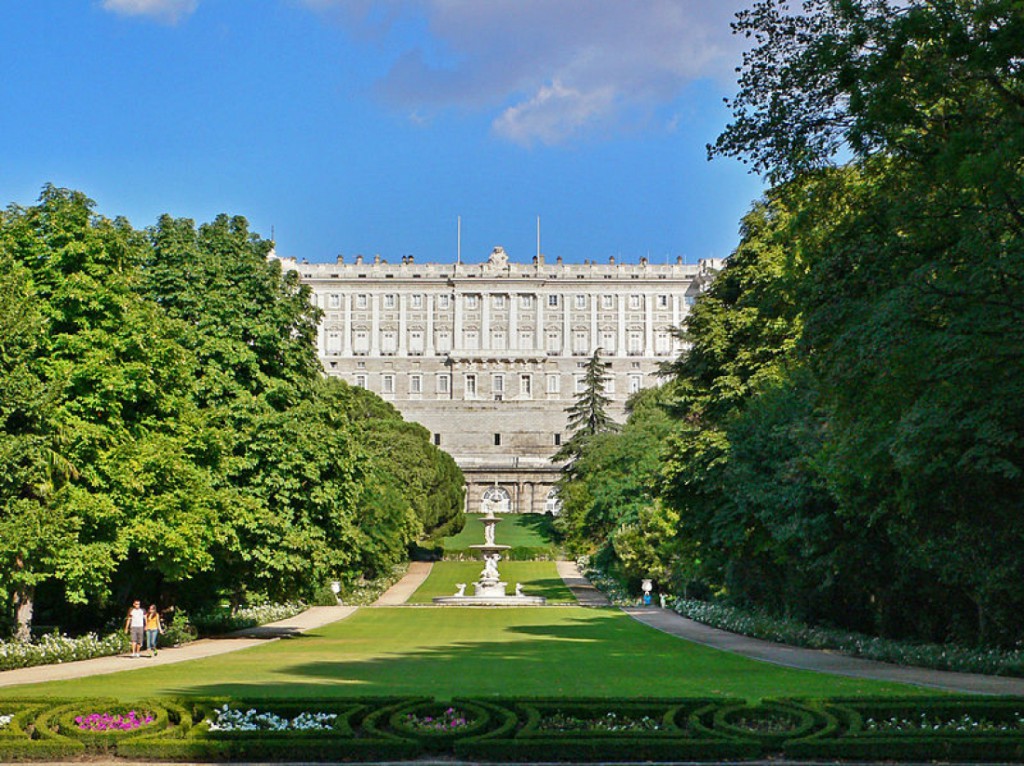
Campo del Moro is a historic garden on the slope between the Royal Palace of Madrid and the River Manzanares. It is free to enter and gives one of the widest views of the palace. This post covers its history, what to see, and the entrances and opening hours in 2026.
Where it is
The gardens lie right behind the Royal Palace, on lower ground, and next to Madrid Río Park, which runs along the river. According to Madrid’s official tourism website, they cover more than 20 hectares and were declared an Artistic-Historic Monument in 1931. Patrimonio Nacional, the body that looks after the royal sites, lists the gardens among the places it opens to visitors.
Campo del Moro is one of several green spaces around the palace. The Sabatini Gardens, laid out in the 1930s on the site of the former stables, are in front of the palace’s north façade. Across the river is the much larger Casa de Campo.
History
The name, “field of the Moor”, comes from an event in 1109. After the death of King Alfonso VI, the Muslim leader Ali ibn Yusuf tried to retake Madrid and attacked the fortress from the hillside by the river. It appears that he and his troops camped on the land that is now the park.
In the 16th century King Philip II bought the land next to the Alcázar, the fortress that stood where the palace is today, and turned it into a recreational area for the court. After the fire that destroyed the Alcázar in 1734 the land lost importance, because other areas near the new palace were preferred.
The gardens were built under Queen Isabella II. The architect Narciso Pascual y Colomer designed them in 1844 with straight main avenues, which remain today. During the regency of Maria Cristina of Austria the park was completely renewed to a landscape design by Ramón Oliva, dated 1890. Oliva used the difference in height between garden and palace: from the bottom of the central lawn the palace appears above a long green carpet, framed by trees.
What to see
- The Conchas Fountain (Fountain of the Shells), made by Felipe de Castro and Manuel Álvarez in 1775. It was brought from the Palace of Infante Don Luis in Boadilla del Monte.
- The Tritons Fountain, a 16th-century Italian piece from the Jardín de la Isla in Aranjuez. It stands in front of the Gruta Grande, the greenhouse.
- The central axis between the two fountains, with the view up to the palace.
- The romantic garden around it: wide and shady, with a botanical trail.
At the top of the gardens is the Royal Collections Gallery, a museum inaugurated in June 2023. Its lowest floor, Floor -3, opens beside Campo del Moro. The gallery has its own ticket and opening times.
The gardens have public toilets and a café-restaurant, La Terraza del Campo del Moro, which opened on 5 April 2025.
Entrances and opening hours
Admission is free. The older gate is on Paseo de la Virgen del Puerto. In June 2023 two more entrances opened, on Cuesta de San Vicente and Cuesta de la Vega. The tourism website gives these hours:
- Paseo de la Virgen del Puerto: 10am to 6pm from October to March, 10am to 9pm in April and September, and 10am to 10pm from May to August.
- Cuesta de San Vicente (beside Plaza de España): 10am to 8pm from April to September and 10am to 6pm from October to March.
- Cuesta de la Vega (behind the Almudena Cathedral): 10am to 8pm all year.
The gardens are open all year except 25 December, 1 January and 1 May. Opening depends on the weather and on official events, and some areas are closed to visitors. La Terraza opens daily from 10am to 5:30pm from October to March and from 10am to 8pm from April to September.
A direct link with Madrid Río Park through the Bonaparte Tunnel is planned. The tourism website describes the tunnel as under construction.
Getting there
The nearest metro stations are Ópera (lines 2 and 5 and the Ramal), Plaza de España (lines 2, 3 and 10) and Príncipe Pío (lines 6 and 10 and the Ramal). Príncipe Pío is also a Cercanías suburban rail station, and the Cuesta de San Vicente entrance is right beside Plaza de España. BiciMAD bike-share docking stations are on Paseo de la Florida and Calle Segovia.
For students
Campo del Moro costs nothing and is a practical stop between the palace, the cathedral and the river. Allow about an hour for a walk down the central avenue and back. The Sabatini Gardens are also free, although pets are not allowed there. More about studying in the city is on the Madrid city page.
More about: Madrid · All blog posts