Puerta del Sol, Madrid
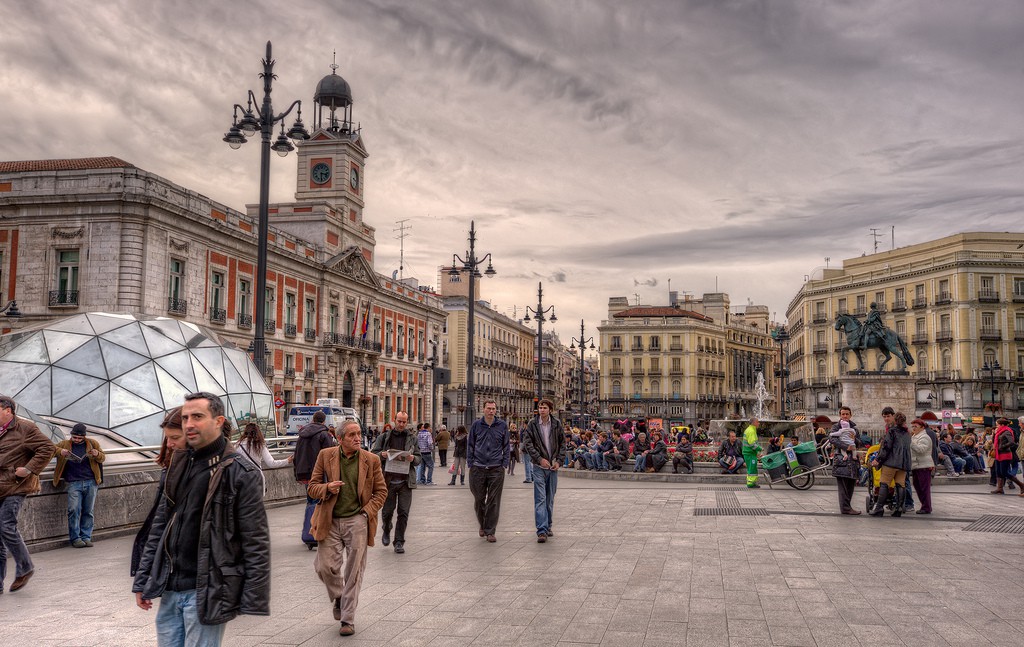
Puerta del Sol is the central square of Madrid and the place where several of the city’s main streets meet. This post describes what stands in the square, how it has changed since it became fully pedestrian, the New Year’s Eve tradition and how to get there.
The square
Puerta del Sol (“Gate of the Sun”) takes its name from one of the old city gates, which stood on this site. The square is semi-circular. Calle Mayor, Calle del Arenal, Calle de Alcalá and Calle de Preciados all start here, and Madrid’s official tourism website describes it as the starting point for all major radial roads in Spain. Plaza Mayor is a short walk away along Calle Mayor.
The square has been completely pedestrian since 20 August 2020. A remodelling that began in March 2022 reordered it: an oval fountain replaced the two earlier fountains, the statues were moved, and the kiosks were grouped at the two ends of the square in new glass pavilions.
Real Casa de Correos and Kilometre 0
The main building on the square is the Real Casa de Correos. The French architect Jacques Marquet built it between 1760 and 1768 as the headquarters of the postal service. It combines brick and stone and is arranged around two square inner courtyards. The clock turret was added in the 19th century; the clock was a gift from the clockmaker Losada. The building has belonged to the Comunidad de Madrid since 1985 and houses the seat of the regional presidency.
On the pavement in front of the main entrance a stone slab marks Kilometre 0, the point from which distances on Spain’s radial national roads are measured. Many visitors have their photograph taken beside it.
The statues
- El Oso y el Madroño (the Bear and the Strawberry Tree) shows the two figures of the city’s coat of arms. The sculptor Antonio Navarro Santafé made it in bronze, and it was inaugurated on 19 January 1967. After the works of 2022 it was put back close to its first position, where Calle de Alcalá meets the square. It is a common meeting point.
- La Mariblanca is a replica of a white marble statue of Venus that was ordered in 1625 for a fountain in the square. The original has been kept in the Casa de la Villa, the former city hall, since 1985. The limestone copy is six metres high with its base. In August 2023 it was moved to the western end of the row of benches on the north side of the square.
- Charles III on horseback stands in the centre of the fountain. The king modernised Madrid in the 18th century with a series of improvements to the city, which earned him the nickname of Madrid’s best mayor.
New Year’s Eve
Every 31 December the clock of the Casa de Correos marks the end of the year for the whole country, and the chimes are broadcast on television. People gather in the square to eat twelve grapes, one with each of the twelve chimes at midnight. A few seconds before midnight a ball at the top of the turret is lowered. Four warning tolls, the “quarters”, follow, and then the twelve chimes.
The most popular explanation of the custom dates it to 1909, when wine producers with a surplus of grapes are said to have given them away as a way of bringing good luck. The event is free. The tourism website lists it as starting at 9:30pm, and a rehearsal is held at midnight on 30 December for those who prefer a quieter evening. Thousands of people come, so it is wise to arrive early.
Getting there and around
Sol metro station, under the square, is served by lines 1, 2 and 3, and the Cercanías suburban rail station Madrid-Sol is at the same place. Many city bus lines stop nearby, and BiciMAD bike-share docking stations are on Calle Carretas and Calle Mayor.
From the square it is easy to continue on foot. Calle del Arenal leads to the Teatro Real opera house, Calle Mayor to Plaza Mayor, and Calle de Preciados is a pedestrian shopping street. Calle de Alcalá, which starts beside the bear statue, is the longest street in Madrid.
For students
Puerta del Sol is a common meeting point in Madrid and a metro and rail interchange that most newcomers learn quickly. The square itself takes about half an hour to see and costs nothing. More about living and studying in the city is on the Madrid city page, and Spanish courses in Spain are listed under language courses.
More about: Madrid · All blog posts