Boadilla del Monte, Madrid, Spain
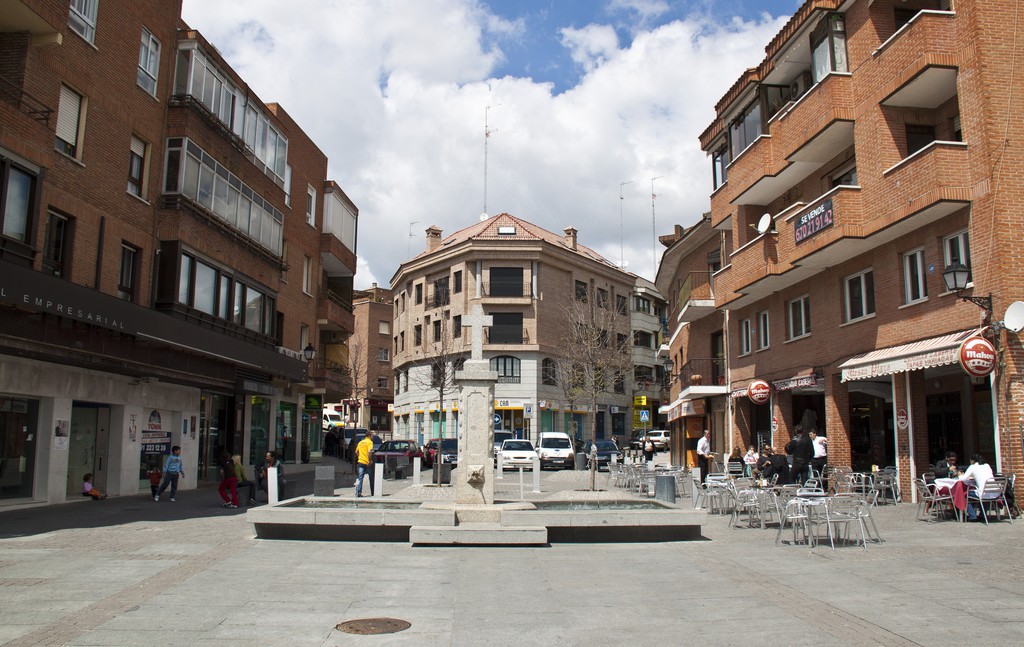
Boadilla del Monte is a town in the west of the Madrid region, reached from the capital by road, interurban bus or the Metro Ligero Oeste tram. Its main sight is the Palacio del Infante Don Luis, an 18th-century palace by the architect Ventura Rodríguez with restored gardens. This post covers the palace, the other monuments on the town’s heritage route, the walking trails in the Monte de Boadilla and how to get there.
The town and its name
The town council gives several theories for the name. One points to an Arabic origin, another to the surname of a landowner, and a third to “boa”, a 13th-century word for a rush-like plant. What the council considers clear is that “del Monte” was added later. The “monte” is the woodland that still surrounds the town and is now crossed by signposted trails.
The historic centre is small. The palace, its gardens, the Ventura Rodríguez fountain, the church of San Cristóbal and the former convent of La Encarnación all lie within a short walk of one another, most of them along Avenida de Adolfo Suárez.
Palacio del Infante Don Luis
The Infante Luis de Borbón, younger brother of King Charles III, bought the lordship of Boadilla del Monte on 20 February 1761. The estate included an older building known as the Palace of the Two Towers. Ventura Rodríguez transformed it into the present palace, which was practically finished in 1765. The infante first meant it as a hunting lodge and a place to keep his art and natural history collections, but he lived there between 1765 and 1776. According to the palace’s own website, Francisco de Goya and the composer Luigi Boccherini were among his guests.
The building is a long rectangle of about 17 by 80 metres, built mainly in brick, with a built area of just over 6,300 m². Inside, the chapel with its dome and the music room are the best-known spaces. During the Spanish Civil War the palace served as a military headquarters and hospital, and it was later a girls’ boarding school. The palace, its gardens and the fountain were declared a historic-artistic monument in 1974, and the town council acquired the site in 1998. Restoration has been carried out in phases since then.
The gardens are laid out on terraces because of the sloping ground, with the orchards on the lowest level. More than 13,000 m² have been restored following the original 18th-century design, with over 10,000 box plants in the parterre.
Visiting the palace and gardens
- Palace interior: by guided visit only, booked in advance through the palace visits page. In 2026 the palace lists Tuesdays, Wednesdays and Fridays for groups and Saturdays and Sundays for individual visitors. The tourism office describes the visits as free and about 90 minutes long.
- Gardens and orchards: free, no booking. From 1 October to 31 March they open Tuesday to Sunday from 11:00 to 14:00 and from 16:00 to 19:00. From 1 April to 30 September the hours are 11:00 to 14:00 and 18:00 to 22:00. They are closed on Mondays.
- Pond and waterwheel: free access.
Other monuments on the heritage route
The town’s monumental route links the palace with several smaller sights:
- Ventura Rodríguez fountain. Also called the Three-Spouted Fountain, it faces the palace’s main façade and is the monumental front of a water tank that supplied the palace, its gardens and orchards. It was restored in 2008.
- Convent of La Encarnación. Founded in 1674 under the patronage of María de Vera, widow of a lord of Boadilla. The nuns left in the 1970s and the convent building became a hotel. The brick church, restored in 1998, is in the sober Baroque style of 17th-century Madrid. It is open Monday to Saturday from 10:00 to 14:00 and from 17:00 to 20:30, and admission is free.
- Church of San Cristóbal. The parish church stands on high ground in the old centre and is described by the tourism office as partly Mudejar in style. Parts of it were rebuilt in 1944 after Civil War damage, and a restoration between 2006 and 2009 recovered its earlier appearance.
The tourism office also runs a guided heritage visit of about 120 minutes that includes both churches, the fountain and the palace, with advance booking.
Walks in the Monte de Boadilla
The woodland around the town has a set of marked routes published by the tourism office. Examples:
- Ornithological route: 2.4 km, 1.5 to 2 hours on foot.
- Water heritage trail: a 4 km loop around the palace past fountains and ponds, about 1.5 hours on foot.
- Wildlife trail: a 7.7 km loop through the Monte Norte, a little over 3 hours on foot.
- Notable tree trail: 17 km, 6 to 6.5 hours on foot or 3.5 hours by bicycle.
There is also a 19 km cycling route on forest tracks. Bicycles are not allowed on part of the Arroyo de la Fresneda trail.
Festivals
The feast of Nuestra Señora del Rosario is on 7 October, with a main Mass. San Babilés, the patron saint of Boadilla, is honoured with a pilgrimage on the last Sunday of May. San Sebastián has a procession on 20 January, and a bonfire is lit for San Juan on the night of 23 June.
Getting there
The town council’s how to get there page lists these options:
- Metro Ligero Oeste: line 3 runs from Colonia Jardín to Puerta de Boadilla.
- Interurban buses: line 573 from Madrid (Moncloa) and lines 571 and 574 from Madrid (Aluche). Night line N905 runs from Moncloa.
- By car: the M-511 from Madrid, or the M-50 ring road.
Boadilla works as a half-day trip for students based in the capital: the gardens and the heritage route cost nothing, and a palace visit only needs a booking. For more places near the capital, see villages in the Madrid area. Students choosing where to study can browse Madrid as a study city or the list of schools in Spain.
More about: Madrid · All blog posts