Campo Real, Madrid, Spain
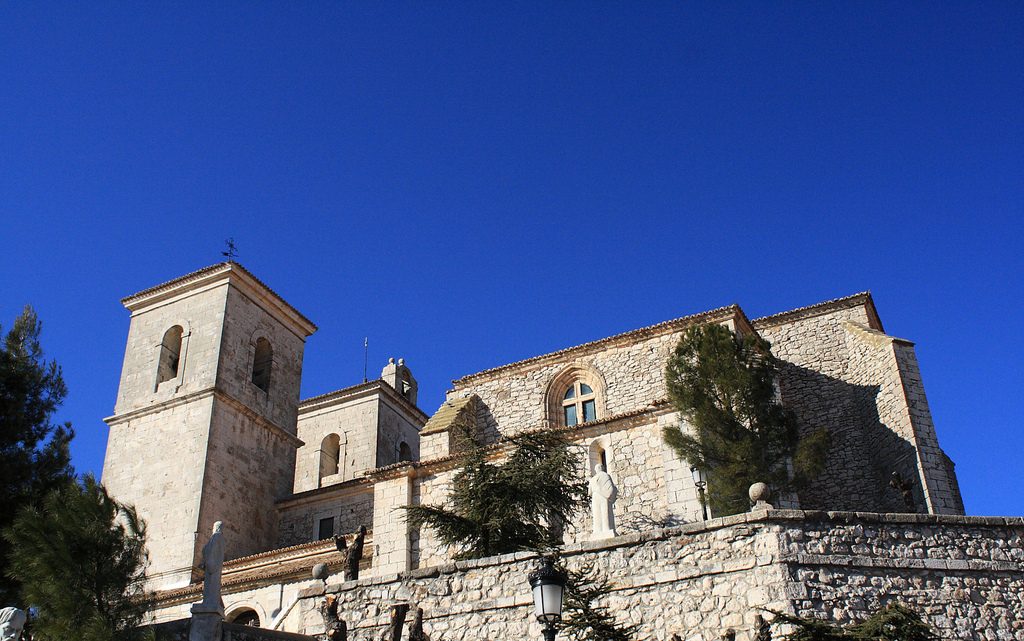
Campo Real is a small town in the south-east of the Community of Madrid, 33 kilometres from the capital. It is known across Spain for its seasoned table olives and its sheep’s cheese, and it has a large hilltop church that can be seen from kilometres away. This post covers the town’s history, what to see, its food and festivals, and how to get there by road and by bus.
A short history
According to the town council’s history page, the earliest finds in the area are Neolithic stone axes. The settlement was first called Aldea del Campo in the middle of the 10th century and Campo de Almoacid under Muslim rule. Fernando I of Castile took it in 1047, it was lost again a year later, and it was finally retaken in 1118 by the Archbishop of Toledo. In 1333 the archbishop held a synod here attended by 12 bishops.
The village depended on Alcalá de Henares until 1555, when Philip II raised it to the rank of town (villa) in exchange for 7,000 ducats. Around 1579 the king sold it to a Genoese moneylender; the residents collected 17,000 ducats, bought their freedom and came directly under the Crown with the present name, Campo Real. In 1636 the jurisdiction was bought by the Count of Oñate. During the Civil War a military airfield was built to the east of the town and the name was briefly changed to Campo Leal. From the 1960s and 1970s pottery and traditional farming gave way to cheese making and the olive industry.
What to see
- Iglesia de Santa María del Castillo. The parish church stands on a crag above the town and was declared a Historic-Artistic Monument in 1981. It mixes Gothic, Renaissance and Baroque styles and was built on the remains of a castle; the council traces its origin to a castle-hospital of the Order of the Hospitallers. The church was consecrated on 10 February 1333 and enlarged in 1543. A tower collapsed onto the building in 1647, and by 1659 it had the look it has today, with two towers, three naves and a choir. Most of the interior decoration was destroyed in the Civil War. Since 1993 twelve statues of the apostles by the sculptor Ángel Lamiel have lined the steep path up to the church.
- Ermita del Santo Cristo de la Peña. A Baroque chapel behind the Plaza Mayor, built in 1717 and dedicated to the town’s patron.
- Ermita de la Virgen de las Angustias. The oldest chapel still standing, from the 16th century, on the east side of town. Its stone columns were destroyed in the Civil War and replaced with iron posts.
- Ermita de la Virgen de los Remedios. A 16th-century chapel rebuilt in the 18th century, home to the image of the town’s co-patron.
- Parque de la Fuente. A shaded garden in the lower part of town around the old spring, drinking trough and public washing place.
- Palacio de los Condes de Oñate. The counts built a palace here in the mid-17th century. It was sold and divided up in the 19th century and hardly any trace is left.
The Museo de Alfarería y Productos Típicos tells the story of local pottery, once the main industry with up to 30 workshops, and has a section on olives and cheese. In October 2026 the council’s page says the museum is closed until further notice for renovation, so check before planning a visit around it.
Olives, oil and cheese
The town’s best-known product is the Campo Real olive. The olives are picked by hand in October, split and then seasoned with garlic, thyme, fennel and oregano. The council states that they account for more than 75% of the table olives produced in the Community of Madrid. Since 1995 they have been covered by the quality label Denominación de Calidad Aceitunas de Campo Real, supervised by the regional government.
Olive oil is made locally from the manzanilla and cornicabra varieties. The cheese is a sheep’s milk cheese: in the 1950s fourteen local farmers joined together to make it in the traditional way and founded the Cooperativa Castellana de Ganaderos. Olives, oil and cheese are sold directly by producers in the town.
Festivals
- Holy Week. Silent torch-lit processions on Maundy Thursday and Good Friday, and a Passion play staged in the parish church by the local theatre group.
- San Isidro. Farming has always been the town’s main activity, so the feast of the patron saint of farmers is celebrated with a farm fair in the Plaza Mayor. The following weekend a procession of decorated floats goes to the Vega de Valdemembrillo for a country lunch. Madrid’s own celebration is described in the post on the Fiestas de San Isidro.
- Patron saint festivals. They take place in the first half of September. The Virgen de los Remedios is carried in procession on 8 September. The main day is 14 September, with a solemn Mass for the Santo Cristo de la Peña, an afternoon procession and fireworks at night; bullfighting events follow on the 15th.
Walking routes
Campo Real lies at the edge of the Parque Regional del Sureste, in a landscape of olive groves, thyme and rosemary. The council publishes three digital walking routes: Cerro de los Rosales y la Vega, Vega de Valdemembrillo, and the Tren de los Cuarenta Días, which follows the line of the wartime railway that linked Madrid with Tarancón. The council advises downloading the track of each route before setting out.
Getting there
By car, take the A-3 Madrid–Valencia motorway to exit 22. The M-209 connects the town with Arganda del Rey and the M-220 with Loeches, Torrejón and Alcalá de Henares. According to the council’s travel page, interurban bus lines 313 and 313A link Campo Real with Valdilecha, Arganda del Rey and Madrid, line 320 runs between Arganda del Rey and Alcalá de Henares, and line 321 between Arganda and Villar del Olmo. The metro can be taken in Arganda. Check current timetables with the Madrid regional transport consortium before travelling.
For students
For students based in Madrid or in Alcalá de Henares, Campo Real works as a half-day trip: the walk up to the church, a look at the chapels and a stop to buy olives and cheese. September, during the patron saint festivals, is the liveliest time. Other small towns in the region are covered in the post on villages in the Madrid area.
More about: Madrid · All blog posts