Los Mesones de Madrid
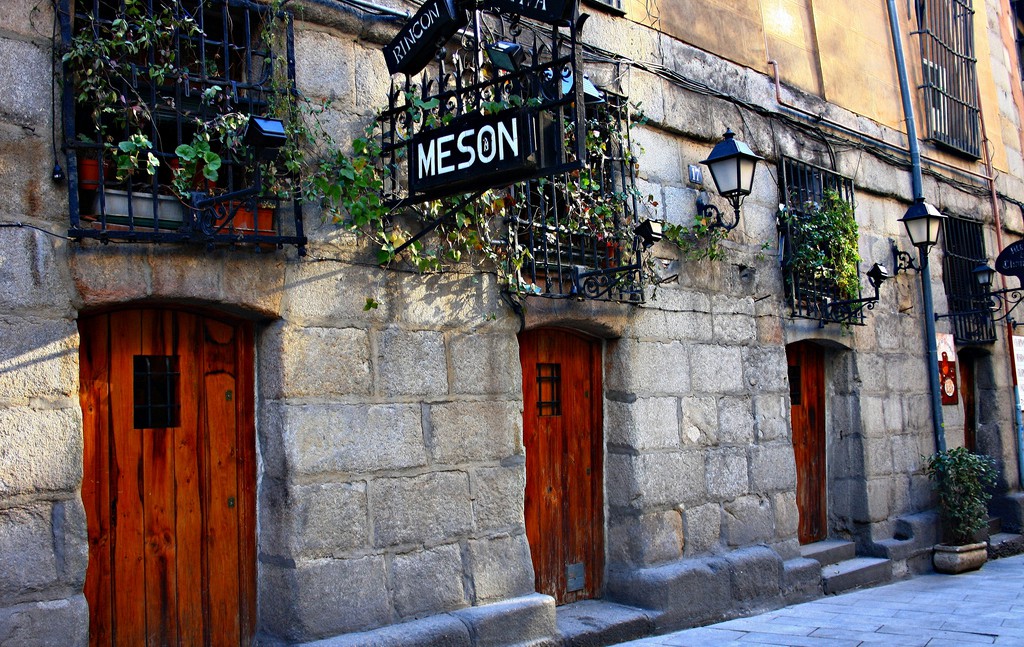
A mesón is a traditional Spanish inn or tavern, and the old streets around Plaza Mayor in Madrid are a place where people go from bar to bar for a drink and something small to eat. This post explains how that custom works, what to order, and where the traditional bars and taverns of the old centre are.
Tapas: what you get with a drink
According to Madrid’s tourist board, tapas in Madrid and other Spanish regions are bite-sized snacks served for free with a drink. Most bars put out a saucer with olives, chips, nuts or a slice of bread with a cold cut on top. In other bars the tapa has grown larger and more elaborate.
The same source gives two accounts of where the custom comes from. In one, King Alfonso X of Castile ordered taverns and inns in the thirteenth century to serve alcohol with a small helping of food. In the other, a slice of bread was laid over the wine pitcher to keep out dust and flies, and tapa is the Spanish word for lid. Spain’s national tourism site calls these stories myths and leaves the question open.
Going from bar to bar is part of it. Spain’s tourism site describes “ir de tapas” as going from bar to bar tasting tapas with friends. Tapas are meant to whet the appetite before lunch or in the late afternoon, and the site adds that a round of several bars can replace a meal.
What to order
Besides the tapa that comes with the drink, a bar sells larger plates to share: a ración or a media ración (half portion), which are charged. Madrid’s tourist board lists these as the classics:
- patatas bravas, deep-fried potato cubes in a spicy sauce
- Spanish omelette
- croquettes
- aged cheese
- Ibérico sausage
The usual drinks are just as fixed:
- Caña: draft beer in a tall, thin glass of about 20 cl
- Chato: wine in a small glass
- Vermú: Spanish vermouth, a herb-marinated wine that traditional bars pour from the tap
Around Plaza Mayor
Plaza Mayor lies in the oldest part of the city, known as Hapsburg Madrid. Nine arches lead into the square. The best known is the Arco de Cuchilleros, whose steep steps lead down to Calle de los Cuchilleros. The street takes its name from the knife makers who had their workshops there and supplied the butchers of the square. Its buildings are taller than others in the area and their façades slant, because they served as buttresses.
This is where the old taverns are. Bodegas Ricla, at Calle de Cuchilleros 6, was established in 1867 and serves preserved and pickled foods and tripe with vermouth or wine. Las Cuevas de Luis Candelas, next to the Plaza Mayor, is listed by the tourist board among Madrid’s centuries-old restaurants and serves traditional Castilian cuisine. Botín, on the same list, is known for its roast suckling pig. More about the arch and its street is in the post on the Arco de Cuchilleros.
A stone’s throw from Plaza Mayor, the Mercado de San Miguel offers the same idea under one roof. It opened in May 1916 as a local food market and became Madrid’s first gourmet market in 2009. It has 30 stands. In 2026 it opens from 10 am to midnight from Sunday to Thursday, and until 1 am on Fridays, Saturdays and the eves of public holidays.
Other streets for tapas
La Latina is one of the three old neighbourhoods that the tourist board names for tapas, together with Barrio de las Letras and Lavapiés. Several of its bars are on Calle de la Cava Baja, among them La Chata, known for its tripe, and La Perejila, with Andalusian-style tapas. Near Puerta del Sol, Casa Labra has been open since 1860 and is known for soldaditos de pavía (battered cod) and croquettes. The post on tapeo and tapas in Madrid covers the custom in more detail.
Getting there and tips for students
The nearest metro stations to Plaza Mayor are Ópera (lines 2 and 5 and the Ramal), Sol (lines 1, 2 and 3) and Tirso de Molina (line 1). The Cercanías local trains stop at Madrid-Sol.
For a student budget, the free tapa is the point: one drink in each of three or four bars comes with something to eat every time, and a shared ración fills the gaps. Ordering in Spanish is good practice for anyone taking a Spanish course in Spain, and the Madrid city page lists places to study in the city.
More about: Madrid · All blog posts