Monumento a Alfonso XII, Madrid
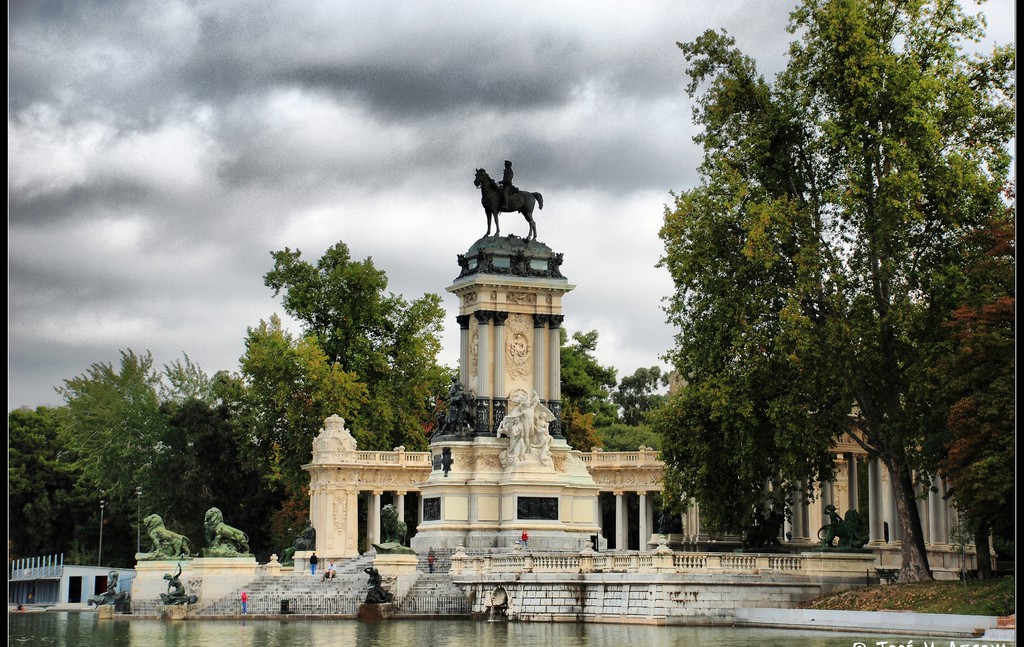
The Monumento a Alfonso XII is the large colonnade with an equestrian statue that rises over the boating lake in El Retiro Park, in the centre of Madrid. This post explains who built it and why, what to look for, how the observation deck inside it can be visited, and the practical details for 2026.
A monument beside the lake
The monument stands on the shore of the Estanque Grande, the large lake of El Retiro. The lake is much older than the monument. It was built between 1634 and 1636 by the architect Cristóbal de Aguilera as the centre of the gardens of the Buen Retiro Palace, and the court used it for mock naval battles and boat rides.
The monument to King Alfonso XII was begun in 1902 and paid for by public subscription. The design is by the Catalan architect José Grases Riera, and the work was completed by Teodoro Anasagasti. King Alfonso XIII, son of Alfonso XII, inaugurated it in 1922. According to Madrid’s official tourism website, the design takes its inspiration from the monuments to Victor Emmanuel II in Rome and to Wilhelm I in Berlin.
What to look for
Madrid’s tourist board describes the ensemble as an outstanding example of historicist architecture. Its main parts are these:
- The colonnade: a semicircle with a double row of Ionic columns. The frieze carries the coats of arms of the Spanish provinces of the time, with scenes of the trades typical of each region.
- The central tower and statue: a tower in the middle supports the figure of the king on horseback, the work of the sculptor Mariano Benlliure. Benlliure also made the statue of Goya next to the Prado Museum.
- The steps: a wide flight of steps leads from the foot of the tower down to the edge of the water.
The observation deck
The column that supports the statue holds an observation deck, opened to the public in spring 2018. From the top, the view takes in the Salamanca district, the Barrio de las Letras and the landmark buildings of Gran Vía.
The deck cannot be visited freely. Access is only with a prior booking, as part of the city’s Pasea Madrid programme of guided visits, and dates are published on that programme’s website. The visit is not accessible: there are 97 steps to the deck and no lift, and it is not recommended for children under 14.
Practical details for 2026
- Price: entry to El Retiro Park is free, and the monument can be seen from outside at any time the park is open.
- Park opening hours: every day, from 6am to midnight between April and September and from 6am to 10pm between October and March. The park may close in severe weather.
- Address: Paseo de Chile, beside the Estanque Grande.
- Metro: Retiro (line 2), Ibiza (line 9), Atocha and Estación del Arte (both line 1).
- Train: Cercanías to Madrid-Atocha.
- Boats: the lake has 100 rowing boats for hire, two of them accessible to wheelchair users.
The monument itself is a short stop. It is usually combined with a longer walk through the park or with rowing on the lake.
The park around it
El Retiro covers more than 125 hectares and has more than 15,000 trees. On 25 July 2021 the park and the Paseo del Prado, together known as the Landscape of Light, were declared a UNESCO World Heritage Site. In spring 2026 the city council launched audio guides and interactive maps covering 38 landmarks in the park, available in Spanish and English through QR codes.
Other stops within a short walk are the Palacio de Cristal, the Casón del Buen Retiro and the Prado Museum.
For students
El Retiro is free and central, and the tourist board describes it as a favourite place of locals for a walk, a run or some sport. For students on a budget it is one of the easiest sights in Madrid to fit between classes. Information on courses and schools in the city is on the page about studying in Madrid.
More about: Madrid · All blog posts