Plaza de España y Monumento a Cervantes, Madrid, Spain
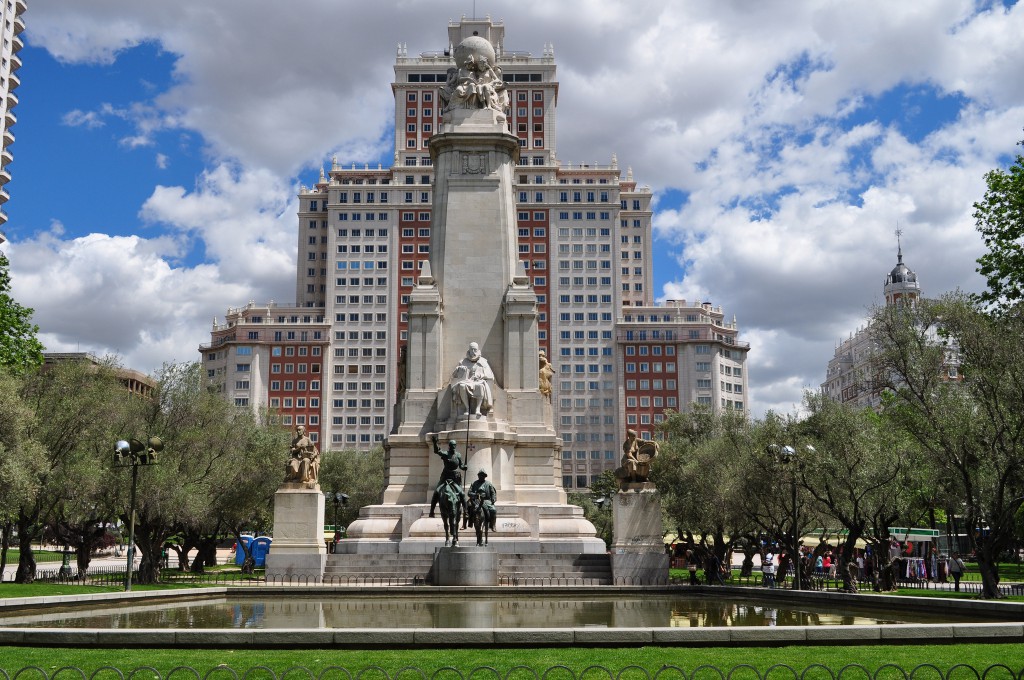
Plaza de España is a large square at the western end of the Gran Vía in central Madrid. It holds the Monument to Cervantes, with the bronze figures of Don Quixote and Sancho Panza, and is flanked by two mid-century skyscrapers. This post describes the square as it is after its renovation, the monument, the buildings around it and how to get there.
The square today
The square was rebuilt in works that lasted two and a half years. According to the Madrid tourist board, it has been pedestrianised and now covers 70,000 m². Through traffic runs underground, in a tunnel that links Calle Bailén and Calle Ferraz. More than 1,100 new trees were planted, and the square has over three kilometres of cycle lanes and large children’s play areas.
The main effect for visitors is that the square now connects on foot with the public spaces around it: the Plaza de Oriente, the Sabatini Gardens, the Campo del Moro and Madrid Río. The Royal Palace is a short walk away through the Sabatini Gardens.
The works uncovered archaeological remains, which have been integrated into the square. They include two floors of the Godoy Palace, part of the former Royal Stables and traces of the former San Gil Barracks, which once stood on the site.
Besides the fountain of the Cervantes monument, the square has a new fountain, the Fuente del Cielo. In winter it is used for seasonal events. In the 2025-26 season an ice rink and a Christmas market ran from 25 November to 11 January.
The Monument to Cervantes
The Monument to Cervantes was commissioned by King Alfonso XIII in 1915, on the 300th anniversary of the publication of the second part of Don Quixote. It is the work of the architect Rafael Martínez Zapatero and the sculptor Lorenzo Coullaut Valera. The main body was erected in the 1920s. The full monument was not completed until the 1960s, when the sculptures of Aldonza and Dulcinea were added at the sides.
What to look for:
- Don Quixote and Sancho Panza on the central pedestal. They are cast in bronze, while the other sculptures are stone.
- Miguel de Cervantes behind them, holding a copy of Don Quixote.
- Scenes from two of his shorter works, La Gitanilla and Rinconete y Cortadillo, on the sides.
- At the back, a female figure that stands for Spanish literature, above a fountain with the coats of arms of the Latin American countries.
- At the top, figures of the five continents holding up a globe.
Access to the monument is free. Cervantes was born in Alcalá de Henares, a short train ride from Madrid, where his birthplace is a museum.
Edificio España and Torre de Madrid
Two towers by the brothers Julián and José María Otamendi stand on the square. Edificio España was begun in 1948 and completed in 1953. It has 25 storeys and is 117 metres tall. After a complete refurbishment it houses the Riu Plaza España hotel, with a bar and terrace on the top floors.
The Torre de Madrid was built between 1954 and 1960. It is 142 metres tall, has 32 storeys and was for some years the tallest concrete skyscraper in the world. A hotel occupies the first nine floors and the rest of the tower is residential.
Nearby and getting there
Several sights are within a short walk: the Cerralbo Museum, a 19th-century noble mansion; the Temple of Debod, a 2nd-century Egyptian temple donated to Spain; and the Sabatini Gardens beside the Royal Palace.
- Metro: Plaza de España (lines 2, 3 and 10).
- Bus: lines 1, 2, 3, 25, 39, 44, 46, 62, 74, 75, 133, 138 and 148, among others.
- Cercanías suburban trains: Príncipe Pío is the nearest station.
- BiciMAD bike-share: a docking station at Plaza de España, 16.
Allow half an hour for the square and the monument, or a couple of hours with the Temple of Debod and the gardens. For students of Spanish the monument is a simple first meeting with Cervantes; Spanish language courses in Spain are listed in the directory.
More about: Madrid · All blog posts