Real Academia de Bellas Artes de San Fernando, Madrid, Spain
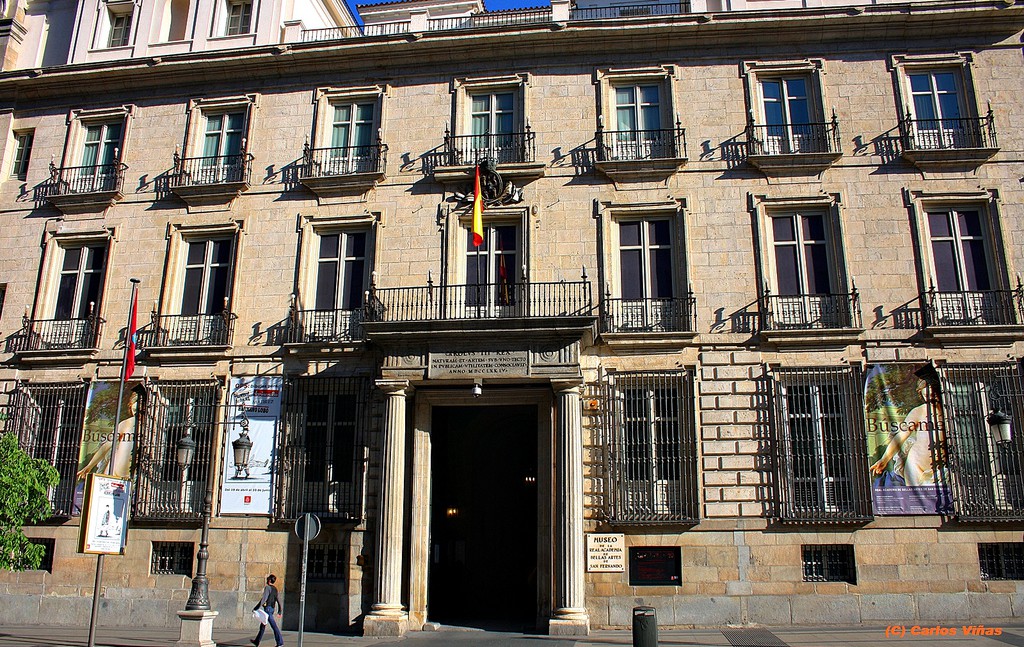
The Real Academia de Bellas Artes de San Fernando is Spain’s royal academy of fine arts and, at the same address, one of Madrid’s main art museums. It stands at Calle de Alcalá, 13, in the centre of the city. This post covers the history of the academy and its building, the highlights of the museum, and the opening hours and ticket prices published in 2026.
The academy and its history
The idea of a royal academy of arts in Madrid goes back to 1726, when the painter Antonio Meléndez proposed one to Felipe V. It took shape with the Italian sculptor Domenico Olivieri: a preparatory board (Junta Preparatoria) approved by the king began work in 1744, and the academy itself was created by royal decree of 12 April 1752, in the reign of Fernando VI.
For more than two centuries the academy was also a school. Its main task was to teach drawing, sculpture and painting to young artists, and it awarded prizes and grants for study abroad, usually in Italy. Goya was a member from 1780. The teaching side ended when the Escuela Superior de Bellas Artes was incorporated into the Universidad Complutense de Madrid in 1975, later becoming its Facultad de Bellas Artes.
Today the academy is one of the eight royal academies of national scope that form the Instituto de España. According to the academy, it has fifty-six full members drawn from architecture, painting, sculpture, music, cinema, graphic art, photography, design and art history. Its stated purpose is to promote artistic creativity and the study, dissemination and protection of the arts and cultural heritage.
The building on Calle de Alcalá
The academy first met in the Casa de la Panadería and soon ran out of room. In 1773 it bought the palace on Calle de Alcalá that José Benito de Churriguera had built in 1720 as the residence of Juan de Goyeneche, a minister and financier of the time of Felipe V. The architect and academician Diego de Villanueva stripped the Baroque ornament from the façade and gave it a Neoclassical look, with a Doric doorway.
By order of Carlos III the upper floors housed the royal cabinet of natural history, and the two institutions shared the building until the end of the 19th century. A Latin inscription on the main balcony still records that the king brought nature and art together under one roof in 1774.
The museum
After several years of alterations the museum was officially opened in 1986, and it was enlarged in 2002. It now has fifty-nine rooms on three floors. The academy gives the size of the collection as more than 1,400 paintings, 600 sculptures and 15,000 drawings, together with decorative arts such as tapestries, silver, ceramics, clocks and furniture. The works run from the Renaissance to the 21st century, with Spanish, Italian and Flemish art at the centre.
Highlights of the permanent collection include:
- Goya: 13 paintings, among them two self-portraits, the Corrida de Toros, the portraits of Moratín, Juan de Villanueva and the actress La Tirana, and the carnival scene known as the Entierro de la Sardina. They hang in the main hall of the palace
- Zurbarán: the Agnus Dei and the Mercedarian Friars
- Ribera: a Mary Magdalene signed in 1636
- Arcimboldo: the only work by the painter kept in Spain
- Rubens: Susanna and the Elders
- Pereda: the Sueño del caballero (The Knight’s Dream)
- 20th century: a Cubist still life by Juan Gris, prints from Picasso’s Suite Vollard and works by Sorolla
The same building houses the Calcografía Nacional, the national collection of engraved plates, whose Gabinete Goya keeps the same hours as the museum.
Opening hours and prices in 2026
The museum is a morning museum, which matters when planning a day. The permanent collection opens from Tuesday to Sunday, 10:00 to 15:00, including public holidays. It is closed on Mondays, on 1 and 6 January, 1 and 30 May, 9 November, 23, 24, 25 and 31 December, and for the whole month of August. The academy has announced that the second floor of the museum is closed from 2 May 2026 until further notice.
Prices, as listed on the academy’s rates page:
- General ticket (museum, Gabinete Goya and temporary exhibitions): €10
- Reduced ticket (permanent collections only): €5, for visitors over 65, students over 25 and holders of an international student card, among others
- Free with proof: under-18s, university students aged 18 to 25, unemployed people and teaching staff, among others
- Free for everyone: Tuesday to Friday (not public holidays) from 13:30 to 15:00, and on 18 May, 12 October and 6 December
Guided visits for individual visitors, limited to 20 people, take place from Tuesday to Friday at 11:00, except on public holidays and from 22 July to 15 September. Groups must book in advance and are limited to 25 people.
For students
Free entry for university students aged 18 to 25 makes this one of the cheapest major collections in the city, so a student card is worth carrying. The academy is a short walk from the Prado Museum which also holds a large group of works by Goya. Other collections are described in the post on museums in Madrid, and art degrees can be found among the universities in Spain.
More about: Madrid · All blog posts