Stop and Visit Madrid, Spain
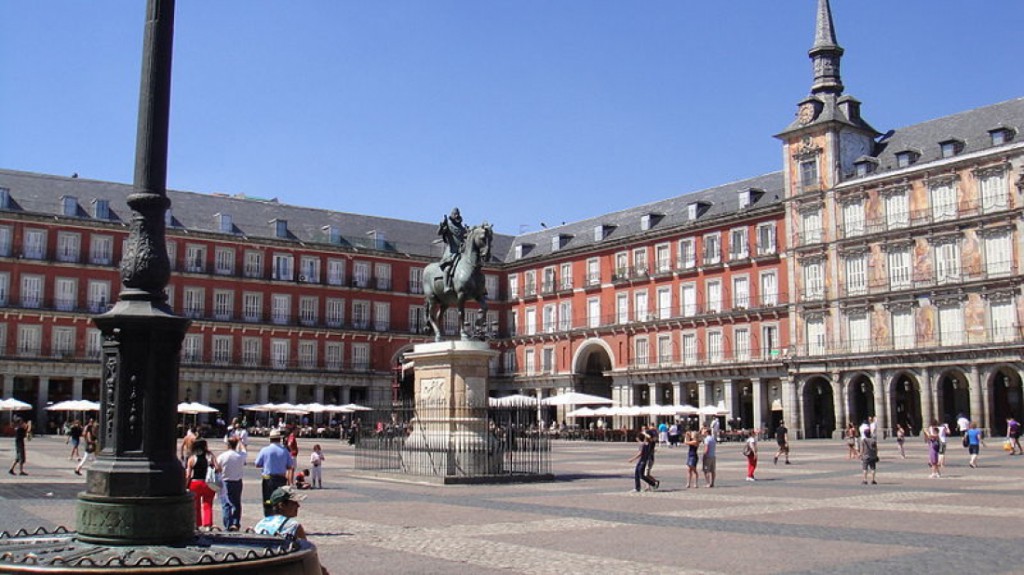
Madrid is the capital of Spain and of the region of the same name, the Comunidad de Madrid. This post is a short introduction for a first visit or a first term of study: the climate, three neighbourhoods worth knowing, the Bernabéu stadium, and how to get around on public transport with the fares valid in 2026.
The city and its climate
Madrid lies on the central plain of the Iberian Peninsula, on the river Manzanares and close to the Sierra de Guadarrama. According to the city’s tourist board, the first historical record dates from the year 865, when Emir Muhammad I ordered a fortress to be built in the village of Mayrit. The city belonged to the Islamic world until 1083, when Alfonso VI of Castile took it. King Philip II later established the royal court here.
The climate is dry with little rainfall, hot summers and cold winters. The tourist board gives these averages: 12ºC in April, 21ºC in June, 15ºC in October and 7ºC in December. January is the coldest month, with an average of about 6ºC, and snow falls now and then. Summer highs pass 35°C, with overnight lows of around 20°C, so in July and August much of city life moves to the late afternoon and evening.
Most of what a visitor wants to see is in the centre: Puerta del Sol and Gran Vía, Plaza Mayor and the Royal Palace in the old Austrias quarter, and the Paseo del Arte with the Prado, Thyssen-Bornemisza and Reina Sofía museums. Separate posts describe the monuments of Madrid and the museums of Madrid.
Three neighbourhoods to start with
- Barrio de las Letras (Huertas). The Literary Quarter lies between Sol-Gran Vía and the Paseo del Arte. Its name comes from the writers of the 17th century who had their homes here, among them Cervantes, Lope de Vega, Quevedo, Tirso de Molina and Góngora. Calle Huertas has quotations from Spanish authors set into the pavement, and Plaza de Santa Ana, next to the Teatro Español, is the centre of the district.
- Malasaña. The district is bordered by Gran Vía to the south, Calle Fuencarral to the east, Calle Carranza to the north and Calle de San Bernardo to the west. It is named after Manuela Malasaña, one of the victims of the rising against Napoleon’s occupation on 2 May 1808, which Plaza del Dos de Mayo commemorates. In the 1980s it was the birthplace of the movida madrileña. Today it has many second-hand and vintage clothes shops.
- Barrio de Salamanca. This district was laid out on a regular grid in the second half of the 19th century, under Queen Isabella II, by the Marquis of Salamanca. It is the main area for fashion shopping, with a stretch known as the Golden Mile. The National Archaeological Museum is here.
The tourist board describes 18 visitor areas in all, including La Latina with the Rastro flea market, Lavapiés, Chueca and Madrid Río, a green area along the Manzanares.
The Bernabéu stadium
Real Madrid is one of the three professional football teams of the city, with Atlético de Madrid and Rayo Vallecano. Its stadium, named after Santiago Bernabéu, who led the club from 1943 to 1978, was inaugurated in 1947 and holds over 80,000 spectators. The Tour Bernabéu includes the museum, panoramic views of the stadium, the changing rooms and the benches. It is open every day of the year except 25 December and 1 January. On non-match days it runs from 9am to 7pm Monday to Saturday and from 9:30am to 6:30pm on Sundays and public holidays; on match days tours end 5½ hours before kick-off. The entrance is at Gate 84 on Avenida de Concha Espina, and the Metro station is Santiago Bernabéu on line 10; in 2026 works at that station interrupt the line between Nuevos Ministerios and Cuzco, with a free replacement bus. Prices are published on the club’s site; the tourist board notes an extra charge of €3 for tickets bought at the box office.
Getting there and getting around
Adolfo Suárez Madrid-Barajas Airport is about 30 minutes from the centre by public transport. Metro line 8 runs from Nuevos Ministerios to the airport in 20 minutes to T4 and 12 minutes to T1, T2 and T3. The Airport Express bus links the airport with the centre in 40 minutes for five euros and runs 24 hours a day.
The Metro has over 300 stations and runs from 6am to 1:30am. Fares valid until 31 December 2026:
- Single ticket in Metro Zone A: €1.50 for up to five stations, rising to €2 for ten stations or more.
- Ten-trip ticket for Metro Zone A and city buses (Metrobús): €7.30.
- Airport supplement: €3 on top of the ticket.
- Tickets are loaded on the Tarjeta Multi, a contactless card that costs €2.50 and can be shared.
Visitors who travel a lot can buy the Tourist Travel Pass for 1, 2, 3, 4, 5 or 7 days. Zone A covers the city, including the airport supplement, and costs €10.30 for one day or €43.20 for seven days. Zone T covers the whole region and is the one to choose for day trips to El Escorial, Aranjuez or Alcalá de Henares. The pass is not valid on high-speed trains.
For students
Madrid has public and private universities and many Spanish language schools. The Tourist Travel Pass suits a short visit; students who stay a term or longer should ask at a Metro office about the monthly passes. Free evening hours at the big museums and the city’s parks keep costs down. Schools and courses are listed on the Madrid city page and among the Spanish language courses in Spain.
More about: Madrid · All blog posts