The Royal Palace of Madrid
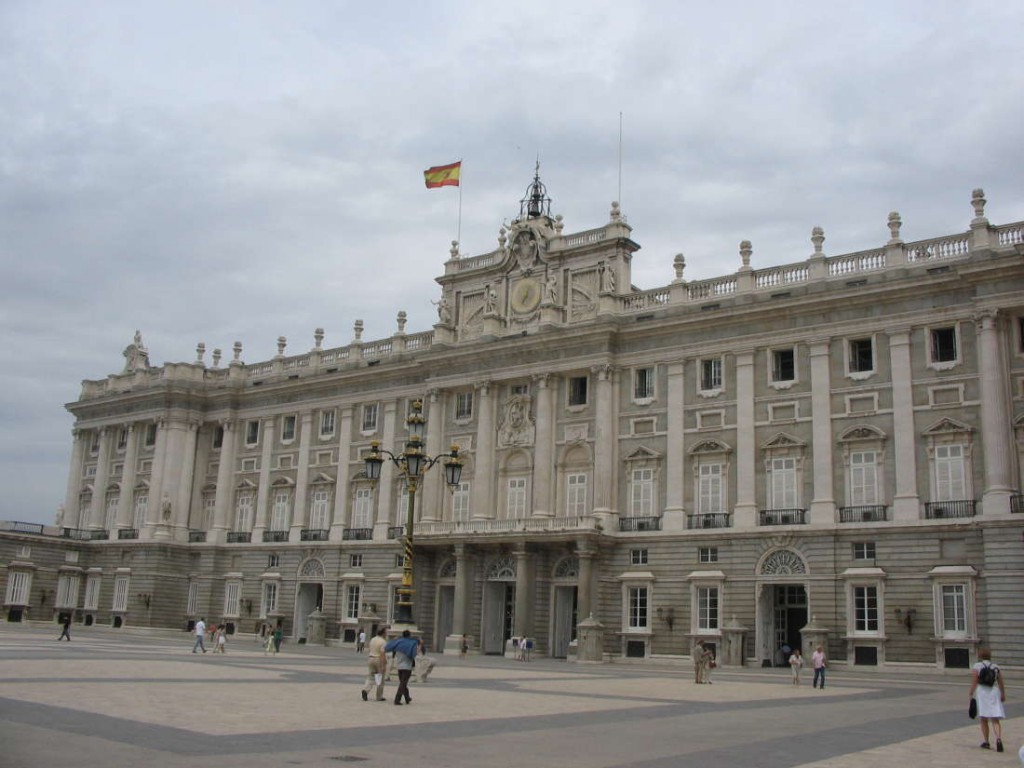
The Royal Palace of Madrid (Palacio Real) is the official residence of the Spanish royal family, although the family does not live there. It stands on Calle de Bailén, next to the Almudena Cathedral and Plaza de Oriente, and is managed by Patrimonio Nacional. This post covers its history, the rooms on the visit, and the opening hours and ticket prices checked in October 2026.
A palace on the site of the old Alcázar
According to Madrid’s tourist board, Emir Mohamed I chose the site for a fortress, which the Kings of Castile later used. Charles I and Philip II made it a permanent royal residence. In 1734 a fire destroyed that palace, and Philip V ordered the construction of the building that stands today.
After the death of the first architect, Filippo Juvara, his pupil Juan Bautista Sachetti drew the final plans. The first stone was laid in 1738. Spain’s official tourism website gives 1764 as the year the building was completed, and credits Sabatini with the southeast wing and the main staircase. Charles III was the first monarch to live in the new palace. The kings of Spain lived here from Charles III to Alfonso XIII. Today the royal family lives at the Palacio de la Zarzuela, and the Royal Palace is used for official events, when it may close to visitors.
What to see inside
The palace has a square floor plan around a large central courtyard and, according to the tourist board, over 3,000 rooms. Only part of it is on the visitor route. The rooms and collections that esmadrid.com and spain.info highlight include:
- The Main Staircase, designed by Sabatini, with over 70 steps
- The Throne Hall, with a ceiling painted by Tiepolo
- The Hall of Halberdiers, which Charles III turned into the Guards Room
- The Hall of Columns and the Hall of Mirrors
- The Gasparini Room, with 18th-century decoration on a floral theme
- The Royal Chapel, which keeps string instruments made by Antonio Stradivari
- The Royal Armoury, with weapons and armour of the kings of Spain since the 13th century
The palace also holds paintings by Velázquez, Goya, Rubens, El Greco and Caravaggio. Several rooms have joined the route recently: the sacristy in March 2025, the office of Charles III in September 2025, and the reliquary of the Royal Chapel on 17 March 2026. The Royal Kitchen, in the first basement, is not part of the usual route and needs a separate or combined ticket.
Opening hours in 2026
Patrimonio Nacional publishes these hours on its ticket page:
- Winter (October to March): Monday to Saturday 10:00 to 18:00, Sundays 10:00 to 16:00
- Summer (April to September): Monday to Saturday 10:00 to 19:00, Sundays 10:00 to 16:00
The ticket office and the entrance close one hour earlier. In 2026 the palace is closed all day on 1 January, 6 January, 1 May and 25 December, and from 15:00 on 24 and 31 December. Extra closures are possible for official events, so check the ticket page before going. A self-guided visit of the halls takes about 45 minutes, and the Royal Armoury about 30 minutes more.
Tickets and prices
- Self-guided visit: €18 standard, €9 reduced
- Guided visit with Patrimonio Nacional staff: €26 standard, €17 reduced
- Royal District Essential Pass (palace and Gallery of the Royal Collections): €24 standard, €12 reduced
- Royal Kitchen only: €8
The reduced price applies to visitors aged 5 to 16, people over 65 and students up to 25 years of age with a valid national or international student card. Children under 5 enter free. Citizens and residents of the European Union and Latin American citizens enter free from Monday to Thursday in the last two hours of the day (16:00 to 18:00 in winter, 17:00 to 19:00 in summer). These free tickets are for the self-guided visit only and are issued at the ticket office on the day, with proof of nationality or residence. Guided tours in English start at 10:45, 11:45, 13:45 and 15:15 from Monday to Saturday.
Getting there and around the palace
Visitors enter from the esplanade of the Almudena Cathedral and Plaza de la Armería. The nearest metro station is Ópera (lines 2 and 5). Bus lines 3, 25, 39 and 148 stop nearby, and the closest commuter train station is Príncipe Pío. The palace is accessible for people with reduced mobility and has wheelchairs available.
The changing of the guard takes place on Wednesdays and Saturdays, weather permitting. Next to the palace are the Sabatini Gardens, the Campo del Moro gardens and the Almudena Cathedral. The Mirador de la Cornisa viewpoint, between the palace and the cathedral, is free and looks over the Campo del Moro and Casa de Campo.
For students
A student card cuts the price by half, and students from the EU or Latin America can use the free hours from Monday to Thursday. Students planning a longer stay can compare courses on the Madrid city page.
More about: Madrid · All blog posts