Palacio del Senado, Madrid
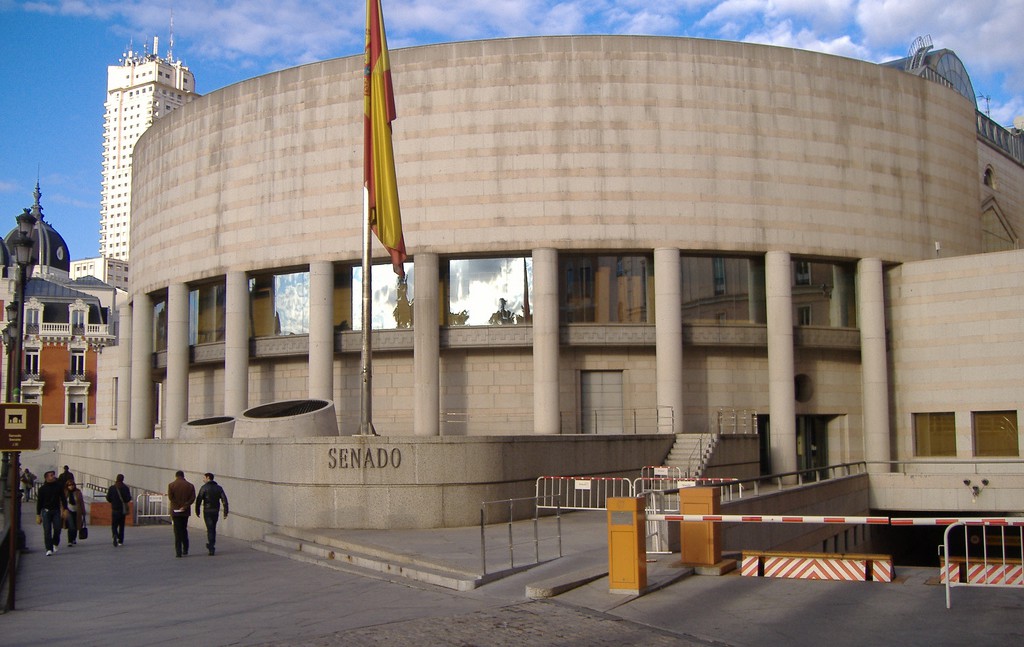
The Palacio del Senado is the seat of the Senate, the upper house of the Spanish parliament. It stands on Calle de Bailén in the centre of Madrid, a short walk from Plaza de España and the Royal Palace. This post explains what the Senate does, how a former convent became a parliament building, and how to visit it on one of the free guided tours.
What the Senate is
Under the Spanish Constitution, the parliament (Cortes Generales) is formed by two chambers, the Congreso de los Diputados and the Senate. Together they pass laws, approve the state budget and control the government. The Constitution defines the Senate as the chamber of territorial representation.
Most senators are elected directly. Each mainland province elects four, the larger islands three each, the smaller islands one each, and the cities of Ceuta and Melilla two each. The parliaments of the autonomous communities appoint further senators: one per community and one more for every million inhabitants. The number of seats therefore changes slightly with the population. A constitutional reform of 19 May 2026 changed the rule for the islands, so that Ibiza and Formentera each elect a senator of their own from the next Senate election.
The Senate is elected for four years. Its main powers are these:
- It reviews every bill passed by the Congreso and has two months to veto or amend it. The Congreso can override the veto.
- It proposes four of the 12 members of the Constitutional Court.
- Its approval by absolute majority is needed before the government can force an autonomous community to meet its legal obligations (article 155 of the Constitution).
From convent to parliament
According to the Madrid tourist board, the building was an Augustinian convent before it became the Senate building in 1835. It has been altered many times since:
- In 1820 the architect Isidro González Velázquez turned the floor of the convent church into a debating chamber and gave the interior a neoclassical look.
- Between 1844 and 1850 Aníbal Álvarez Bouquel restored the whole interior and built a new neoclassical façade.
- In 1882 Emilio Rodríguez Ayuso removed what was left of the religious building and added the library and reading room.
- In 1987 it was decided to add a new building, designed by Salvador Gayarre. King Juan Carlos I opened it in 1991.
The building did not always house the Senate. From 1931 to 1977 it had other uses: the Second Republic abolished the Senate, and under Franco the building housed the National Movement. The Senate returned with democracy.
Since 2008 the neighbouring convent and church of Las Reparadoras has also belonged to the Senate, which bought it to gain more space. The conversion work stopped during the economic crisis, and the expansion project was taken up again in February 2020.
Visiting the Senate
The Senate can be visited only on a guided tour. Tours are free but must be booked in advance; the Madrid tourist board gives the address [email protected] for reservations. In 2026 it lists the following tour times:
- Monday to Thursday: 10am, 11am, 12pm, 1pm, 4pm and 5pm
- Friday: 10am, 11am, 12pm and 1pm
There are no visits in August, at Easter, on public holidays or on days with a plenary session, so check the Senate calendar before choosing a date. A hearing system is available on the tour for visitors with a hearing impairment.
Plenary sessions of both chambers are public under the Constitution, unless the chamber decides otherwise.
How to get there
The address is Calle de Bailén, 3. The nearest metro station is Plaza de España (lines 2, 3 and 10), and the nearest Cercanías station is Príncipe Pío. Many city bus lines stop nearby, among them 3, 25, 39, 46, 62, 75, 138 and 148, and there are BiciMAD bicycle docks at Plaza de España.
The Senate fits easily into a walk through this part of the city: Plaza de España is next to it and the Royal Palace is further along Calle de Bailén.
For students
A tour of the Senate is a free way to see how Spanish institutions work, and it is useful background for anyone studying law, politics, history or Spanish. Because tours stop on plenary days and in August, students on a short course should book early. More about studying in the capital is on the Madrid city page.
More about: Madrid · All blog posts