Aranjuez, Madrid, Spain
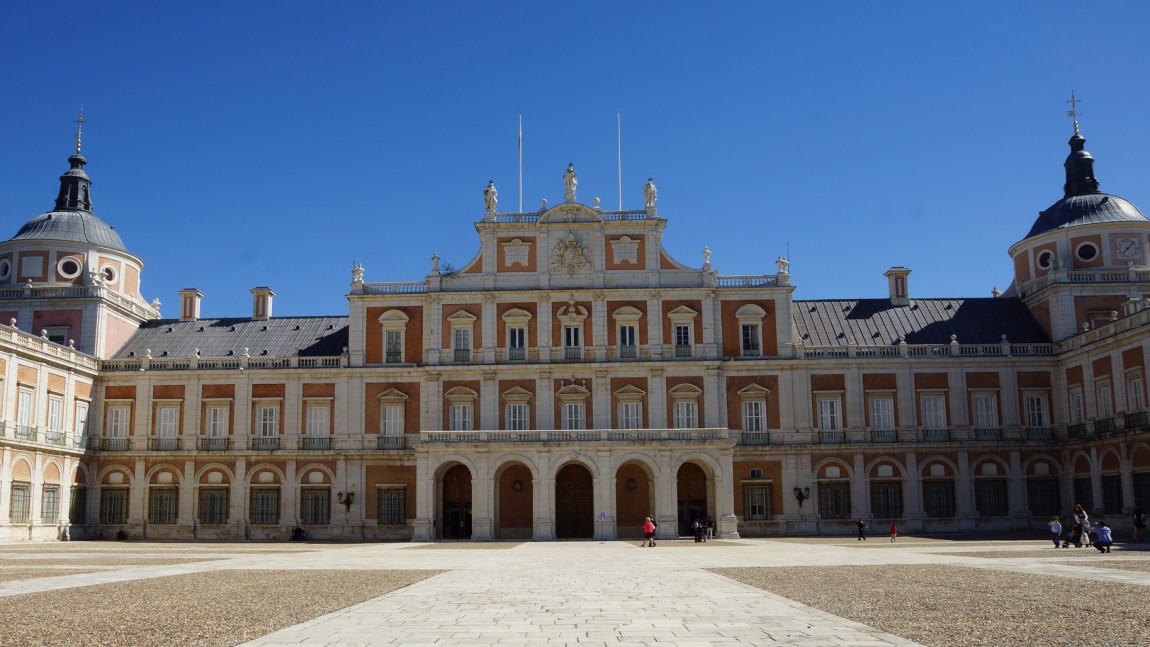
Aranjuez is a town in the south of the Madrid region, built where the Tagus and Jarama rivers meet. It grew up around a royal estate, and its palace, gardens and planned streets were declared a World Heritage Site by UNESCO in December 2001. This post explains how the town came about, what to see in the centre and in the gardens, what the main visits cost in 2026 and how to get there from Madrid.
From royal estate to town
The low-lying meadow at the confluence of the two rivers has been a Royal Site since the time of the Catholic Monarchs. In 1561 Philip II ordered the old residence to be replaced with a new building, the forerunner of the present Royal Palace. For a long time Aranjuez was a place for the court rather than a town. That changed under Ferdinand VI, who ordered a plan for a new township. The old quarter was designed in 1747 by Giacomo Bonavia (Santiago Bonavía in Spanish) and is protected today as an example of Baroque town planning.
Two later events put the town in the history books. In March 1808 the Mutiny of Aranjuez forced Charles IV to abdicate in favour of his son Ferdinand VII and ended the career of the minister Manuel Godoy. In 1851 the railway from Madrid was opened, the second stretch of railway in Spain; it carried the produce of the local market gardens to the capital and became known as the Strawberry Train. The town council itself dates from 2 January 1835.
The name is known abroad mainly through music. Joaquín Rodrigo wrote the Concierto de Aranjuez for guitar and orchestra in Paris in 1939, with the palace gardens in mind, and it was first performed in Barcelona on 9 November 1940. Rodrigo and his wife are buried in Aranjuez.
Plaza de San Antonio and the old quarter
The Plaza de San Antonio links the palace area with the residential streets. The square and the Real Capilla de San Antonio were designed by Bonavía in 1750 as the first step in laying out the town. Arcades join buildings of very different dates: the Casas de Oficios y Caballeros by Juan de Herrera and Gómez de Mora, the round chapel with its dome, and the Casa de Infantes from the end of the 18th century. The fountain in the square is topped by a Venus by the sculptor Juan Martínez Reina that local people call the Mariblanca; the fountain took its present form in 1831.
Next to the square is the Jardín de Isabel II, a small railed garden laid out around 1835 and one of the first public gardens in a Spanish town. Other stops in the centre:
- The bullring, built in 1796 and opened on 14 May 1797, which houses the bullfighting museum. According to the town’s tourism site it can be visited on Mondays and Fridays at 11:30 and 13:00; the general ticket costs €5, reduced tickets €3 and €2, cash only.
- The Royal Convent of San Pascual, founded by Charles III, with a painting by Anton Raphael Mengs on the main altar.
- The railway station, a red-brick neo-Mudéjar building of the 1920s by Narciso Clavería.
The palace and the gardens
The Royal Palace is run by Patrimonio Nacional. In 2026 it opens Tuesday to Sunday, 10:00 to 18:00 from October to March and 10:00 to 19:00 from April to September, and closes on Mondays. Admission is €9, or €4 for students up to 25 with a current student card, people over 65 and visitors aged 5 to 16.
Three historic gardens surround it. The Jardín del Parterre lies in front of the eastern façade, and the Jardín de la Isla sits between the Tagus and a side channel, with stone and marble fountains on mythological themes. The Jardín del Príncipe, between Calle de la Reina and the river, is the largest. It was created for the Prince of Asturias, the future Charles IV, who from 1772-1775 had the gardener Pablo Boutelou plant a much larger area; the later landscape section and its Chinese pavilions are by Juan de Villanueva.
Two buildings stand inside the Jardín del Príncipe. The Museo de Falúas Reales, near the old jetty, shows the river barges of the Spanish kings. The Casa del Labrador is visited only with a guide: Friday, Saturday and Sunday, 11:00 to 18:00 in winter and 11:00 to 19:00 in summer, €10 per person, about 50 minutes. Depending on the garden gate used, the walk to the house can take up to 20 minutes.
Strawberries, asparagus and festivals
Local cooking is based on the market gardens and on game: asparagus, strawberries, tomatoes, Brussels sprouts and pheasant. The historic Tren de la Fresa (Strawberry Train) recalls the old railway. According to the town’s tourism site it runs on Saturdays and Sundays in spring and autumn from Delicias station in Madrid, the home of the Railway Museum, and the ticket includes visits in Aranjuez.
The patron saint’s day, San Fernando, is 30 May. The main festival is in September, when more than 170 residents re-enact the Mutiny of Aranjuez in front of the palace. An early music festival, the Festival de Música Antigua, is usually held between May and June.
Getting there
Commuter train line C-3 from Atocha takes about 40 minutes, and the station is 10 minutes on foot from the palace and the monuments. Buses run from Madrid’s Estación Sur at Méndez Álvaro. By car, the route is the A-4 and then the M-305.
For students
Aranjuez is an easy day out for anyone studying in Madrid, and the reduced palace ticket makes it a cheap one. It is also a university town: the Universidad Rey Juan Carlos has a campus here, with teaching in historic buildings such as the former Hospital de San Carlos and the Casa del Gobernador. A second post covers the palace and gardens in more detail, and another describes other day trips in the Madrid region.
More about: Madrid · All blog posts