Colmenar Viejo, Madrid, Spain
Colmenar Viejo is a town about 30 kilometres north of Madrid, on the plain below the Sierra de Guadarrama. It is known for a large Gothic basilica, for archaeological sites from the Visigothic period and for two traditional festivals, La Vaquilla and La Maya. This post describes the town, its main sights and festivals, and how to reach it from the capital.
The town
With 18,250 hectares, Colmenar Viejo is one of the largest municipalities in the Community of Madrid after the capital, and it borders 13 others. According to the Community of Madrid’s municipal data it had 58,654 registered inhabitants in 2025. The average altitude is 883 metres, and the highest point is the Cerro de San Pedro (1,423 m).
The River Manzanares crosses the municipality from north to south, and a large part of the land lies inside the Cuenca Alta del Manzanares park, so areas such as the Dehesa de Navalvillar and the river banks are strictly protected. The landscape is one of holm-oak woods and pasture. Storks, kestrels and bee-eaters are easy to see, and black vultures, griffon vultures and imperial eagles fly over the area.
Basílica de la Asunción de Nuestra Señora
The basilica is the town’s main monument and, according to the parish, a Property of Cultural Interest. It stands on the site of the earlier parish church of Santa María. Work began around 1480–90 and went through several stages under different architects until it was finished in the 1540s. The first stage, up to 1496, was directed by the architect Juan Guas, who also designed the doorways. The final stage, which added the choir and the sacristy, is attributed to Rodrigo Gil de Hontañón or his school.
The building is Gothic with Renaissance additions and has three naves, a transept and a polygonal apse. The ashlar tower measures 8.80 metres on each side and rises 50.12 metres to the top of its spire. Inside, the main altarpiece is twelve and a half metres high and has six panels painted in oil between 1566 and 1583 with scenes from the New Testament.
The basilica’s Museo de Arte Sacro occupies the upper choir and rooms in the tower. The town council lists its opening hours as Monday to Friday from 11:00 to 13:00, and Saturdays on request to the basilica. Admission is €3 for individual visitors and €1 for groups.
Remedios and the Visigothic sites
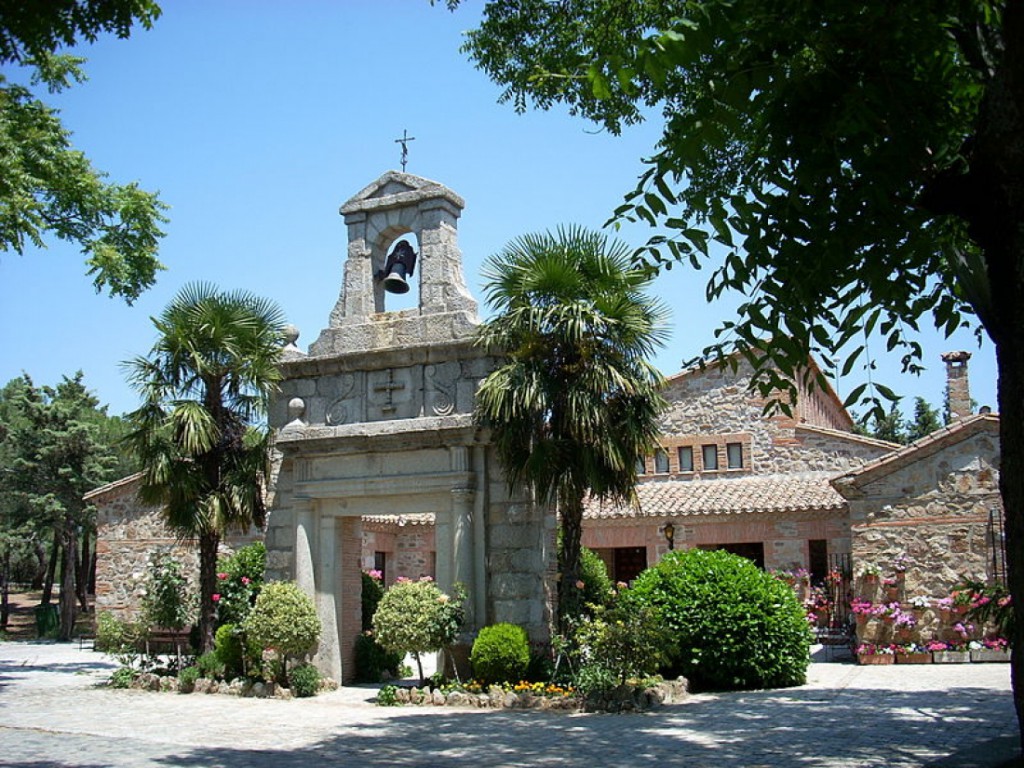
The hermitage of Nuestra Señora de los Remedios, patron of Colmenar Viejo, stands on a low hill at an altitude of 1,000 metres. Around it lies a necropolis from late Antiquity. It was discovered in 1969 during building work on the hermitage, excavated from 1999 and included in 2003 in the regional plan of archaeological sites open to visitors. The graves are of two kinds, stone-lined cists and tombs cut into the rock, and they spread out from the highest point, where the hermitage now stands.
A Roman boundary stone found on the site was later reused as an altar support. Local tradition links it to the legend of the appearance of the Virgin. The first written references to a hermitage here, then dedicated to Saint Bartholomew, date from the middle of the 15th century, and the dedication to Our Lady of Remedios dates from around 1670 or earlier.
In the Dehesa de Navalvillar, the sites of Navalvillar and Navalahija, separated by the Tejada stream, can also be visited. They are the remains of rural settlements of the 6th and 7th centuries, with simple stone buildings. Slag found on the floors shows that the villagers worked iron.
Museums and the old town
The Casa Museo de la Villa, at Plaza del Maestro Almeida, 1, is open on Thursdays, Fridays and Saturdays from 10:00 to 14:00 and from 17:00 to 20:00, and on Sundays and public holidays from 10:00 to 14:00. The municipal tourist office, in the same building, is listed as temporarily closed on the council’s website in 2026. The old town also has small chapels and hermitages, among them the Capilla de Santa Ana and the Ermita de la Soledad, and the Pósito Municipal, the former public granary.
Festivals
La Vaquilla
La Vaquilla has been a Festival of National Tourist Interest since 1986 and in recent years has been held on a Saturday in late January. In 2026 it took place on Saturday 31 January with 26 groups. Each “vaquilla” is a wooden frame with two horns at the front, dressed with Manila shawls, silk scarves and flowers. It leaves from a house and is carried through the streets by its group to the Plaza del Pueblo. There the vaquillas dance one by one, simulating charges at the people around them. Afterwards each returns to its starting point, where its death is simulated with three shots in the air and sangría.
La Maya
The Fiesta de La Maya is held every 2 May. At several points in the old town a girl, the Maya, dressed in petticoats, a white blouse and a Manila shawl, sits motionless in front of an altar of wild flowers, while the other girls of her group ask passers-by for a donation. The festival has been of regional tourist interest since 2005, and in 2023 the Community of Madrid declared it a Property of Cultural Interest.
Patron saint festivities
The festivities in honour of the Virgen de los Remedios take place at the end of August. In 2026 they ran from 28 August to 1 September.
Getting there
From Madrid, Colmenar Viejo is reached by the M-607 road or by Renfe’s Cercanías commuter trains. Bus lines 721 and 722 link the town with the Plaza de Castilla interchange in Madrid. Lines 724, 725 and 726, which run from Madrid to towns in the sierra, also stop here, so a visit combines well with Manzanares el Real or Miraflores de la Sierra. For students based in Madrid, the town is close enough for a half-day visit, and the two festivals are a chance to see local traditions.
More about: Madrid · All blog posts