Miraflores de la Sierra, Madrid, Spain
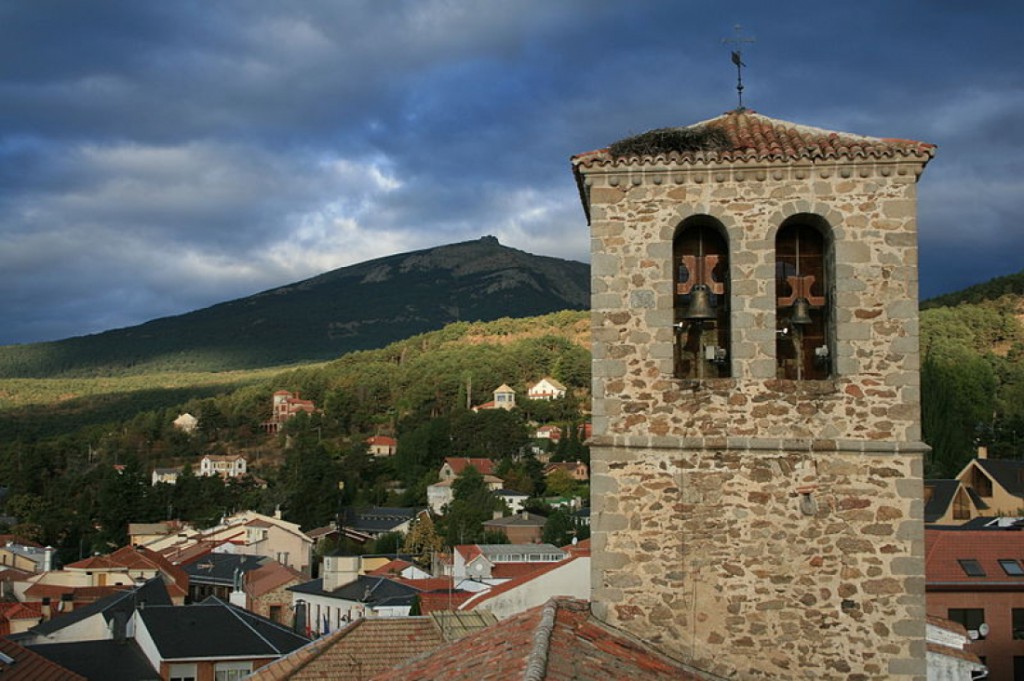
Miraflores de la Sierra is a mountain town 49 kilometres from Madrid, on the southern slope of the Sierra de Guadarrama. It has been a summer retreat for people from the capital since the late 19th century and is a starting point for walks to the Morcuera and Canencia passes. This post covers its history, what to see, the main festivals, the local walking routes and how to get there.
The town and its name
According to the Community of Madrid’s municipal data, Miraflores had 7,335 registered inhabitants in 2025. The town lies at an altitude of 1,150 metres, below the peaks of La Najarra and the Pico de la Pala. It forms part of the Sierra de Guadarrama National Park and of the Cuenca Alta del Manzanares Regional Park.
The town’s first name was Porquerizas. Settlers, mainly from Segovia, established themselves on this side of the sierra in the 11th and 12th centuries, and the village became part of the Real de Manzanares, the territory that passed to the Mendoza family in 1383. On Christmas Eve 1523 the Emperor Charles V granted Porquerizas the status of a town (villa) with its own jurisdiction.
The change of name is linked to a legend. Isabel de Borbón, wife of Philip IV, is said to have stopped to rest on her way to the monastery of El Paular along the royal road over the Morcuera pass. Looking down at the village she exclaimed “¡Mira, flores!” (“Look, flowers!”), and her companions suggested the words as a new name. The municipal tourism website notes that the first record of the new name dates from 9 November 1627, that this date does not match the queen’s journey and that no document about the change has been found. The spot where she is said to have stopped is known as La Parada del Rey.
What to see
- The parish church. The first church was built between 1419 and 1481. The square tower belongs to that 15th-century building and is the only part of it that survives. The church was altered many times over the centuries and now has three naves, two porches and side chapels. Inside is a baptismal font from 1492.
- Fuente Nueva. The town’s best-known fountain was built in 1791 to replace an older one. The Fuente del Pino dates from the same year.
- La Colonia. Along the roads to Rascafría and Canencia stand the summer villas built from the last quarter of the 19th century by wealthy families from Madrid.
- Humilladero de San Blas. This wayside shrine stands where the former hermitage of San Blas was built in the first third of the 17th century, at the crossing of the roads to Manzanares and El Paular.
- The poplar of Vicente Aleixandre. The poet first came to Miraflores in 1910 and spent long periods here from 1925. He received the Nobel Prize in Literature in 1977, and the council named the street where he lived after him.
Festivals
The main winter festival is San Blas, on 3 February. It starts the day before, when the “perreros” come down from the sierra into the town making noise with cowbells. Tradition says that during the French occupation the villagers imitated a stampede of cattle with cowbells at night to drive out Napoleon’s troops. On the afternoon of 2 February children also run races for a large ring-shaped cake in the Fiesta de La Rosca.
On 3 February the perreros gather at about 09:00 in their costume of top hat and white shirt and trousers decorated with coloured ribbons, with cowbells on their backs. They walk in procession to the Humilladero de San Blas, where mass is said at 13:00. The council then offers residents and visitors the traditional potatoes with salt cod. Back in the town, the death of the “vaquilla” is acted out to the music of drums and dulzainas, and limonada is handed out.
San Isidro is celebrated on 15 May with a procession, and the patron saint festivities in honour of the Assumption take place in the week of 15 August.
Walking routes
The municipal tourism website describes four local paths (SL):
- SL-01, ascent of the Pico de la Pala and Perdiguera: 10.6 km, 4 hours, high difficulty.
- SL-02, La Parada del Rey by Monte Aguirre and La Raya: 10.6 km, 3.5 hours, medium to low difficulty.
- SL-03, Ermita de San Blas: 7.83 km, 3 hours, low difficulty.
- SL-04, ascent of La Najarra: 7.9 km, about 5 hours, high difficulty.
Several of them start at the Fuente del Cura recreation area on the M-611 road, which has drinking water. In winter the Canencia and Morcuera passes are used for cross-country skiing.
Getting there
- By bus: line 725 runs between Miraflores de la Sierra and the Plaza de Castilla interchange in Madrid (bay 28, level -3).
- By car: take the M-607 from Madrid, leave at exit 35 near Colmenar Viejo and follow the M-611 to Miraflores.
- Tourist office: Calle José Yáñez, 7.
For students in Madrid, Miraflores works as a day trip by bus. Nearby destinations are described in the posts on Colmenar Viejo, Rascafría and the Sierra de Guadarrama.
More about: Madrid · All blog posts