Basilica de San Francisco el Grande, Madrid, Spain
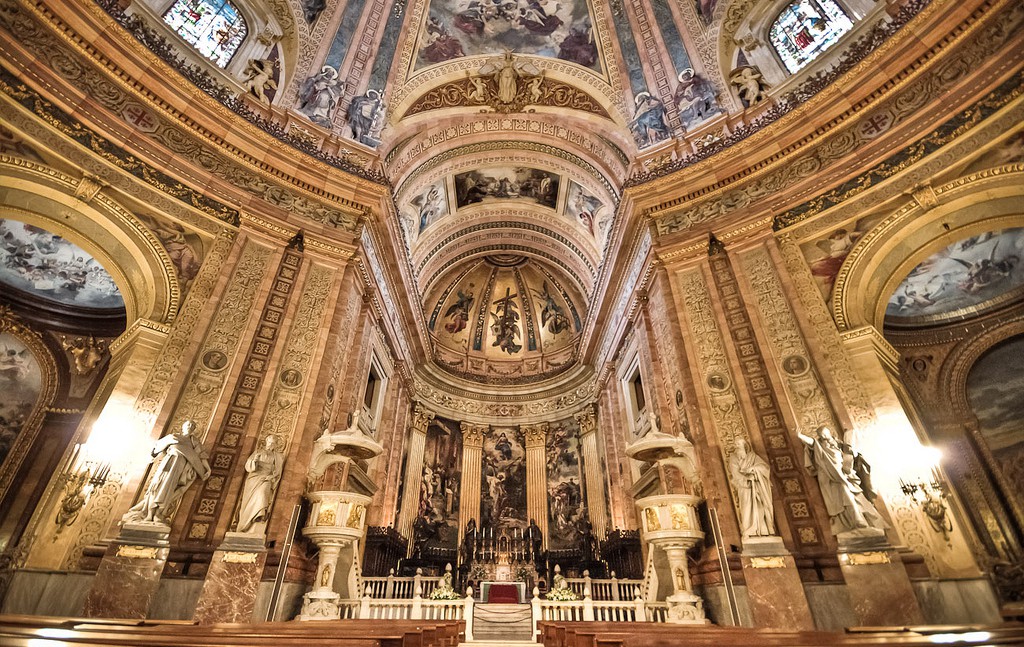
The Real Basílica de San Francisco el Grande is a neoclassical church in the La Latina area of Madrid, known for its very large dome and for a chapel painted by Goya. This post covers its history, what there is to see inside, and the opening times, prices and transport for a visit in 2026.
What it is
The church stands at the southern end of Calle de Bailén. According to the Ministry of Foreign Affairs, it is about 900 metres in a straight line from the Royal Palace and the Almudena Cathedral, so it combines easily with a visit to the Palacio Real and the Catedral de la Almudena.
The building is run as a museum-basilica. It is linked to the Ministerio de Asuntos Exteriores, Unión Europea y Cooperación through the Obra Pía de los Santos Lugares, a public institution in charge of managing and conserving the complex. Madrid’s tourist board records that it was declared a National Monument in 1980.
History
Tradition says that Saint Francis of Assisi built a small chapel on this site at the start of the 13th century, on his pilgrimage to Santiago de Compostela; the tourist board gives 1214 as the year he passed through Madrid. The official name of the church is Santa María or Nuestra Señora de los Ángeles. People in Madrid have always called it San Francisco el Grande, to tell it apart from a smaller convent that once stood at the Puerta del Sol.
The first stone of the present church was laid in 1761, to a design by the Franciscan friar Francisco Cabezas. After delays and changes, the architects Francisco de Sabatini and Miguel Fernández completed the work. King Charles III presided over the inauguration on 6 December 1784.
The church was badly damaged during the Peninsular War and after the confiscation of church property of 1835, and it served as a barracks for almost a century. In the 19th century there was a plan to turn it into a National Pantheon. A restoration under Alfonso XII replaced the plain neoclassical interior with the richly painted decoration seen today. In 1963 Pope John XXIII raised the church to the rank of basilica.
The dome and the chapels
The basilica has a circular floor plan with a vestibule and an apse. A large central dome covers the rotunda, and six smaller domes cover six side chapels. The ministry describes the dome as the largest in Spain, with a diameter of 33 metres. Its height is 58 metres, or 72 metres measured from the floor. Six stained-glass windows, finished in 1882, light the dome, and marble statues of the twelve Apostles stand around the rotunda below.
The side chapels were decorated in 1885 and 1886 by painters of the time. The best known is the Chapel of San Bernardino, also called the Goya chapel. Its main canvas, San Bernardino de Siena predicando ante Alfonso V, was painted by Goya, who included his own portrait in the picture. Other chapels are dedicated to Santiago and the military orders, to the Virgen del Olvido and the Order of Charles III, and to the Immaculate Conception.
The choir stalls in the presbytery come from the monastery of Santa María del Parral in Segovia and were carved in 1526. The organ, ordered from the Cavaillé-Coll workshop in Paris, was installed in 1884 and is still used for concerts.
The picture gallery
The gallery occupies rooms next to the church that are reached from the presbytery: the old cloister gallery, the ante-sacristy, the sacristy and the chapter house. Most of the paintings show episodes from the life of Saint Francis. The chapter house holds works on deposit from the Museo del Prado, among them two paintings by Alonso Cano and a San Buenaventura by Francisco de Zurbarán. A ceremonial cope that belonged to Charles III is also on show.
Visiting in 2026
- Entrance for visits: Calle San Buenaventura, 1
- October to June: 10:30 to 14:30 and 16:00 to 18:30
- July to September: 10:30 to 15:30
- Closed: Mondays, Sundays and public holidays
- Prices: general ticket €6; reduced ticket €3.50 for minors, pensioners and groups; free entry on Thursdays
- Transport: metro La Latina (line 5) or Puerta de Toledo (line 5); EMT buses 3, 60 and 148
The ticket office closes 30 minutes before closing time. Guided visits are led by official guides with the help of cultural volunteers. Groups are limited to 20 people, must book at least 5 days ahead by telephone, and are not admitted on Thursdays. Opening times can change because of religious services, so it is worth checking the ministry’s opening times and prices page before going.
For students
The free Thursday makes the basilica an easy addition to a walk through La Latina and the old centre. Students of art history can see a Goya, a Zurbarán and two works by Alonso Cano in the setting they were hung in, and compare 18th-century architecture with 19th-century decoration in a single building. More about studying in the city is on the Madrid page.
More about: Madrid · All blog posts