El Rey Carlos III, King Charles III, Madrid, Spain
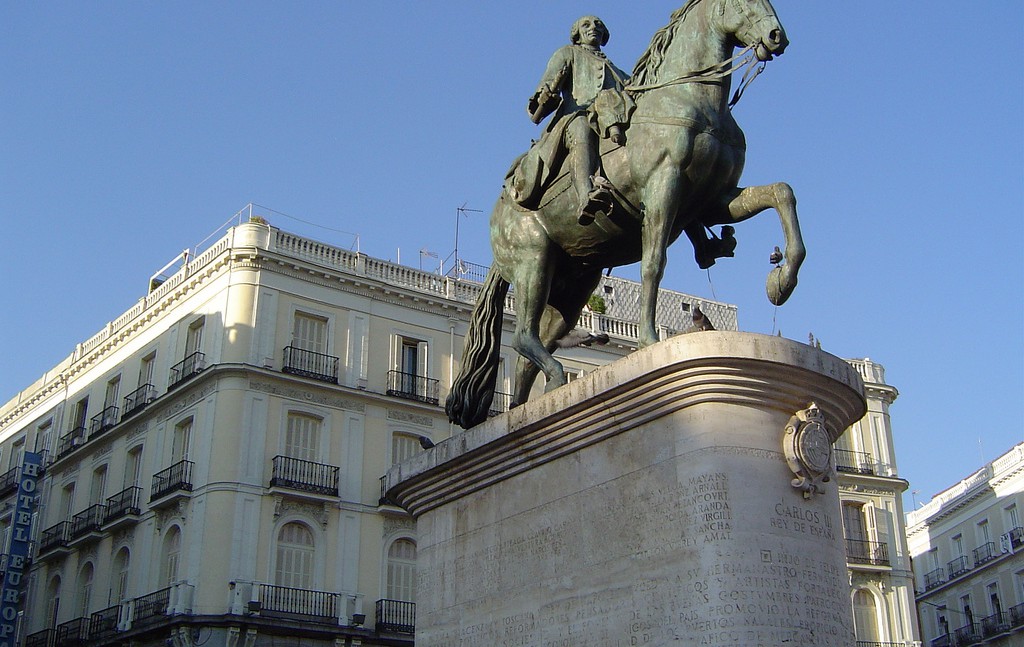
Carlos III (Charles III) was King of Spain from 1759 to 1788 and is remembered in the capital as “the best mayor of Madrid” for the building and public works of his reign. This post gives a short account of his life and reforms and then lists the places in Madrid where a visitor can still see his mark.
From Madrid to Italy and back
Charles was born in Madrid on 20 January 1716, the son of Philip V of Spain and Elisabeth Farnese (Isabel de Farnesio). According to the record held by Spain’s state archives portal PARES, he was Duke of Parma from 1731 to 1735 and then King of Naples and Sicily from 1734 to 1759, reigning in Naples as Charles VII. In 1738 he married Maria Amalia of Saxony; they had thirteen children.
When his half-brother Ferdinand VI died without children, Charles was proclaimed King of Spain in 1759. He gave up the crown of Naples in favour of his son Ferdinand and returned to Madrid, where he became the first monarch to live in the newly built Royal Palace. He reigned until his death in Madrid on 14 December 1788 and was succeeded by his son Charles IV.
An enlightened reformer
Charles III ruled in the manner of the enlightened despots of his time, with a team of reforming ministers that included Floridablanca, Campomanes, Aranda and Jovellanos. PARES summarises his main measures as follows:
- reorganising local government and municipal finances;
- trying to extend education through schools run by the town councils, the Royal Economic Societies and schools of agriculture and commerce;
- opening up industry and trade;
- bringing the universities under royal patronage and creating the Estudios de San Isidro in Madrid.
The inscription on his monument in the Puerta del Sol adds that he established free trade with America and created the Banco de San Carlos, the first national bank of the kingdom.
The reforms were not welcomed by everyone. Discontent over the changes to Madrid’s streets, attempts to alter popular customs and new taxes led in 1766 to the riot known as the Motín de Esquilache, which forced the king to leave the capital for a time. The Jesuits were accused of encouraging the unrest, and in the early hours of 2 April 1767 Charles III expelled the order from all his territories.
What he left in Madrid
Madrid City Council’s heritage service credits his reign with paving, lighting and cleaning the public streets and with a long list of buildings. Those that are easiest to visit today:
- Puerta de Alcalá. The triumphal gate beside El Retiro was erected in 1778 by the Italian architect Francesco Sabatini. Madrid’s tourist office notes that the king commissioned it because he was unimpressed by the gate that received him when he arrived in 1759.
- Royal Palace. Building began under Philip V, but Charles III was the first king to occupy it. Since mid-September 2025 the visitor route has included the room designed as his office, where he met his ministers. See the post on the Royal Palace of Madrid.
- Cibeles Fountain. Commissioned by Charles III and designed by Ventura Rodríguez, like the Neptune Fountain further down the Paseo del Prado.
- Royal Botanic Gardens and the Prado building. The king wanted a complex devoted to the natural sciences in Madrid. The garden stands next to the building put up in the late 18th century for the Museum of Natural History, which is now the Prado Museum.
- Real Casa de Correos in the Puerta del Sol, and the Basilica of San Francisco el Grande, both listed by the council among the buildings of his reign.
The statue in the Puerta del Sol
The equestrian statue of Charles III in the centre of the Puerta del Sol is, according to the council’s monument record, the only one in Madrid that shows him on horseback; other statues of the king stand in the Sabatini Gardens and the Botanic Gardens. It is a reproduction of a statue of 1780 attributed to Juan Pascual de Mena, kept in the Real Academia de Bellas Artes de San Fernando. In 1993 the council asked residents where it should go, and the Puerta del Sol won with 40% of the vote, ahead of the Puerta de Alcalá. The monument was inaugurated on 16 December 1994. The text carved round the pedestal summarises his reign and ends with the phrase that gave him his nickname.
For students
Most of these places lie within walking distance of each other: from the Puerta del Sol along Calle de Alcalá to Cibeles and the Puerta de Alcalá, then down the Paseo del Prado to the museum and the Botanic Gardens. Allow two to three hours on foot without going inside. The route is a useful introduction to 18th-century Spain for anyone taking history or art courses in Madrid, and the outdoor monuments cost nothing to see.
More about: Madrid · All blog posts